Tag: Royal Collection

Saint Anthony

Saint Anthony

Temptation, Burning Skin Disease, and Care as Cure.

After writing about the prophets Jeremiah and Isaiah, and more recently about Daniel, I feel it’s time to return to the Saints: who they are, and how to recognise them in art. One saint I’ve long wanted to write about is Saint Anthony. There are several saints named Anthony, but I mean Saint Anthony the Great also known as Saint Anthony the Abbot. He is the protector and healer of those suffering from Saint Anthony’s Fire, or Ergotism, which is a burning skin disease combined with hallucinations.

Anthony’s story is also a fascinating example of the difference between care and cure in the history of medicine. The monks of the Antonine order offered such dedicated care to the sick that it was often seen as a cure. And of course, plenty of prayer, that helped too.

The stories around Saint Anthony I’ll be exploring are:

A recurring theme is care as cure; how, in the pre-scientific medical era, the care offered by monks served as both physical and spiritual healing.

Saint Anthony as a historical figure

First, a few words about Saint Anthony and who he was as a historical figure. Anthony was a monk who lived in Egypt during the 3rd and 4th centuries AD. At a young age, Anthony gave away all his wealth and worldly possessions after hearing the Gospel message to ‘sell all you have and give to the poor.’ He chose to live an ascetic life in the desert, devoting himself to solitude, prayer, and spiritual struggle. He is often considered the father of Christian monasticism.

Monasticism, in the Christian tradition, refers to a way of life in which individuals withdraw from worldly society to live in spiritual discipline, often in communities (monasteries) devoted to prayer, work, and contemplation. Saint Anthony is called the father of monasticism because he was among the first to retreat into the desert purely for religious reasons, inspiring many others to follow his example. Although he lived as a hermit himself, his life and teachings laid to the foundation of communal life in monastries as the Hospital Brothers of Saint Anthony, later known as the Antonines.

The Temptation of Saint Anthony

During his years of isolation, Anthony reportedly endured intense temptations, visions and torments involving lust, wealth, pride, and physical suffering, which he resisted through faith and prayer. These battles became central themes in later depictions of him in art, especially in the many dramatic scenes of ‘The Temptation of Saint Anthony.

Here we see Anthony with his hands clasped in prayer, fleeing from a dark, hellish vision. As the saint flees, his hands point to a monastery, a reminder that he was the founder of monasticism.
Temptation of Saint Anthony (c.1517), Giovanni Girolamo Savoldo (Italian, c.1483 – 1548), 70x119cm, Timken Museum of Art, San Diego, CA.
Anthony sits reading from a book; from the right approaches a woman with a goblet in her hand; the horns on her head indicate she is a demon. She tries to seduces Anthony with a goblet of abundance, which Anthony refuses of course.
Temptation of Saint Anthony (1509), Lucas van Leyden (Netherlandish, c.1494 – 1533), Engraving, 18x16cm, Metropolitan Museum of Art, New York.
Search for Saint Anthony in this painting full with demons and temptation! He is sitting under the tree at the right side. A lady is trying to seduce him. And demons galore!
Temptation of Saint Anthony (1650), Joos van Craesbeeck (Flemish, c.1605 – 1660), 78×116, Staatliche Kunsthalle Karlsruhe, Germany.
The Temptation of Saint Antony (1556), Engraving by Pieter van der Heyden (Flemish, 1530 – 1572) after a design by Pieter Bruegel the Elder (Flemish, c.1525 – 1530), 24x33cm, Metropolitan Museum of Art, New York.
I couldn’t resist the temptation to add this Brueghel print to the collection of Temptations. First, look for Saint Anthony, he is seated on the right side, beneath the tree trunk. On his cloak, he wears the Tau-cross, the symbol of the Antonine monks. Compare this print to the painting by Joos van Craesbeeck shown above. The painting (from 1650) could not have existed without inspiration from Brueghel’s print (from 1556).
The Temptation of Saint Antony (1556), Engraving by Pieter van der Heyden (Flemish, 1530 – 1572) after a design by Pieter Bruegel the Elder (Flemish, c.1525 – 1530), 24x33cm, Metropolitan Museum of Art, New York.
The bearded saint is gazing toward a woman who symbolises Lust. The devil sent the demons to beat him and alluring women to distract him from his prayers. Saint Anthony evens sees the devils fly above his head, which is a typical form of hallucination caused by the poison in the Ergot fungus, as well as in LSD trips; LSD contains same chemical elements.
Temptation of Saint Anthony (1647), David Teniers the Younger (Flemish, 1610 – 1690), 51×71, Prado, Madrid.
Saint Anthony gazes serenely out at the viewer as frenzied demons grab at his limbs, clothes, and hair and pound him with sticks.
The Temptation of Saint Anthony (c.1472), Martin Schongauer (German, c.1445 – 1491), Engraving, 31x23cm, Musée Unterlinden, Colmar, France.

Saint Anthony’s Fire and Ergotism

Anthony’s legendary temptations bear a striking resemblance to the symptoms of Ergotism, a disease caused by eating rye bread contaminated with the ergot fungus. In the Middle Ages, rye was a staple food for the poor. When stored in damp conditions, especially during the wet autumn months, the grain could easily become infected. Bread made from this tainted rye caused severe outbreaks of illness across entire mostly-rural communities. This mysterious and terrifying illness, especially the burning pain of the skin (like a fire) is known as Saint Anthony’s Fire, or in Dutch as Kriebelziekte (“Itching Disease”). Common Ergotism symptoms included this burning skin pain, but also hallucinations, convulsions, mania, and gangrene, often mistaken for demonic possession or divine punishment. At the time, people had no idea that a fungus in their bread was the cause. Instead, they believed they were possessed or being punished by the devil. In their desperation, many turned to Saint Anthony, whose legendary temptations in the desert seemed to reflect their own torments. His name became associated with miraculous healing and spiritual endurance.

In response to widespread suffering, the Hospital Brothers of Saint Anthony, later known as the Antonines, were founded in France in the late 11th century by two French noblemen who credited Saint Anthony with healing them. The order established monasteries and hospitals across Europe, particularly along pilgrimage routes, where they cared for victims of Saint Anthony’s Fire. Though unaware of the disease’s true cause (infected bread), the Antonines provided nourishing food (proper bread and not infected rye bread), hygiene, skin treatment, and spiritual care. Their compassion and effectiveness further strengthened Saint Anthony’s reputation as a protector of the sick and suffering.

The Isenheimer Altarpiece, created by Matthias Grünewald in the early 16th century, was made for the Antonine monastery and hospital in Isenheim, near Colmar, France. The altarpiece held a central place in the hospital chapel. With its vivid, often harrowing imagery of suffering and healing, it was meant to offer spiritual comfort and a sense of connection between Christ’s pain and the patients’ own suffering from Saint Anthony’s Fire.

With its inner wings open, the Altarpiece allowed pilgrims and patients to venerate Saint Anthony, protector and healer of Saint Anthony’s fire. Saint Anthony occupies the place of honour at the centre of the altarpiece and at his side two pigs can be seen. The panel on the right depicts Saint Anthony being tormented by monstrous creatures.
Isenheim Altarpiece (c.1514), inner wings opened, Matthias Grünewald (German, c.1470 – 1528), open 269x589cm, Musée Unterlinden, Colmar, France.
Isenheim Altarpiece (c.1514), detail with Temptation of Saint Anthony and a creature suffering from skin ulcers, Matthias Grünewald (German, c.1470 - 1528), Musée Unterlinden, Colmar, France.
Saint Anthony being tormented by monstrous creatures. Trampled to the ground, beaten with sticks, pulled by his hair, torn by claws and bitten, Saint Anthony appeals to God for help. In the lower left corner, the being with a distended belly seems to personify the disease caused by ergot poisoning, resulting in swelling and ulcerous growths.
Isenheim Altarpiece (c.1514), detail with Temptation of Saint Anthony of Saint Anthony. and a creature suffering from skin ulcers, Matthias Grünewald (German, c.1470 – 1528), Musée Unterlinden, Colmar, France.
The wings of the altarpiece were mostly kept closed, displaying The Crucifixion framed on the left by the martyrdom of Saint Sebastian pierced by arrows, and on the right by Saint Anthony, remaining calm although he is being taunted by a frightening monster. The two saints protect and heal the sick, Saint Anthony as the patron saint of the victims of Saint Anthony’s fire and Saint Sebastian, whose aid was invoked to ward off the plague, a disease also leading to terrible skin lesions.
Isenheim Altarpiece (c.1514), closed, Matthias Grünewald (German, c.1470 – 1528), open 269x589cm, Musée Unterlinden, Colmar, France.

The symptoms of ergotism can lead to a range of psychiatric and neurological disturbances, including mania and psychosis. The symptoms are akin to bad LSD trips, as LSD contains chemical elements related to the ergot fungus. Sufferers may see all kinds of monsters flying or even believe they can fly themselves. Very much alike the temptations of Saint Anthony.

By the end of the 15th century, the monks had built roughly 370 hospitals across Europe to treat outbreaks of Saint Anthony’s Fire. The brothers were also instrumental in caring for those infected with the plague or Black Death. The success of these hospitals may be attributed to feeding their patients bread made from uninfected grains, such as wheat or other cereals, and providing compassionate care as a form of treatment. The Antonine Order as a monastic institution no longer exists. It began to decline in the 17th century, and by the late 18th century, it was absorbed into other religious orders or dissolved, especially during the wave of secularization and monastic reform that swept Europe.

However, their legacy of care lived on and we still see traces of it today, particularly in the naming of hospitals, clinics, and charitable institutions. Names like Antonius Gasthuis (Hospital) in the Netherlands preserve this heritage, reminding us that long before modern medicine, healing was closely tied to religious devotion, charity, and the care of the sick.

How to recognize Saint Anthony in art

The Antonines were allowed to let their pigs roam freely through towns and villages. These pigs often wore little bells to signal that they belonged to the order and should not be harmed. The fat from these pigs was used by the monks to make the medicinal Saint Anthony’s balm, a healing ointment for treating the skin lesions and intense burning sensations caused by ergotism (by Saint Anthony’s Fire). When going around for alms, the monks were also carrying and ringing bells.

Over time, the pig and the bell became symbols of Saint Anthony’s role as a protector of the sick. In art, the pig is a subtle allusion to both his healing work and the monastic order’s care practices. Another symbol is the fire, which represents the fire-like burning pain of the skin disease, the Saint Anthony’s Fire.

Another symbol closely associated with Saint Anthony is the Greek letter Tau (Τ). This simplest form of the cross was a decorative emblem with a spiritual meaning. Saint Anthony is said to have used the Tau as a sign of protection against evil, and it became the emblem of the Antonine order and the monks wore it on their habits.

Saint Anthony with his various symbols: the Tau Cross on his cloak, a pig, a bell, and the fire, representing Saint Anthony’s Fire, the burning skin diseases.
Saint Anthony the Great (c.1455), Joan Reixach (Spanish, 1431 – 1486), Tempera on Panel, 91x64cm, Prado, Madrid.
Saint Anthony the Great (c.1520), Lucas van Leyden (Netherlandish, 1498 – 1533), Engraving, 11x7cm, National Gallery of Art, Washington.
Also a symbol of Saint Anthony is the bell, so that everyone could hear the monks going around for alms; a bell is hanging on the pig and in the top left corner.
Saint Anthony the Great (c.1520), Lucas van Leyden (Netherlandish, 1498 – 1533), Engraving, 11x7cm, National Gallery of Art, Washington.
An engraving of St Anthony, seated and reading a book. Anthony’s symbols, a bell is hanging on the cross next to him.
Saint Anthony (1519), Albrecht Dürer (German, 1471 – 1528), Engraving, 10x15cm, Royal Collection Trust, London.

Travel destinations

Two important sites are closely connected to the legacy of Saint Anthony and are now high on my visit-wish-list: Saint-Antoine-l’Abbaye in France and the Monastery of Saint Anthony in Egypt.

Saint-Antoine-l’Abbaye, France.

Saint-Antoine-l’Abbaye, in southeastern France, is a medieval village that developed around an abbey housing relics of Saint Anthony, brought there in the 11th century. In the Middle Ages, it became a major pilgrimage destination, especially for those seeking healing from Saint Anthony’s Fire. It was also the motherhouse of the Antonines, or the Hospital Brothers of Saint Anthony, the religious order devoted to care and healing.

Monastery of Saint Anthony, Egypt

The Monastery of Saint Anthony in Egypt, located in the Eastern Desert near the Red Sea, is one of the oldest Christian monasteries in the world. Founded in the 4th century near the cave where Saint Anthony lived in seclusion, it has remained a center of pilgrimage and monastic life ever since, preserving the spiritual heritage of early Christian monasticism within the Coptic Orthodox tradition.

Medical literature

And here are two great articles from the medical literature.

An article (in Dutch) about healthcare in relation to the Isenheim Altarpiece, published in 1995 in the Dutch Magazine for Healthcare, J.P. Mackenbach, ‘De kriebelziekte en het Isenheimer altaar’, Nederlands Tijdschrift voor Geneeskunde, 1995.

In another beautiful article (in English) the writers underscore that at least three distinct diseases, one toxic (i.e., ergotism) and two infectious (i.e., erysipelas and herpes zoster) have been called Saint Anthony’s Fire, and that even some cases of plague may have been included. The article is from 2021, “One holy man, one eponym, three distinct diseases. St. Anthony’s fire revisited”, by G. Cervellin, U. Longobardi an G. Lippi, in Acata Biomedica, 2021.

Closing Notes

Although the Antonine monasteries no longer exist, their legacy is still with us. Hospitals and care institutions across Europe still bear the name of Saint Anthony, such as the ‘St. Antonius Gasthuis’ in Zeeland, The Netherlands. These names are not coincidental. They are echoes of a time when healing the sick was considered a sacred duty, and when monks provided care long before the advent of modern medicine. The spirit of Saint Anthony’s compassion, and the idea that care itself can be a form of healing, continues to influence how we think about health and humanity today.

In our modern world, medicine often revolves around the idea of cure: fixing what is broken, extending life, eliminating disease. While this is a noble and essential goal, we sometimes risk forgetting the quieter, older value of care. Saint Anthony and the Antonine monks remind us that healing is not always about eradicating illness. Their gentle presence, their comfort, their tending to the pain of others – these were acts of care that, in their time, were experienced as cures.

For the old, the frail, and those nearing the end of life, a cure may no longer be possible. But care, simple and devoted and human, can still be given. And in many cases, it may be the greater blessing.

Bonus

This 1946 painting by Salvador Dalí was created for an invitational competition on the theme of The Temptation of Saint Anthony, organized by the Loew-Lewin Company, a film production firm. The winning entry would appear in the movie The Private Affairs of Bel Ami, based on a story by Guy de Maupassant. Eleven artists participated, including Dalí, Paul Delvaux, and Max Ernst. Although Dalí’s painting did not win the contest, it later became the most well-known of all the submissions. The prize ultimately went to Ernst.

The King Drinks

The King Drinks

“The Three Kings and The Bean King”

In the Low Countries, the Feast of Epiphany, or Twelfth Night of Christmas, is known as Drie Koningen (Three Kings). The Christian holiday is traditionally celebrated on January 6th with a festive meal at which friends and relatives gather to eat, drink and be merry. Drie Koningen originated as a medieval church holiday with public performances and festivals reenacting the biblical story of the Three Kings from the East who follow a bright star to find and do homage to the newborn Jesus. Although public performances had become outmoded in the 17th century, Twelfth Night continued to be celebrated in taverns and homes.

The king was chosen by chance, either by finding a bean or a coin in a cake baked for the occasion or by lottery, as is evident here from the two slips of paper on the floor and the one stuck on the hat of the young man seated at back.
The King Drinks or Peasants Celebrating Twelfth Night (1635), David Teniers the Younger (Flemish, 1610 – 1690), 47x70cm, National Gallery, Washington.

It was a secular way to celebrate the Catholic Epiphany; the Protestants did disapprove of these Catholic festivities, but could not prohibit the feast staying popular indoors and within the family. The evening began with the proclamation of a “King,” played by the eldest member of the company or chosen by lot. This was done by drawing paper lots or by the concealment of a bean or coin in a large cake, and the person in whose portion it was found would preside over the festivities as “King” or “Bean King.” He put on a fake crown, chose a queen, and appointed a staff of courtiers – from minister to jester.

The Latin inscription as translated “None is closer to the fool than the drunkard”, lends the degenerate carryings-on a moralistic undertone.
The Feast of the Bean King (c.1642), Jacob Jordaens (Flemish, 1593 – 1678) 242×300cm, Kunsthistorisches Museum, Vienna.

Royal duties were extremely simple: When the King raised a glass of wine or beer, everyone had to exclaim in chorus: “The King Drinks!” as an appeal to the participants in the feast to follow the King’s example. And that happened often enough! Such feasts dragged on the whole night.

The inscription above the King reads: “In Een Vry Gelach, Ist Goet Gast Syn”, which translates as “It’s great to be a guest at a free drinking party”. The King had to pay the bill at the end of the evening.
The King Drinks (c.1639), Jacob Jordaens (Flemish, 1593 – 1678), 156×210 cm, Royal Museums of Fine Arts of Belgium, Brussels.

The “King” was not necessarily meant to represent one of the Three Kings, but might refer to the misrule of Herod, who is mocked as a drunkard and as a reminder of his all too excessive indulgence.

A Twelfth Night Feast, The King Drinks (c.1661), Jan Steen (Dutch, 1626 – 1679), 40x55cm, Royal Collection Trust, London.
The King Drinks (c.1655), David Teniers the Younger (Flemish, 1610 – 1690), 58x70cm, Prado, Madrid.
January, with “The King Drinks” scene, and with skating in the background (1629), from a series with the 12 months.
Crispijn van de Passe I, engraver (Dutch, c.1564 – 1637) after design by Maerten de Vos (Flemish, 1532 – 1603), engraving, 12cm, Centraal Museum, Utrecht.
The King Drinks (c.164), Gabriël Metsu (Dutch, 1629 – 1667), 81x98cm, Bayerische Staatsgemäldesammlungen, Alte Pinakothek, München.
Twelfth Night (c.1665), Jan Steen (Dutch, 1626 – 1679) 41x49cm, Nasjonalmuseet for kunst, arkitektur og design, The Fine Art Collections, Oslo.
King’s Letter for a Twelfth Night celebration, with 16 lottery pieces for the various roles, King, Queen, Cook, Jester, Secretary, Singer, etc.
Publisher Widow Hendrik van der Putte, Amsterdam, c.1766, 31×22cm, Rijksmuseum, Amsterdam.
The Seven Sacraments

The Seven Sacraments

Rogier van der Weyden’s altarpiece (c.1445)

Last week, I visited the Royal Museum of Fine Arts in Antwerp, with a specific goal in mind: Rogier van der Weyden’s masterpiece, “The Seven Sacraments”. My visit was not solely to admire this exquisite triptych but also to delve deeper into the meaning of the seven sacraments. This exploration hereunder will be guided by seven works of art as visual narratives, with Van der Weyden’s triptych serving as our starting point.

In the interior of a Gothic church, Rogier van der Weyden has depicted two interconnected scenes. The Crucifixion is the main scene, with smaller episodes in the aisles of the church on the side panels and in front of the main altar in the central panel, forming the second scene: the “Seven Sacraments”. From left to right, we see Baptism, Confirmation, Confession, the Eucharist, Ordination, Marriage and the Anointing of the Sick. This church is a microcosm of medieval society, with rich and poor, young and old, all together on these three panels.
The Seven Sacraments (c.1445), Rogier van der Weyden (Flemish, c.1399 – 1464), 200x223cm, Royal Museum of Fine Arts, Antwerp.
On the left panel from the front towards the back:
Baptism: initiation into the Christian faith involving water, symbolising purification of sins and rebirth.
Confirmation: children receive the Holy Spirit and become full members of the church, with anointing and laying on of hands by a priest or bishop.
Confession: forgiveness of sins through confession to a priest, and with penance if appropriate.
On the central panel, behind the Crucifiction and in front of the main altar:
Eucharist: the communion or the Lord’s Last Supper, it involves the consumption of bread and wine as symbols of Christ’s body and blood.
On the right panel, from the back towards the front:
Ordination: individuals are ordained as priests, to serve the church.
Marriage: symbolizing the union of two individuals in a lifelong partnership.
Anointing of the Sick: spiritual and physical healing, often administered to those who are seriously ill.

The Seven Sacraments in seven paintings

Baptism

Baptism is the sacrament of regeneration and initiation into the Church that was begun by Jesus, who accepted baptism from St. John the Baptist. Baptism is understood, therefore, as the annulment of one’s sins and the emergence of a completely innocent person.

Christ stands in a shallow, winding stream as Saint John the Baptist reaches up to pour a small bowl of water over his head. John had been preaching, encouraging people to repent of their sins and to be baptized: the river’s water symbolized the washing away of sin. The river is considered the river Jordan.
The Baptism of Christ (c.1440), Piero della Francesca (Italian, c.1417 – 1492), Egg Tempera on Poplar, 167x116cm, National Gallery, London.

Confirmation

A sacrament that is conferred through the anointing with oil and the imposition of hands, Confirmation is believed to strengthen or confirm the grace bestowed by the Holy Spirit at baptism. The Confirmation rite is a relatively simple ceremony that is traditionally performed during the Mass by the bishop, who raises his hands over those receiving Confirmation and prays for the bestowal of the Holy Spirit. He then anoints the forehead of each confirmand with holy oil and says, “Accipe Signaculum Doni Spiritus Sancti” (“Be sealed with the gifts of the Holy Spirit”).

This work depicts the moment when the Holy Ghost, in the form of flames, rests on the Virgin and the Apostles, as happend during pentecost day in Jerusalem.
Pentecost (c.1600), El Greco, (Greek and Spanish, 1541 – 1614), 275x127cm, Prado, Madrid.

Confession

This sacrament of reconciliation or penance, reflects the practice of restoring sinners to the community of the faithful by confessing one’s sins to a priest. The Roman Catholic Church claims that the absolution of the priest is an act of forgiveness. To receive it, the penitent must confess all serious sins, manifest genuine sorrow for sins, and have a reasonably firm purpose to make amends. The sacrament of confession was rejected by most of the Reformers on the grounds that God alone can forgive sins, and not through a priest.

John the Baptist was a hermit, living in the wilderness, calling on all who would listen to repent their evil ways, and of course, all in the name of God. That’s why he is pointing towards heaven. John the Baptist thus preached confession, repentance, and being baptized to be totally cleansed of any sins.
Saint John the Baptist in the Wilderness (c.1636), Guido Reni (Italian, 1575 – 1642), 225x162cm, Dulwich Picture Gallery, London.

Eucharist

The Eucharist (from the Greek word “εὐχαριστία” which means “thanksgiving”) is the central act of Christian worship, also known as Holy Communion and the Lord’s Supper. The rite was instituted by Jesus at the Last Supper when he blessed the bread, which he said was his body, and shared it with his disciples. He then shared a cup of wine as his blood. Jesus called on his followers to repeat the ceremony in his memory. It is a commemoration of his sacrifice on the cross.

The focus in this painting is on Christ, serene and triumphant at the moment of consecrating the bread and wine, amidst the apostles at the Last Supper. The bread in the form of the Sacred Host.
The Last Supper (c.1556), Juan de Juanes (Spanish, c.1504 – 1579), 116x191cm, Prado, Madrid.

Ordination

Ordination is a sacrament essential to the church, as it bestows an unrepeatable, indelible character upon the priest being ordained. The essential ceremony consists of the laying of hands of the bishop upon the head of the one being ordained, with prayer for the gifts of the Holy Spirit and of grace required for the carrying out of the ministry.

Christ orders Peter to feed the sheep, meaning that he actually charges Peter to take care of the believers. That’s how Peter became a priest and the first pope of the Catholic Church. Raphael here combines the story with giving Peter the keys to the kingdom of heaven.
Christ’s Charge to Peter (c.1515), Raphael (Italian, 1483 – 1520), cartoon as design for the tapestry for the Sistine Chapel, 343x532cm, Royal Collection Trust, Victoria & Albert Museum, London.

Marriage

Marriage as a sacrament, also known as holy matrimony, is the covenant by which a man and a woman establish between themselves a partnership for the whole of life, administered in the presence of a priest. However, the inclusion of marriage among the sacraments gives the Roman Catholic Church jurisdiction over an institution that is of as much concern to the state as it is to the church.

Christ and Mary are invited to a wedding at Cana in Galilee. When Mary notices that the wine has run out, Christ delivers a sign of his divinity by turning water into wine. The account is taken as evidence of Jesus’ approval of marriage and earthly celebrations and has also been used as an argument against the total abstinence of alcoholic drinks.
Wedding at Cana (c.1305), Giotto (Italian, 1266 – 1337), Fresco, 200x185cm, Scrovegni Chapel, Padua, Italy.

Anointing of the sick

This sacrament is conferred by anointing the forehead and hands with blessed oil and pronouncing a prayer. It may be conferred only on those who are seriously ill or on elderly people who are experiencing the frailties of old age. In popular belief, anointing is most valuable as a complement to confession or, in the case of unconsciousness, as a substitute for it. Anointing is not the sacrament of the dying; it is the sacrament of the sick.

This painting shows Christ’s mission to save the unfortunate and heal the sick. Christ is opening the eyes of a blind man, who kneels at his feet. His dog stares out of the painting, a reminder that soon he will no longer be needed to lead his master. There are three more unfortunate individuals: a lame beggar, with a crutch and a bowl, and two madmen. One of the latter is manacled, his chain held by a keeper; the other is cured of his possession, as an evil spirit (looking rather like a winged lizard) leaves his mouth. It seems likely that this painting has been commissioned by a hospital where its theme of healing and salvation would have been appropriate.
Christ Healing the Sick (1577), Crispin van den Broeck (Flemish, 1524 – 1591), 91x142cm, Royal Collection Trust, Windsor Castle.
Winter in art

Winter in art

“Baby, it’s cold outside…”

Now that we are in the middle of the winter, I’ve started thinking about how this “winter” concept has been represented in art. It’s the harshest season of the year, certainly when there was no electricity or gas, but some touching images have been produced over the centuries.

It was not just landscape painters who gave us winter scenes with frozen rivers and skaters. Painters also personified winter as an old man with a fur coat and warming his hands at a brazier. And from the the 18th century, artists depicted winter as a young woman, adding a sensual and warm touch to the cold.

I choose some ten works of art, all depicting winter as a “personification”; as a human figure depicted with symbolic attributes, representing the abstract idea of “winter”. Starting with the French Impressionist Berthe Morisot, as I like her paintings so much. And then going back in time to the 17th century Flemish painter David Teniers, to Madame de Pompadour – lover of King Louis XV of France, to the bedroom of King George III of England, to La Frileuse, the chilly girl, by the French sculptor Houdon. It’s an eclectic batch of art, but all lovely. They give inspiration and warmth in this cold season. Like Vivaldi’s Winter from The Four Seasons.

Along with its Summer pendant, Winter depicts a fashionable Parisian woman who personifies a season. Berthe Morisot debuted the paintings together at the Paris Impressionist exhibition in 1880. Morisot’s images of the Parisienne, a popular figure type representing an elegant, upper-class Parisian woman, were considered utterly contemporary. A critic said about Morisot’s Winter: “with its figure, so courageously modern, of the Parisian woman braving the cold in her furs.”

Berthe Morisot (Édouard Manet’s model and sister-in-law) was one of the most respected members of the Impressionist movement. At the beginning of the 20th century, her aura began to dim and her painting, labelled “feminine”, was relegated to second rank. Only recently, thanks also to the grand 2019 Morisot exhibition in the Musée d’Orsay, Berthe Morisot was incontestably regarded again as a great artist.

Abraham Bloemaert (Dutch, 1566 – 1651), Allégorie de l’hiver (et de l’amour) or Winter (and love), c.1627, 70x58cm, Musée du Louvre, Paris.

This old man by the Dutch Golden Age painter Abraham Bloemaert is representing Winter. Wearing a fur hat and very carefully warming himself at a small stove full of red-hot coals or charcoal. His nose and cheeks reflect the heat of the coal. It’s not only a representation of winter, but also hinting to love and passion. Love – and it’s pleasure – happens to be gallant to the ones who court the fire of love with caution.

David Teniers the Younger (Flemish, 1610 – 1690), Winter, from the series The Four Seasons, c.1644, Oil on Copper, 22x16cm, National Gallery, London.

David Teniers the Younger brings the cycle of the seasons to an end with an old man representing Winter. Wrapped in velvet and fur, he hunches over to warm his hands at a brazier, a small stove that’s heated with charcoal. His face is wrinkled, his beard long and frosted with white. In the background a small, monochrome skating scene. It’s a personification of winter and Teniers chose a character of an appropriate age and dressed him accordingly. Winter as the last season of life.

The tiny picture is on a copper base, which allowed the paint to flow more freely than it would on canvas. Teniers could show minute detail: the facial characteristics and expressions, Winter’s splendid hat and the objects on his table. Allegorical paintings of the seasons were popular at the time, and Teniers painted several versions of the subject. David Teniers was cashing in on the popularity of the series and turning them out quickly to fulfil demand.

Caesar Boëtius van Everdingen (Dutch, 1616 – 1678), A Young Woman Warming her Hands over a Brazier: Winter, c.1646, 97x81cm, Rijksmuseum, Amsterdam.

This young woman by Caesar Boëtius van Everdingen warms her hands above a dish of glowing coals, holding her hands under a piece of cloth. She personifies Winter. This season was usually represented as an old man: old because the year is coming to an end, like towards the end of life. Van Everdingen’s choice of a young, richly attired woman is rather unusual. Cesar Boëtius van Everdingen was a Dutch Golden Age painter, from Alkmaar.

Giovanni Battista Pittoni the younger (Italian, 1687 – 1767), Allegory of Winter and Summer, c.1730, 125x112cm, Bristol City Museum & Art Gallery, Bristol, United Kingdom.

For this allegory of Winter and Summer, the painter Giovanni Battista Pittoni turned to traditional iconographic examples. Summer is personified as a young woman, and Winter as an old man warming his hands over a brazier. Summer gestures to a small angel-like figure in the top right corner (difficult to see on the picture). That’s the Spirit of Dawn whose urn of water provides the dew droplets of summer and frost in the winter.

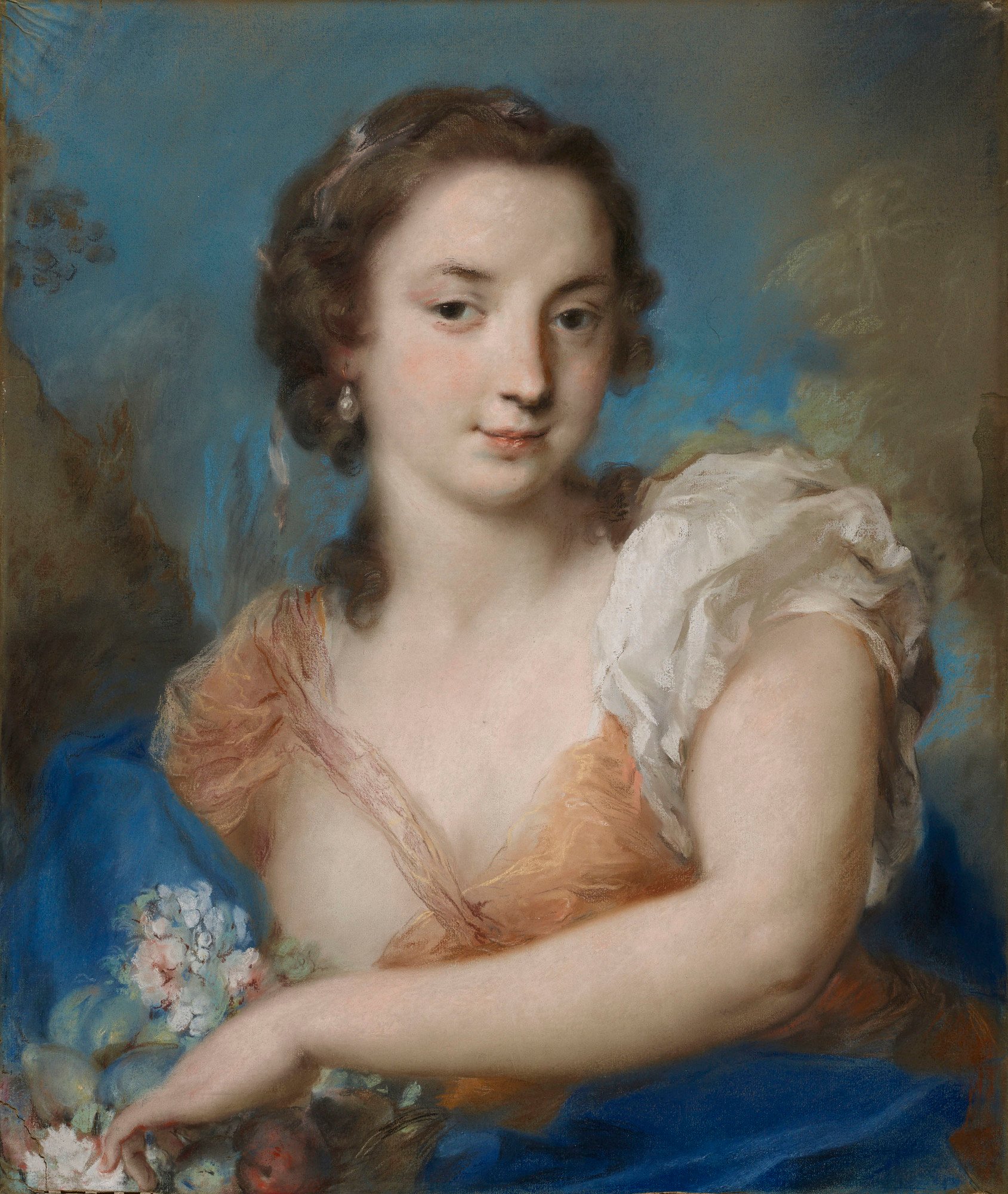
The Winter pastel by Rosalba Giovannia Carriera was acquired by George III, King of England. It entered the Royal Collection in 1762 as “a Beautiful Female covering herself with a Pelisse”. In traditional images Winter was typically shown as an old man, but Rosalba Carriera transformed the subject into a beautiful young woman. “Winter” was put on display in George III’s bedchamber at Buckingham Palace, alongside “Summer”.

Rosalba Carriera was born in Venice. She began her career as a painter of snuffboxes, but rose quickly to fame for her pastel portraits, which became highly desired across Europe. Carriera made several sets of allegories of the Four Seasons. The largest group of pastels by Carriera belonged to Frederick Augustus Elector of Saxony. Over 100 of her pastels were on display at his residence in Dresden in a ‘Rosalba Room’. The artist became blind in later life and died in 1757.

François Boucher (French, 1703–1770), The Four Seasons: Winter, 1755, 57x73cm, The Frick Collection, New York.

François Boucher painted this Winter from the series The Four Seasons in 1755 for Madame De Pompadour, King Louis XV’s long-term official mistress. Their original location is unknown, but their peculiar shape suggests that they were used as overdoors, no doubt in one of Pompadour’s many properties in France.

Instead of the hardship that traditionally illustrates the theme of winter, Boucher depicts a delightful encounter in joyous colours, a frosty background and a landscape buried under snow. A Tartar in pseudo-Russian dress pushes an elaborate sleigh with the heroine – most likely referring to Madame de Pompadour herself. Glancing out at us coyly, she sports a billowing fur-trimmed gown and a little fur necklace. Her hands may be warmed by a muff, but her upper body is completely exposed. This combination of luxury and seduction, treated in a fanciful and humorous manner, is typical of Boucher.

Étienne-Maurice Falconet (French, 1716 – 1791), Winter, c.1770, Marble, 135 cm, The Winter Palace, State Hermitage Museum, St Petersburg.

In April 1764, the 42-year-old Madame Marquise de Pompadour, the official chief mistress of King Louis XV of France unexpectedly died, and in the workshop of her beloved sculptor Etienne Maurice Falconet, the last of the statues she commissioned remained unfinished – the marble Winter, a young woman sitting on an ice cube and gracefully covering flowers with her robe.

A year later Falconet received an invitation from the Russian Empress Catherine the Great to work at her court. It was agreed that at the expense of the Russian treasury all unfinished work from the Falconet workshop would travel with him to Russia. And part of that deal was the unfinished “Winter” sculpture. Falconet completed “Winter” only 5 years after arriving in Russia. That’s how this statue, made by a French sculptor, ended up in the Winter Palace of the State Hermitage Museum in St Petersburg. Contemporaries of Falconet received the work as a masterpiece and the artist himself wrote: “This might be the very best work which I can do; I even dare to think that it is good.”

Jean Antoine Houdon (French, 1741 – 1828), Winter (La Frileuse), 1787, Bronze, 144x39x51cm, Metropolitan Museum of Art, New York.

L’Hiver or Winter is a bronze statue of a young woman cast by the neoclassical French sculptor Jean-Antoine Houdon. The statue personifies the winter season and is nicknamed La Frileuse, The Chilly Girl. This is reflected in both the medium (a cold, dark bronze) and the features of the sculpture, a young woman clad only in a shawl. Upon its completion and presentation at the 1787 Salon, the French yearly art fair, Winter shocked the French artistic establishment but delighted art lovers. The critics at the Salon indulged in some irony: “La Frileuse by Monsieur Houdon does not seem to achieve its effect. When someone is really cold, he tries to pull all his limbs close to him and covers his body more than his head. Nevertheless, it is pleasant to the eye and the proportions are correct” and “One must concur that winter would be a very desirable season if pretty shivering girls did not cover themselves in any other way.” Don’t think this critic will still have a job after saying this nowadays. In terms of her clothing, the Metropolitan Museum of Art describes it as “elegant but hardly adequate”. La Frileuse made me think of the song Let it Go from Frozen, “The Cold Never Bothered Me Anyway.”

The statue was bought by Louis Philippe Joseph, Duc d’Orléans, confiscated during the French Revolution and now in the Metropolitan Museum of Art, New York.

Paul Heermann (German, 1673 – 1732), Winter, c.1700, Marble, 65x64x34cm, Getty Center, Los Angeles. 

Shrouded in a heavy hooded cloak, this elderly man by Paul Heermann looks down with a deeply furrowed brow. As a personification of Winter, the bust gives visual expression to the chilling cold of that season. His old age refers to winter’s occurrence at the very end of the calendar year. This bust was probably part of a series of sculptures personifying the four seasons. At the Versailles Palace, it was fashion including statues of the seasons in the program for garden sculpture. The high level of finish and finely worked details of this bust, however, suggest that Winter was meant to be viewed up close, in an indoor palatial setting.

Jacob Matham (Dutch, 1571 – 1631) engraver, after Hendrik Goltzius (Dutch, 1558 – 1617) drawer, Winter, 1589, from the series The Seasons, engraving, diameter 26cm, National gallery of Art, Washington DC.

This Winter engraving has a very traditional iconography. The personification of Winter is an elderly man wearing a coat and warming his hands by holding a pot containing a fire; beyond is a wintery townscape with ice skaters and people collecting fire wood; the signs of the winter zodiac (Pisces, Aquarius and Capricorn) in the sky; and a cute little putto plays the cold Northern wind blowing into a cloud which results in rain and snow. And just so that we do not get it wrong, Hendrick Goltzius put the name “Hyems” just above the man, which is Latin for “Winter”.

Hendrick Goltzius designed four series with the seasons; Winter depicted here is from the set engraved by Jacob Matham.

Leonardo da Vinci; A Life In Drawing, exhibition

The Queen’s Gallery, Buckingham Palace, London
24 May 2019 – 13 October 2019

Marking the 500th anniversary of the death of Leonardo da Vinci, the exhibition in the Queen’s Gallery in Buckingham Palace brings together more than 200 of the Renaissance master’s greatest drawings from the Royal Collection.

Drawing served as Leonardo’s laboratory, allowing him to work out his ideas on paper and search for the universal laws that he believed underpinned all of creation. The drawings by Leonardo in the Royal Collection have been together as a group since the artist’s death in 1519. Acquired during the reign of Charles II (King of England from 1660 to 1685), they provide an unparalleled insight into the workings of Leonardo’s mind and reflect the full range of his interests, including painting, sculpture, architecture, anatomy, engineering, cartography, geology and botany. Leonardo died at Amboise in France on 2 May 1519, aged 67. He was careful to leave his drawings – perhaps 2000 or more loose sheets, and dozens of notebooks – to his pupil Francesco Melzi. Most of these drawings have survived to the present day, but widely published and understood only from the late nineteenth century. We now have a greater understanding of Leonardo’s life, work and thought than at any time since his death, and – primarily through his drawings – an insight into one of the greatest minds of the Renaissance. (From the museum’s website)

Leonardo da Vinci, The seed-heads of two rushes (Scirpus lacustris and Cyperus sp.), with notes (c. 1510), 20x15cm, Royal Collection.