Category: Art Stories

Thomas de Keyser (c.1596 – 1667)

Thomas de Keyser (c.1596 – 1667)

Thomas de Keyser (c. 1596–1667) was a Dutch painter, stone merchant and architect. His father was the famous Amsterdam architect and sculptor, Hendrick de Keyser (1565 – 1621). Thomas was buried on this day June 7th, 1667, in the family vault in the Zuiderkerk (Southern Church) in Amsterdam.

Thomas de Keyser excelled as a portrait painter and was the preeminent portraitist of Amsterdam’s burgeoning merchant class until the 1630s, when Rembrandt eclipsed him in popularity. From then on, Thomas’ style of painting became out of fashion and he received less commissions. This forced him in 1640 to return to the stone trading family business. His father was also the municipal stonemason of the city of Amsterdam.

The men on the 1627 painting above were the board and syndics of the Amsterdam guild of gold- and silversmiths. They controlled the quality of the raw material and of the finished products of the guild members. These group portraits were ordered by board members of the guilds and displayed in the guild’s hall, showing off success and authority. Thomas de Keyser put them together in a less static and almost informal manner, a composition that later will be followed by Rembrandt. The syndic on the right is Jacob Everts Wolff. He has a silver belt in his hand and seems to make an eloquent speaking gesture of persuasion, as if to say, “Trust us.” On the left is the dean of the guild, Loef Vredericx, of whom an individual portrait can be seen hereunder.

Thomas de Keyser (c.1596 – 1667), “Portrait of Loef Vredericx as an Ensign” (1626), 93x69cm, Oil on Panel, Mauritshuis, The Hague.

This is the portrait of Loef Vredericx, from the Mauritshuis in the Hague. In his daily life Loef was silversmith and dean of the guild. But here he is portrayed in the honourable position of Ensign of the Amsterdam civic militia. Although a full-length portrait, the size is relatively small and will have fitted better in the Amsterdam house of Loef Vredericx. Reducing the scale of such portraits to make them suitable for their patrons’ urban homes is one of Tomas de Keyser’s innovations within Dutch portraiture.

Thomas de Keyser (c.1596 – 1667), “Portrait of a Silversmith, probably Christian van Vianen” (1630), 64x54cm, Oil on Oak Panel, Auctioned at Sotheby’s 2015, current whereabouts unknown.

This is full-length portrait of another silversmith. Thomas de Keyser transformed Dutch portraiture from a static, formal approach towards a more informal and personal representation of the sitter, bridging portraiture and domestic genre scenes. It’s as if we interrupted this young silversmith while he was studying the design of the salt cellar. The identity of this silversmith has been debated ever since. It could be Christian van Vianen, who was the most innovative and celebrated silversmith in The Netherlands in those days. The large ornamental salt cellar on the table has a close resemblance to similar designs by Christian van Vianen.

Thomas de Keyser (c.1596 – 1667), “Officers and other Civic Guardsmen of the IIIrd District of Amsterdam, under the Command of Captain Allaert Cloeck and Lieutenant Lucas Jacobsz Rotgans” (1632), 220x351cm, Oil on Canvas, Rijksmuseum, Amsterdam.

This is a group portrait of very large size, more than 2 x 3 meters. It’s a portrait of the Officers and Civic Guardsmen of the IIIrd District of Amsterdam, under the Command of Captain Allaert Cloeck and Lieutenant Lucas Jacobsz Rotgans. Joining these guards was a privilege for the rich well-connected members of the Amsterdam merchant families. Although they were indeed a police force and had to safeguard their part of the city, being a member had a high social and networking purpose. And you had to be rich to join, as it’s on a voluntary basis and you had to pay for your own uniform and weapons.  And occasionally paying for a group portrait!

Hendrick Avercamp (1585 – 1634) and playing golf on ice

Hendrick Avercamp (1585 – 1634) and playing golf on ice

It’s winter. But the real winters are far behind us. When will we skate again on frozen rivers? Let’s have a look at the Dutch 17th century winter-wonderland paintings by Hendrick Avercamp. And let’s speak about those harsh winters and about the Dutch as the inventors of playing golf.

Hendrick Avercamp (1585 – 1634), “A Scene on the Ice” (c. 1625), 39x77cm, Oil on Panel, National Gallery of Art, Washington.

First about the harsh winters. In the 16th and 17th century a climatic shift happened, nicknamed “The Little Ice Age”. It was an era with severe winters that started early and lasted long. The frigid weather came with heavy snow, freezing temperatures, and the Dutch waterways and lakes were frozen for months. Avercamp specialized in painting winter scenes and he could draw and paint what he witnessed firsthand. In his paintings, people young and old, rich and poor, share the joy and the hardship of The Little Ice Age. Avercamp shaped our perception of the Dutch winter.

Hendrick Avercamp (1585 – 1634), “Winter Games on the Frozen River IJssel” (c. 1626), 20x33cm, Pen and Ink with Watercolor on Paper, National Gallery of Art, Washington.

Avercamp had a keen eye for detail. He captured children skating and gentlemen playing “kolf” on the ice. Avercamp emphasized the social contrast between the elegantly dressed kolf players, who were successful Amsterdam merchants, and the common people like fishermen and beggars. Peasants and tradesmen, young and old, men and women, on the ice everyone mingles and Avercamp knows how to tell those winter stories.

Hendrick Avercamp (1585 – 1634), “Winter Landscape with Skaters” (c. 1622), 19x31cm, Pen and Ink with Watercolor on Paper, Teylers Museum, Haarlem, The Netherlands.

The frozen rivers and lakes were the perfect place to play “kolf”. It’s a Dutch early form of golf, mainly played by the elite gentlemen. Kolf as a game was very popular in The Netherlands. It was played wherever there was space. Streets and public squares were favorite places, but city and church councils were not so happy with the cost of this sport, mainly the broken windows. There are many official ordinances, dating back to the 15th century, banning playing kolf from the narrow city streets and around churches. Kolf had to be played outside the municipal borders. And the severe winters offered the perfect solution. The kolf players took to the ice and found all the space (and joy) they needed for their game.

Hendrick Avercamp (1585 – 1634), “Enjoying the Ice near a Town” (c. 1620), 47x89cm, Oil on Panel, Rijksmuseum, Amsterdam.

The Dutch in the 17th century were leading in wool trading with Scotland and that’s how “kolf” migrated to the Scots, where it is played on their coastal sandy grasslands, as modern “golf” on modern golf courses. Scots are right in claiming the origin of nowadays version of golf, but it’s the Dutch who are the original inventors of the game, known then as kolf and as depicted many times by Hendrick Avercamp.

Hendrick Avercamp (1585 – 1634), “Kolfplayers on the Ice” (1625), 29x51cm, Oil on Panel, Collection Edward and Sally Speelman.
Mary and the Immaculate Conception

Mary and the Immaculate Conception

Bartolomé Esteban Murillo (1617 – 1682), “The Aranjuez Immaculate Conception” (1675), 222x118cm, Oil on Canvas, Museo del Prado, Madrid.

Today December 8th is the day of the Immaculate Conception of the Virgin Mary. It’s one of the major Christian feast days and it’s a holiday in many Catholic countries. But what is it about; what is the Immaculate Conception of Mary? First of all: do not confuse it with Mary’s virginal conception of her son Jesus! That’s only happening on March 25th, when it’s announced to Mary that she will be pregnant, being 9 months before the birth of her son Jesus, which happens on December 25th and that’s Christmas day. December 8th is about the Immaculate Conception of Mary herself, and it’s exactly 9 months before another feast day in the Catholic church, the Nativity or Birth of Mary, and that’s on September 8th. It’s all easy to remember when you count with those 9 months pregnancy.

The Immaculate Conception of Mary is nothing more than that she was born immaculate, pure, spotless and without any sin. That’s in contrary to any other human being. Everyone is born with the Original Sin, which is the inherited sin of Adam and Eve, who were eating the forbidden fruit while being in Paradis. That was the first sin of mankind ever, and it became an inheritable sin. It means that every baby is born with this Original Sin, to be washed away by baptizing, as soon as possible after birth. Mary on the contrary was born without this Original Sin, she was born Immaculate. That also makes her the one and only human being ever been without any sin. And Mary being so immaculate and the purest of all, is celebrated on December 8th.

Francisco de Goya y Lucientes (1746 – 1828), “The Immaculate Conception” (1783), 80x41cm, Oil on Canvas, Museo del Prado, Mardrid.

The parents of Mary are Anna and Joachim, and these two are in that sense the grandparents of Jesus. Many believe that Anna, Mary’s mother, stayed a virgin herself while becoming pregnant of Mary. That’s not correct and officially considered an error by the Catholic doctrine. It’s also not so that Mary, after being born without the Original Sin, by default stayed without any personal sin. In general however, it’s believed that Mary was born without sin and stayed without sin.

Mary’s Immaculate Conception is a doctrine, being established as a faith by Popes and widely accepted within the Church. Already celebrated since the 5th century, the doctrine was only dogmatically defined in 1854, when Pope Pius IX declared so with “papal infallibility”. So, since then it’s a “true” story.

Giovanni Battista Tiepolo (1696 – 1770), “The Immaculate Conception” (1767), 281x155cm, Oil on Canvas, Museo del Prado, Madrid.

It’s for artists not so easy to depict the concept of Immaculate Conception. Painters were struggling with the concept for long time, and only from the 17th Century onwards a standard image developed, based on paintings from the circle of the Spanish painter Murillo. It’s mostly an image of Mary in a heavenly realm with clouds and a golden light, surrounded by symbols of purity like white lilies and roses, with sometimes an image of God above Mary. On some painting symbols of the Original Sin, like snake and apple, can be seen at Her feet. Mary is standing on a crescent moon, symbol of virginity and chastity. It’s always an image of Mary herself and certainly without the baby Jesus, as that happened only later in the life of the Virgin Mary.

Narcissus and Echo

Narcissus and Echo

Meet Narcissus and Echo! Although we know them already, as they are around us every day and everywhere. But originally they are two mythological characters from the “Metamorphoses”, an 1st century book in Latin, by the Roman poet Ovid.

John William Waterhouse (1849 – 1917), “Echo and Narcissus” (1903), 109x189cm, Oil on Canvas, Walker Art Gallery, Liverpool.

Let’s start with Narcissus. He was in those ancient mythological times a most beautiful young man. One sunny day, while walking in a wood and being thirsty, he wanted to drink from a well. But then another thirst grew in him. As Narcissus drank, he was enchanted by an attractive young boy he saw in the pond. Narcissus fell in love with that pretty guy in the water, mistaking that shadow of himself for a real body. Absolutely spellbound, he could not stop looking at that mirror image of himself. But poor Narcissus, whenever he wanted to kiss his lover, and when his lips touched the water, the reflection disappeared. Whenever he reached his hands to that guy in the pond, the image faded away. The boy he fell in love with did not exist and was nothing else than his own reflection.

Caravaggio (1571 – 1610), “Narcissus” (c. 1598), 110x92cm, Oil on Canvas, Palazzo Barberini, Rome.

Narcissus lay down next to the pond and being deeply in love kept on staring at his own image. No food anymore and no sleep. He started crying, but when his tears touched the water, the pool rippled and the object of his desire disappeared. Narcissus ultimately faded away and died. On that spot where he died, flowers started to grow; it’s the Narcissus flower, the daffodil, with its head hanging down, as if looking at the flower’s own refection in the water. See the painting by Waterford, some daffodils start to grow already next to Narcissus.

Anonymous, “Narcis” (c.1765), 30x19cm, Watercolor on Paper, Rijksmuseum, Amsterdam.

Would Narcissus have lived now and amongst us, he probably non-stop posted pictures of himslef on his social media. In that sense Narcissus invented the “selfie”, as ultimate passionate love for ones own image. We all know some of these guys and girls; check your InstaGram! We might even Narcissus ourselves?

Now about Echo, a young girl who fell in love with Narcissus. But first back to the beginning as described in Ovid’s Metamorphoses. Echo was one of those girls who cannot stop talking, a chatterbox first class. Whenever in that mythological world the god Jupiter was playing around with girls, Echo distracted his wife Juno with her endless babbling. Juno got pretty angry and punished Echo. From that moment on, Echo could only repeat the last few words mentioned by someone else.

Alexandre Cabanel (1823 – 1889) “Echo” (1874) 98x67cm, Oil on Canvas, The Metropolitan Museum of Art, New York.

When Echo noticed Narcissus walking in the woods, she immediately fell in love. Narcissus sensed that someone was around and said: “Who is there, come here!”. And Echo said: “Come here!”. Narcissus said: “Let’s meet” and Echo said “Let’s meet!”. But when Narcissus saw Echo, he did not like her at all. Echo, feeling ashamed and rejected, hide in a cave where she became old and wrinkled and then died. Only her voice remains and that voice can still be heard when you are hiking in the mountains. Poor Echo will forever continue to repeat your last few words. I guess we all know some of these girls, endless talking and basically saying nothing more than just a few echoed words.

Of course there are deeper psychological meanings behind being a Narcist or being like Echo. The Narcists around us are the self-centered persons and the Echoists are the ones always focusing on others and neglecting themselves. And that makes them attracting each other, but never really connecting. They both should learn to share a bit each other’s characteristics. For Narcissus to echo more and for Echo to become a bit more narcistic.

The Caravaggio painting became the iconic image of Narcissus. The painting is currently to be seen on the exhibition “Caravaggio & Bernini, the Discovery of Emotions” in the Kunsthistorisches Museum in Vienna, until January 19, 2020. This exhibition (and Caravaggio’s Narcissus) will then move to the Rijksmuseum Amsterdam as “Caravaggio-Bernini, Baroque in Rome” from February 14 until June 7, 2020.

Willem Claesz. Heda (1594 – 1680)

Willem Claesz. Heda (1594 – 1680), “Still Life with a Roemer and Watch” (1629), 46x69cm, Oil on Panel, Mauritshuis, The Hague.

Let’s have Sunday brunch 17th Century style! And that’s best done with Willem Claesz. Heda, Dutch Golden Age painter from Haarlem, The Netherlands. He specialized in the genre of “banketjes” and “ontbijtjes” (banquets and breakfasts), and most of them in a monochrome manner. Not much known about his life, not even an exact date of birth or death. But his legacy can be seen in the important museums all over the world. Let’s have a closer look at the one from the National Gallery of Art in Washington. And let’s find the hidden message in what seemingly is just a banquet still life painting.

Willem Claesz. Heda (1594 – 1680), “Banquet Piece with Mince Pie” (1635), 107x111cm, Oil on Canvas, National Gallery of Art, Washington.

This is the aftermath of a feast meal; a table filled with exotic food, luxurious tableware and precious glasses. The lemon and olives have been imported from the Mediterranean. The salt – expensive in those days – can been seen on a silver salt cellar. The mince pie, filled with meat and fruits and spices, is a dish for special occasions and on this painting has clearly been eaten already. A glass broke, the goblet fell over and the candle went out. But the message is shown exactly in the middle and in the front; it even sticks out of the painting right into our face. And that’s the piece of bread. The roll has not been touched. Bread in the Eucharistic meaning represents the body of Christ. Heda tells us that we should not overlook the Christian faith while being seduced by the pleasures and richness of food and earthly goods.

Willem Claesz. Heda (1594 – 1680), “Still Life with a Ham, Bread and Precious Vessels” (1654), 105x147cm, Oil on Canvas, Museum of Fine Arts, Budapest.

And here is another still life breakfast painting by Heda. It’s from the Museum of Fine Arts in Budapest. On the table a ham, lemon, oysters, the salt on the silver salt cellar, precious vessels, Venetian glass and even a “nautilus cup”, made of the nautilus shell imported from the Far East. This painting shows the wealth of a rich merchant from the Dutch Golden Age. But also here, on the left side of the table, is that very modest, untouched, lonely piece of bread. All the richness on one side of the table and on the other side, at that pure white clean tablecloth, the power of the Christian faith, symbolized by a simple bread roll. I guess the owners of these paintings, those rich merchants in the 17th Century, liked to show off their wealth and their taste for international and exotic treasures, but they also wanted to show how modest and down-to-earth they were. It’s true Calvinist behavior; almost as an excuse for wealth and success.

Assumption of Mary

Tiziano “Titian” Vecelli (1488 – 1576), “The Assumption of the Virgin Mary” (1516), 690x360cm, Oil on Panel, Basilica di Santa Maria Gloriosa dei Frari, Venice.

Today August 15 is the official feast day of the “Assumption of Mary”. It’s a holiday in many, mostly Catholic, countries. But what is it about and how has it been depicted in art? This day is to celebrate that the Holy Virgin Mary, mother of Christ, is taken up into Heaven at the end of her earthly life. It’s not so much a historic event, but it’s deeply embedded in the Christian tradition, belief and faith. The historic element is that somewhere around the year 41, Mary passed away. From around the 3rd century the belief was added that the body of Mary was taken up into Heaven and in that sense she followed her son Jesus Christ, who was crucified and subsequently taken into Heaven about 10 years earlier. From the 5th century onwards, it was added that all the apostles were present at this very moment, which is depicted on the many paintings with Mary’s Assumption. They are the group of guys looking up in astonishment when Mary is taken into Heaven, up into the arms of God. On most paintings Mary goes up with the help of angels, like on the gigantic Titian altar piece, almost 7×4 meters, which is still on its original location in the Frari Church in Venice.

Annibale Carracci (1560 – 1609), “The Assumption of the Virgin Mary” (1587), 130x97cm, Oil on Canvas, Museo del Prado, Madrid.

There is still an endless dispute about the moment just before the heavenly Assumption of Mary. Did Mary only fell asleep, the so-called “Dormition”, and then went up? Or did she actually also really die? The official Catholic dogma around the subject is not clarifying this element. Pope Pius XII proclaimed in 1950 that Mary indeed “completed her earthly life” and that her body and soul went up into heavenly glory. The Pope used his Papal authority to declare this dogma and did so with “Papal Infallibility”. He made not clear if Mary just fell asleep and went up, or if she also really died before going up into Heaven. On the Titian painting, Mary goes up into Heaven and no indication of the moment just before the Assumption. On the Carracci painting from the Prado, Madrid, Mary is ascending from a tomb, which would indicate that Mary indeed died. On the Rubens altar piece, still in its original location in the Cathedral of Our Lady in Antwerp, the tomb is also present.

Peter Paul Rubens (1577 – 1640), “The Assumption of the Virgin Mary” (1626), 490x325cm, Oil on Panel, Cathedral of Our Lady, Antwerp.

I think the Assumption of Mary is a beautiful belief and it’s great to depict this story. Every viewer of a painting with the Assumption of Mary, the mother of Christ, has a mother him- or herself and many viewers are also “mother” themselves. And all those mothers will one day pass away. It must have given – and still gives – a lot of comfort to know or believe that Mary, as the mother of all mothers, was taken up into heaven after her death. It gives hope to everyone, and certainly to our mothers, that one day they will follow Mary up into Heaven. August 15 is a public holiday, but it’s above all the ultimate and sacred Mother’s Day.

Hans Memling (1430 – 1494)

Hans Memling from Bruges, Belgium, died on this day August 11 in 1494. Besides producing the standard devotional paintings, he also became one of the most sought-after Netherlandish portrait painters. He invented an unique and totally new style of portrait, with a landscape in the background, as if the sitter is portrayed outside or in front of a window.

Hans Memling (1430 – 1494), “Portrait of a Man with a Letter” (c1485), 35x26cm, Oil on Panel, Le Gallerie Degli Uffizi, Florence, Italy.

Memling’s clientele was quite international. Bruges had many visitors from Florence, Tuscany, as the Italians and the Flemish were partners in textile trading and banking. The Medici family even had their permanent representatives in Bruges. These wealthy merchant guys with haircuts fashionable in Florence, asked to be portrayed against a Flemish background.

Hans Memling (1430 – 1494), “Portrait of a Young Man” (c1472), 38x27cm, Oil on Panel, The Metropolitan Museum of Art, New York.

The portraits were shipped to Florence and many of these are now in Italian museums. Already a few years after the first Memling portraits were sent home to Florence, painters from Tuscany started to use similar Flemish backgrounds in their own paintings. Memling is the perfect example of the influence of Netherlandish art on the Italian Renaissance. Memling revolutionized Italian painting.

Saint Lawrence

Bernardo Strozzi (1581 – 1644), “Saint Lawrence Distributing the Treasures of the Church” (1625), 118x158cm, Oil on Canvas, North Carolina Museum of Art, Raleigh, NC.

It’s August 10, the feast day of Saint Lawrence. Who is he and how to recognize him in art? Lawrence was a deacon of the Christian Church in 3rd Century Rome. The Roman Emperor of that time prosecuted the Christians and ordered Lawrence to hand over all the riches of the Church. Lawrence thought differently and quickly gave everything away to the poor of the city. When the Emperor asked him where the treasures were, Lawrence answered, while pointing at the poor: “Look, those are the true treasures of the Church”.

Jean-Baptiste de Champaigne (1631 – 1681), “The Martyrdom of Saint Lawrence” (1660), 82x69cm, Oil on Canvas, National Gallery of Art, Washington.

That act of charity was not very well received by the Roman Emperor and Lawrence was put to death by being roasted on a BBQ type of gridiron. After a while on the grill, Lawrence made his famous cheerful remark, “I’m well done. Turn me over!”. And so he became an important martyr and the patron saint for cooks, chefs and comedians.

Juan Correa de Vivar (c1510 – 1566), “Saint Lawrence” (1559), 181x78cm, Oil on Panel, Museo del Prado, Madrid.

The grill became the symbol of Saint Lawrence and that’s the most easy way to recognize him in art. Quite a few “San Lorenzo” churches in Rome are dedicated to this saint. The grill iron can still be seen in the Basilica of San Lorenze in Lucina, Rome. And the name of Saint Lawrence is now all over the world. The French landed on August 10, 1535 in the estuary of the Great Lakes between Canada and the USA and they named it the Gulf and River of Saint Lawrence.

Giuseppe Arcimboldo (1527 – 1593)

It’s summer; fruits and veggies galore! So, let’s speak about Giuseppe Arcimboldo, an Italian painter who spent his whole career at the Habsburg court, in Vienna for Emperor Maximilian II and later in Prague for Rudolph II. Arcimboldo was highly successful during his lifetime, but soon forgotten after his death. Only in the 1930s Arcimboldo got rediscovered. About 20 of his paintings remain and those 20 are quite something! A genius with an absolutely unique imagination, Arcimboldo combined fruits, plants and vegetables into allegorical portraits. Here is “Summer”, from one of his “Four Seasons” series, displaying a summer abundance of fruits and vegetables. Arcimboldo’s signature and the date of the painting are woven into the straw coat.

Giuseppe Arcimboldo (1527 – 1593), “Summer” (1563), 67x51cm, Oil on Wood, Kunsthistorisches Museum, Vienna.

The Habsburg Court encouraged the study of art, nature and science. They not only collected works of art, but also established botanical and zoological gardens. Arcimboldo created a portrait of Emperor Rudolph II as “Vertumnus” the God of the Four Seasons, Gardens and Fruits. And of course Rudolph, who had a sense of humor indeed, loved to show off with this portrait as a symbol of the agricultural richness of his empire. Now the painting is on view in Skokloster Castle in Sweden. In 1648 the Swedish army took it with them after joining the Thirty Year’s War and having looted the castle in Prague.

Giuseppe Arcimboldo (1527 – 1593), “Emperor Rudolf II as Vertumnus, the Roman God of the Seasons”, c1590, 70x58cm, Oil on Canvas, Skokloster Castle, Sweden.

Arcimboldo had another trick. Some of his painting can be turned upside-down. Look at this basket of fruits, a painting from 1590. Reverse it and it’s the smiling face of the gardener himself. What a wonderful and witty way to paint the wealth of summer. Current whereabouts of the painting unknown, latest at French & Company art gallery, New York.

Mary Magdalene

Mary Magdalene

July 22nd is the feast day of Mary Magdalene. But who is she, and how to recognize her in art? If there had been more gender equality in the days of Jesus, than Mary Magdalene certainly would have become one of the 12 Apostles. She was the number one female follower of Jesus and is generally considered a historical figure. Most likely Mary Magdalene was wealthy, mundane, intellectual and beautiful. Rumors say that Mary Magdalene was a penitent prostitute and the lover of Jesus, that she was washing Jesus’ feet with her tears and drying His feet with her hair and rubbing His feet with precious ointment. These are fantasy stories made up from the Middle Ages onwards. But it’s through these stories that we can identify Mary Magdalene in art: as a beautiful long-haired woman with a perfume or ointment jar, or as a penitent sinner.

Jan van Scorel (1495 – 1562), “Mary Magdalene” (1530), 66x76cm, Oil on Panel, Rijksmuseum, Amsterdam.

Mary Magdalene depicted as a prostitute or sinful woman, whose sins are forgiven by Jesus, was a popular image. As everyone has some sins, big or small, one would love to see a painting with a sinner whose sins are forgiven and who sees the light of salvation. So let’s now look at this painting by El Greco. It’s the ecstatic moment when the penitent Mary Magdalene converts to the heavenly light and the skull representing her earthly mortality is rolling out of her hand. And of course in the left bottom comer is the omnipresent ointment jar.

El Greco (1541 – 1614), “The Penitent Mary Magdalene” (1576), 157x121cm, Oil on Canvas, Museum of Fine Arts, Budapest.

Another story is about Mary Magdalene wiping and anointing Jesus’ feet with precious perfume or ointment. Or washing His feet with her own tears and drying with her long hair. That’s pretty dramatic and will certainly appeal to any sinner who is looking for forgiveness.

James Tissot (1836 – 1902) “The Ointment of the Magdalene – Le Parfum de Madeleine” (c.1886), 22x28cm, Watercolor on Paper, Brooklyn Museum, New York.

As a historical figure, Mary Magdalene most likely was present when Jesus was crucified. See hereunder the crucifixion triptych by Rogier van der Weyden. And just so that we do not mix up Mary Magdalene with anyone else, she is the person carrying the jar with the perfume or ointment. The jar is Mary Magdalene’s traditional attribute and a great trademark to recognize her in art.

Rogier van der Weyden (1399 – 1464), “The Crucifixion Triptych” (c.1443), 96x123cm, Oil on Wood, Kunsthistorisches Museum, Vienna.

Sir Joshua Reynolds (1723 – 1792)

July 16th, 1723, birth of Joshua Reynolds. English painter and the most fashionable portraitist of the 18th Century elegant society of England. As a young painter he made his grand European tour and studied all the Italian Old Masters. This influenced his style of painting, which we now know as the Grand Style. His clients were portraited in the most impressive and perfect way. Reynolds portraits show lavish dresses and hats fit for Royal Ascot. His paintings have often been inspiration for Hollywood costume designers.

Sir Joshua Reynolds (1723–1792), “Elizabeth, Lady Taylor” (1780), 127x102cm, Oil on Canvas, Frick Collection, New York.

Joshua Reynolds had a busy career. No exception were 6 sitters a day, each for an hour. And next to work he was an incredible socialite, social climber and self-promoter Reynolds was a smooth talker, friendly to everyone and had no enemies. He stayed single his whole life, but of some of his female clients it was said that they visited his house for more sittings than strictly necessary for painting a portrait.

Sir Joshua Reynolds (1723–1792), “The Hon. Miss Monckton” (1777), 240x147cm, Oil on Canvas, Tate, London.

Reynolds also painted so-called “fancy pictures”, which are character studies. Painted after someone, often a family member of the artist, but now mostly unknown who the model was. Here is Reynolds “The Age of Innocence”. It’s from the Tate London and an all-time favorite of the public. Reynolds himself entitled this painting simply “A Little Girl”. The current and more poetic title has been given after Reynold’s death.

Sir Joshua Reynolds (1723–1792), “The Age of Innocence” (1788), 77X64cm, Oil on Canvas, Tate, London.

Reynold’s use of pigments for paint was of less high standard. His paintings have fading colors and the blacks tend to crack. But better to have a “Reynolds” of low quality than none at all. Sir Joshua Reynolds died in 1792 and was buried in St Paul’s Cathedral in London.

Adriaen Coorte (active 1683 – 1707)

It’s summer; fruits and vegetables galore! And that’s what Adriaen Coorte painted. Mini still lifes, the size of a postcard, often painted just on paper. Around 60 of these fragile works of beauty still exist and were mostly collected by the 17th Century elite in the province of Zeeland in the south-western part of The Netherlands. Fortunately Adriaen Coorte signed and dated his paintings, because that artistic legacy is all we know about the artist himself. Mystery surrounds his personal life.

Adriaen Coorte (active 1683 – 1707), “Still Life with Gooseberries” (1701), 30x23cm, Oil on Paper, The Cleveland Museum of Art, Cleveland, Ohio.

There are some records of a family of rope and cord makers in IJzendijke, a small city in Zeeland. Their family name “Coorte” means “cord”, and amongst the family members is  a certain “Adriaen Coorte”. Could this be our painter? This Adriaen had 3 brothers and we know more about them. They were sailor and soldier on ships for the Dutch East and West India Companies. Maybe Adriaen stayed at home and painted his delicate paintings as an amateur painter? He certainly lived far away from the influence of centers of art like Amsterdam and he invented his own personal and unique style.

The fruits and vegetables Coorte painted are seasonal and a bit special. Peaches, apricots, asparagus, wild strawberries: these are delights that could be found in the gardens of the Zeeland merchant elite. They collected exotic plants that arrived in Zeeland with the trading ships coming back from the Far East and West.

Adriaen Coorte (active 1683 – 1707), Still Life with Asparagus and Red Currants” (1696), 34x25cm, Oil on Canvas, National Gallery of Art, Washington.

But what to paint in winter? How about exotic shells! And that’s another specialty of Adriaen Coorte. Maybe he got these on loan from a local wealthy trader who collected precious goods from around the world, or he got these as gifts from his brothers who took these from far-away exotic places? Adriaen remains a person of mystery. We only know him through his wonderful paintings. Adriaen Coorte is not anonymous, but now almost a “Banksy” of his own time.

Ferdinand Bol (1616 – 1680)

On June 24th, 1616, birth of Ferdinand Bol, celebrity-portrait painter of the Dutch Golden Age. Bol married himself into the Amsterdam high society of merchants and the Dutch Admiralty with their naval heroes. Always being compared to Rembrandt, Bol went his own way and became very successful and famous. His style of painting is less “emotional” than Rembrandt’s, but more “polished” and pleasing towards his audience. When Bol died he had been retired for years already and been living in one of the biggest Amsterdam canal houses. He was the painter-to-go-to for a portrait that would give the sitter eternal remembrance and make them surpass their earthly existence.

Ferdinand Bol (1616 – 1680), “Portrait of Michiel de Ruyter” (1667), 157x135cm, Oil on Canvas, Mauritshuis, The Hague. This painting was hanging in the Amsterdam Admiralty headquarters from 1667 – 1798.

In 1667 Bol painted a portrait of Michiel Adriaenszn de Ruyter (1607 – 1676), Admiral of the Dutch fleet and winner of sea battles all over the world. De Ruyter was loved by his sailors and admired by the government of the then Dutch Republic. And on the occasion of his 1666 victory against the British at the Four Days Battle on the North Sea, the Dutch Admiralty decided that Michiel’s portrait should hang in the six local headquarters of the Dutch Admiralties. And those six copies had to be painted by Ferdinand Bol. It was the Admiralty who ordered the portraits, but Michiel de Ruyter had to pay for it himself.

The portrait shows Michiel de Ruyter as Admiral and Chief Commander of the Dutch Fleet, conqueror of the world and man of great dignity, discipline and decisiveness. His flagship “De Zeven Provincien” (Seven Provinces) is in the background. The portrait is seen from a low perspective, which adds to the image of power of Michiel de Ruyter. No emotions are shown. This is a state portrait and depicts Michiel de Ruyter as he wanted to be remembered.

Abraham Storck (1644 – 1708), “The Four Days Battle, 1666, with Admiral Michiel de Ruyter’s ship “De Zeven Provincien” (Seven Provinces) on the left” (c.1670), 79x111cm, Oil on Canvas, National Maritime Museum, Greenwich, London.

Ferdinand Bol is a master in inventing an image of the one portrayed. And with much success. Everyone remembers Michiel de Ruyter as the one depicted in Bol’s portrait. This is how one believes Michiel de Ruyter looked like. It’s an idealized portrait, but so well known that our communal memory believes this is Michiel de Ruyter.

When we look at portraits in general we should be careful with believing what we are seeing. When looking at this portrait of Michiel Adriaenszn de Ruyter, we need to realize that this is not the real Michiel de Ruyter. No, this is a portrait of Michiel de Ruyter. By Bol!

Han Huang 韓滉 (723 – 787)

Han Huang (韓滉) was a Chinese painter from the Tang Dynasty (618 – 907). But he was also a high ranking court official under a range of Chinese Tang Emperors. Han painted “Five Oxen (五牛圖)” and it is said that in this painting he shows to the Emperor his loyalty and hardworking dedication, like the loyalty of an ox serving his master. Painted 1250 years ago, this is the oldest painting on paper and one of the top ten Chinese masterpieces of art.

The painting was owned by many Chinese Emperors, who according to tradition put their seals on the painting. Those are the red stamp marks. This is adding historical importance to the painting and shows its provenance. Some Emperors also wrote poems and added these to the painting. It became a handscroll of 140cm long, and just 21cm high. The painting was kept in the Old Summer Palace in Beijing, but stolen in 1860, when the Palace was looted and burnt down. In the 1950s the handscroll resurfaced at a Hong Kong auction house and the then Chinese Prime Minister Zhou Enlai immediately ordered the purchase of the painting and the return to Beijing. It’s now kept in Beijing’s Palace Museum.

Han Huang (韓滉) (723 –787), “Five Oxen (五牛圖)”, Tang Dynasty (618 – 907), Handscroll of 21x140cm, Ink and Colors on Paper, The Palace Museum, Beijing.

Oxen, or cattle in general, are a universal symbol of wealth. In agricultural nations, cattle are the foundation of society; providers of strong labor, milk and meat, and they stand for prosperity and economic development. Look at this 1650 painting by Aelbert Cuyp, a leading landscape painter of the Dutch Golden Age. This painting is more than just a pastoral scene. These cows are symbolizing abundance and wellbeing. The people who bought Cuyp’s paintings had invested substantial capital in canalization and draining the Dutch wetlands. They increased their wealth from exploiting the new agricultural land. And that means cows! This work is expressing the quintessence of Dutch agricultural richness and wealth.

Aelbert Cuyp (1620 – 1691), “Cows in a River” (1650), 59x74cm, Oil on Oak, Museum of Fine Arts, Budapest.

Here are a few prints by the famous Dutch cattle painter Paulus Potter (1625 – 1654). These are from his “Bullenboekje” from 1650, a booklet with cows and oxen. Portrayed almost as human beings. As ourselves!

Frans Hals (1582 – 1666), a family (portrait) reunited!

This is the story of a rich merchant family from 17th Century Haarlem in The Netherlands. Or it’s actually the story of a portrait of that family. Gijsbrecht and Maria van Campen celebrated in 1624 their 20th wedding anniversary, by ordering a family portrait from the famous Dutch painter Frans Hals. They wanted to be portrayed in grand style, together with their 13 children. And that became a big painting of nearly 4 meters long. Almost too big to fit in any house. Oh, small detail indeed, after the painting was finished, child nr 14 was born. It’s a daughter, and she conveniently got photoshopped into the painting in the bottom left corner. Not by Frans Hals but by Salomon de Bray (1597 – 1664), another famous painter from Haarlem.

Proposed reconstruction of the original Van Campen Family portrait (1624) as painted by Frans Hals (1582 – 1666).

Frans Hals was a popular portrait painter, who lived and worked in Haarlem. He depicted his clients in an informal realistic and relaxed way, but certainly grand and with elegance. Exactly how a liberal “new-rich” successful merchant wants to be depicted. It should be old-style “royal”, but in an informal modern way. Think how the European royal families of these days like to be photographed: royal and grand, but informal at the same time!

Frans Hals (1582 – 1666), “Van Campen Family Portrait in a Landscape” (1624), 151x164cm, Oil on Canvas, Toledo Museum of Art, Toledo, Ohio.
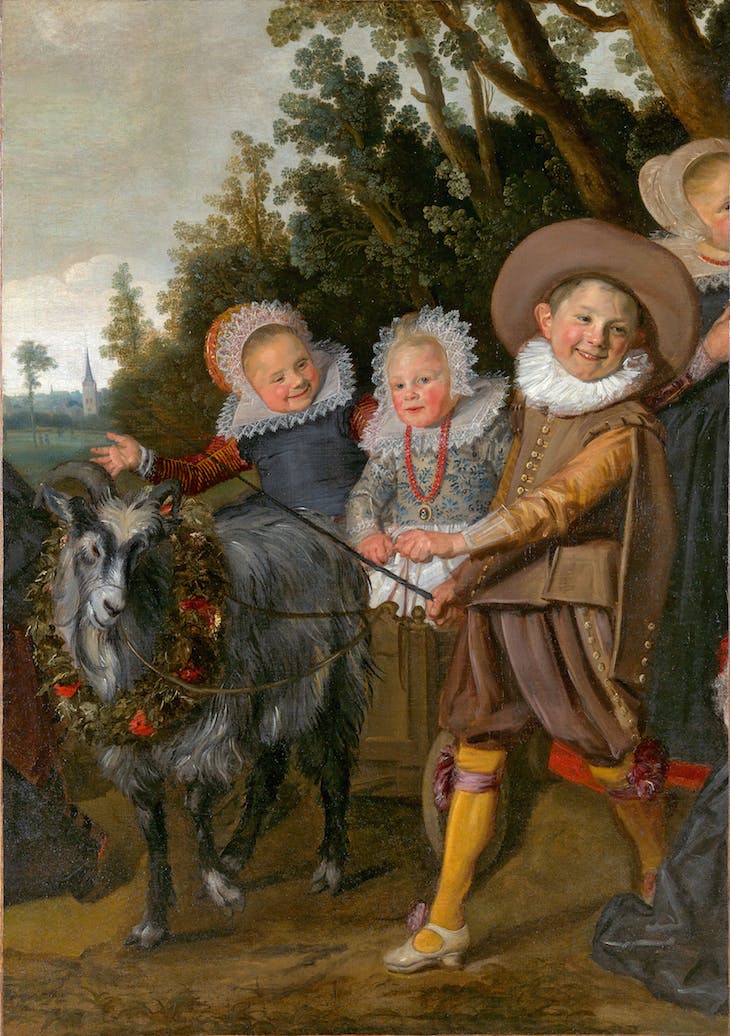
Frans Hals (1582 – 1666), “Children of the Van Campen Family with a Goat Cart” (1624), 151x108cm, Oil on Canvas, Royal Museums of Fine Arts of Belgium, Brussels.

The picture with the parents and their 14 children as shown here above is a reconstruction. Of the original painting, three pieces still exist: “Van Campen Family in a Landscape” in the Toledo Museum of Art, “Children of the Van Campen Family with a Goat Cart” in the Royal Museums of Fine Arts of Belgium and “Head of a Young Boy” in a private collection. For the first time in two hundred years, the three surviving pieces of this monumental family portrait are on view side by side at an exhibition in the Fondation Custodia in Paris (until August 25, 2019.

Frans Hals (1582 – 1666), “Head of a Young Boy” detail from “Van Campen Family Portrait in a Landscape” (1624), Private Collection.

The descendants of the Van Campens decided to cut their family portrait into pieces and sell it as separate “Frans Hals” paintings. The original painting was rather big and difficult to fit in any decent house and almost unsellable in its original format. And by cutting in into pieces, one actually creates even more paintings by the famous Frans Hals! Now, after a few hundreds of years, those three individual paintings have been puzzled together to reunite the parents and children Van Campen in one family portrait. In modern times, you sometimes edit someone out of a picture. But here we are happy to put a family with 14 children together again. The original piece with the portrayal of the two children in the bottom right corner is still missing. If you happen to know the whereabouts of these two kids, please do contact me or the Royal Museums of Fine Arts in Brussels.

Reconstruction of “Van Campen Family Portrait in a Landscape” (1624) by Frans Hals. The child at the bottom left was added by Salomon de Bray. The part in grey is still missing.

John Constable (1776 – 1837)

On June 11th, 1776, birth of John Constable, English landscape painter. Now considered one of the greatest English painters, but during his life more successful outside England than at home. From Suffolk, England, Constable spent almost his whole life painting the local landscape, with clouds full of rain. His paintings show the England we know from Jane Austen and Downton Abbey. It all looks very romantic, and even the endless rain and clouds have their own charm.

John Constable (1776 – 1837), “Salisbury Cathedral from the Bishop’s Garden” (1826), 89x112cm, Oil on Canvas, The Frick Collection, New York.

Here is Constable’s “Salisbury Cathedral from the Bishop’s Garden”, from 1826. Painted for his friend the Bishop of Salisbury. The Bishop and his wife are standing in the front and he points out to the spire of the cathedral. An earlier version of this painting exists (in London’s Victoria and Albert Museum), but when the Bishop had seen that version he asked Constable if the weather could maybe be a bit more sunny. That’s why this second version has more blue sky. Apparently even for the English themselves, the endless clouds and rain can become too much. In our modern days of Instagram, one would put a filter over it. And that’s what Constable did by painting this second and more sunny version. Unfortunately the Bishop died just before his “sunny” painting was completed. It’s now on view in the Frick Collection, New York.

John Constable (1776 – 1837), “Stonehenge” (1835), 39x60cm, Watercolor, Victoria and Albert Museum, London.

Also here is Constable’s wonderful 1835 watercolor painting of the Stonehenge ruins. This watercolor expresses sadness. Its painted after his dear beloved wife passed away and left him alone with their seven children. Constable was extremely sad and deep grief came over him. Look now at this painting. We see one strong remote set of stones standing in the centre, all other pieces have fallen to earth. But lonely as these remote standing stones are, there is hope. A beam of light (or is it a rainbow?) gives warmth and power. I think Constable is expressing his feelings here and also uses this painting to cope with his grief. Constable is like that lonely standing piece. Everything around him fell down, but Constable knows that he needs to cope with his losses. This beautiful Stonehenge watercolor painting confirms to me the healing strength of art. Constable himself said: “Painting is but another word for feeling”.

Pentecost

What is Pentecost and how is it depicted in art? Pentecost (UK: Whitsunday; NL: Pinksteren) is a Christian holy day, that must be seen in connection with Easter and the Ascension of Christ. It’s celebrated 50 days after Easter Sunday, and 10 days after Ascension Day. The word “Pentecost” comes from the Greek word “Πεντηκοστή” and simply means “fiftieth”. What happened is the following: Easter is the moment of the crucifixion and resurrection; at Ascension Day the physical body of Christ goes up to heaven and with Pentecost the spirit of Christ comes back to earth in the form of the Holy Ghost. And the Holy Ghosts descend upon the Apostles, the disciples of Christ, so that they can start spreading His word around the world.

El Greco (1541 – 1614), “Pentecost” (c. 1600), 275x127cm, Oil on Canvas, Museo del Prado, Madrid.

This can be depicted with great drama. Look at El Greco’s painting from c. 1600. The Apostles and Maria are being covered by light and flames coming down from above, and the Holy Ghost is descending in its classic form of a white dove. Their hands up in wonder, and their faces with big glorious admiration. Drama galore! Small mundane detail: the second apostle from the right in the top row has been given the portrait of El Greco himself, and he is the only one looking at us viewers.

If I may demystify this moment a bit, than let’s look at the fresco by Giotto from the Scrovegni Chapel in Padua, painted roughly 300 years before the El Greco painting. It’s the Apostles, sitting together in a meeting session. It’s a few weeks after the moment Christ left them, and can it be that they are going from a mourning phase into a phase of accepting what happened? They are discussing how to move forward and they are deciding to spread the good word of Christ around the world. They seem to have received a sparkle of hope; they are seeing now light in darkness. Giotto depicted this moment as rays of light (or fire) coming from above and spreading over the Apostles. Compare this to the El Greco painting where this abstract concept of seeing light in darkness has been turned into a visual concrete drama with rays of light, the dove and flames descending upon the Apostles.

Giotto (c. 1267 – 1337), “Pentecost”, (c. 1304), 185x200cm, Fresco, Capella degli Scrovegni, Padua.

And to put Ascension and Pentecost next to each other, please look at these 17th Century Dutch prints: Ascension as the physical movement of Christ up to heaven and Pentecost as the spiritual movement of the Holy Ghost down from heaven.

Saint Luke the Evangelist

Who is Saint Luke and how to recognize him in art? Luke is one of the Four Evangelists and the author of the Gospel of Luke, one of the New Testament books that describe the life of Christ. Luke is definitely a historic figure, who lived in the 1st Century and originally came from the then Greek city of Antioch, now on the Turkish-Syrian border. He was an physician, painter and writer and died at the age of 84. As he is one of the Four Evangelists, he became pretty popular and important in Western art. Luke was also a physician, and thus his name is used for many Saint Luke Hospitals all over the world.

Guercino (1591 – 1666), “Saint Luke Displaying a Painting of the Virgin” (1652), 221x180cm, Oil on Canvas, The Nelson-Atkins Museum of Art, Kansas City.

In the 8th Century a story popped up telling that Luke once painted a portrait of the Virgin Mary with the Christ child. Most likely just a cute legend, but it helps with recognizing Luke in art. He is shown as a painter at work, and his model is the Virgin. This also made Luke become the patron saint of painters. He gave his name to the Guilds of Saint Luke, which were the trade unions for painters in the 16th and 17th Century. Here is a 1652 painting by Guercino. Saint Luke shows the viewer his painting with the Virgin and Child. And look what’s on the table behind him. It’s a book. That refers to the Gospel he wrote. And on the book is an inkstand in the form of an ox. And the ox is the very most common attribute to recognize Saint Luke the Evangelist. The other three Evangelists also have their own symbols: Matthew – angel; Marcus – lion; John – eagle.

Here is another painting, from c. 1603, by El Greco (“The Greek”). His real name is Doménikos Theotokópoulos, a Greek painter but mainly living and working in Toledo in Spain. El Greco painted this magnificent portrait of Saint Luke for the Toledo Cathedral where it still can be seen. He must have felt close to Saint Luke, as they both came from Greece. Saint Luke shows us the Gospel, and his painting of the Virgin and Child is now incorporated in the Gospel book itself.

El Greco (1541 – 1614), “Saint Luke the Evangelist” (c. 1603), 100x76cm, Oil on Canvas, Toledo Cathedral, Spain.

Most common is to depict Luke as a writer, together with an ox or a bull, which animal became Luke’s trademark symbol. The ox or bull, as an animal often used for offers, refers to Christ’s sacrifice and crucifixion. Here are a few Dutch Old Master prints from series with the Four Evangelists. The person writing, depicted together with an ox, can only be Saint Luke the Evangelist. Once you make the link between Luke and the ox, it will be super easy to recognize this saint.

Jan Lievens (1607 – 1674)

Jan Lievens (1606 – 1674), “Samson and Delilah” (c. 1632), 131x111cm, Oil on Canvas, Rijksmuseum, Amsterdam.

On the 4th of June 1674, death of Jan Lievens, Dutch Golden Age painter and friend, colleague and rival of Rembrandt. Only a year younger than Rembrandt, they grew up together in Leiden and shared a studio in Amsterdam. Rembrandt became the well known favorite of all times, and Lievens always stayed in his shadow. But let’s look now at Jan Lievens’ “Samson and Delilah” painted around 1632. The story is from the Old Testament (Judges 16: 17-20) and goes as follows. The Israelite Samson is the strong invincible super-hero. Delilah is a treacherous smart woman, bribed by the Philistines, who seduces Samson into telling her the secret of his heroic strength. He tells her that he will lose his strength when his hair will be cut. When Samson falls asleep on her lap, she hands a pair of scissors to a frightened Philistine and in the next scene Samson’s powerful hairlocks will be gone. This is a scene of terror and suspense. On the painting it’s the moment when Samson still has all his strength, and the Philistine guy knows that and looks pretty anxious. But Delilah is determined and Samson’s hair (and strength!) will be gone in a second. This subject appeals to the viewer for a few reasons. It’s about a strong muscled guy, who now sleeps like a baby and will be powerless very soon. It’s also about women being smart and able to seduce men. And there is a moral: strong as you may be as a man, you are weak in the arms of a beautiful woman. And Lievens is depicting the moment when Samson still has all his power and strength. It can all still go wrong! There is suspense in this part of the story!

Here is also a painting that’s actually more a sketch. Over the centuries this small painting has been attributed on and off to Rembrandt or to Lievens. There are endless discussions between historians of art who the artists is behind this painting. Its for sure from the Rembrandt/Lievens studio, from around 1626, and it shows again the terrifying moment just before the cutting of Samson’s hair. Currently this painting is attributed to Rembrandt.

Attributed to Rembrandt (1606 – 1669), “Samson and Delilah” (c. 1626), 28x24cm, Oil on Panel, Rijksmuseum, Amsterdam.

In the days of Rembrandt and Lievens, artists were using prints as source of inspiration. It could very well be that the below print has been seen by Rembrandt and Lievens. It’s a print from 1611 by the Dutch artist Jacob Matham, after a painting by Rubens made in 1609. Most likely Lievens and Rembrandt have never seen the Rubens painting and only know the work through the Matham print. Rubens is depicting the moment of cutting the hair. But Rembrandt and Lievens choose the moment just before that, creating masterly that sense of terror and suspense. It can still go wrong! That’s like a Hitchcock thriller, but painted in the 17th century!

The Four Evangelists

The Four Evangelists are the ones who wrote the four gospels in the New Testament, which is the second volume of the Bible. These gospels describe the life of Christ and are therefore in essence four times the same story but written by four different authors. The word “evangelist” comes from the Greek word εὐ-αγγέλιον (eu-angelion), which means “the good message”; εὔ = good, αγγέλιον = message. The word “angel” has the same origin and actually means “messenger”. The authors of these 4 gospel-books are the Saints Matthew, Mark, Luke and John.

Jacob Jordaens (1593 – 1678), “The Four Evangelists” (1625), 133x118cm, Oil on Canvas, Musée du Louvre, Paris.

The Four Evangelists are mostly depicted separately, but here is a 1625 painting by Jacob Jordaens in which they form a group. It’s clearly a group of four wise men, writing books. And therefore these can immediately be identified as the Four Evangelists. Identifying the individual evangelists is the next step. Each of them has his own symbol, and that’ the easy way to recognize them. That can be seen on the painting (c. 1614) by the Utrecht painter Abraham Bloemaert. Luke’s symbol is the ox, Mark has a lion, John his eagle, and for Matthew it’s an angel. It’s still the group of the Four Evangelists, together in one painting. But in most cases they are depicted in individual pictures, and as there are four of them, it’s excellent for series of four paintings, prints and even sculptures. Look for the ox, lion, eagle or angel and you know who is who.

Abraham Bloemaert (1566 – 1651), “The Four Evangelists” (c. 1614), 179x227cm, Oil on Canvas, Princeton University Art Museum.

Here are two Dutch Old Master prints from a series of the Four Evangelists. It’s Saint Matthew with the angel, and Saint John with the eagle. And both of them are receiving holy and spiritual inspiration for writing their gospel: the Gospel according to Matthew and the Gospel according to John. Prints from 1606 by Crispijn van de Passe after paintings by Gortzius Geldorp, 42x30cm, Engraving on Paper, Rijksmuseum, Amsterdam.

Peter Paul Rubens (1577 – 1640)

On the 30th of May, 1640, death of Peter Paul Rubens, the most important Baroque painter from the Flemish Netherlands. Rubens was not only a well-educated scholar and painter, but also businessman and diplomat. He made religious altarpieces, portraits of royalty, mythological paintings and hunting landscapes. All his paintings are impressive big pieces with lots of color and typical Baroque-emphasized movement and sensuality. He run a large studio in Antwerp which is now the Rubenshuis Museum.

Peter Paul Rubens (1577 – 1640), “The Descent from the Cross” (1613), 420x320cm, Oil on Panel, Cathedral of Our Lady, Antwerp, Belgium.

Here are two of his paintings. It’s “The Descent from the Cross” (1613), which is the 4×3 meters magnificent central panel of a triptych, which is still in its original place in the Cathedral of Our Lady in Antwerp, Belgium. The body of Christ is lowered from the cross, with very energetic support of Saint John (in the red mantle). Mary Magdalena is gracefully supporting Christ’ leg and Mary, a mother in despair, is stretching out her arms towards her son. Joseph of Arimathea and Nicodemus are placed on both sides of the scenel.

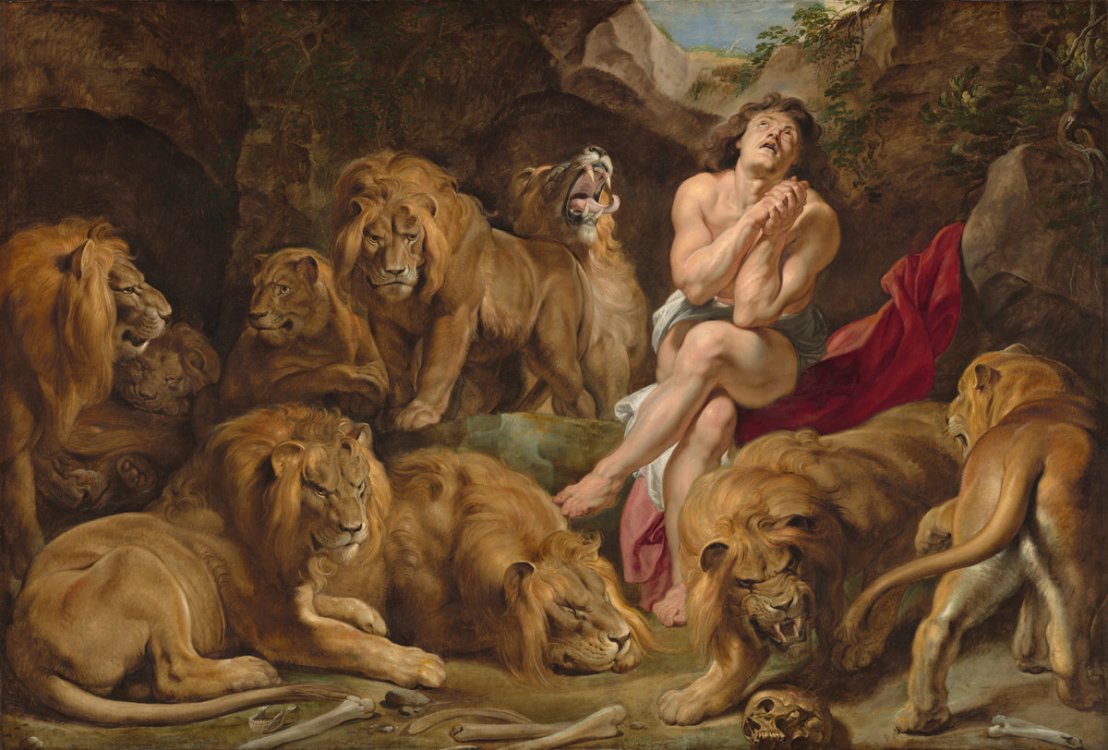
Also here is a 2×3 meters big painting of the legendary hero “Daniel in the Lions’ Den” (1614). Chief counselor to the Persian king, Daniel fell victim to his jealous co-officials. They plotted against him and threw him into a den of lions. But that plot truly failed! Daniel keeps on staring up and praying towards the light of heaven. And he stayed unharmed! Next day he was freed without a single scratch. A strong moral: look up when things get you down; keep your head up and think positive!

Peter Paul Rubens (1577 – 1640), “Daniel in the Lions’ Den” (1614), 224x351cm, Oil on Canvas, National Gallery of Art, Washington.

Mannerism

Bronzino (1503 – 1572), “An Allegory with Venus and Cupid” (1545), 146x116cm, Oil on Wood, The National Gallery, London.

Mannerism is a European art style that follows Renaissance and precedes Baroque, originating in Italy around 1520 and spreading over Europe. Mannerism lasted until the end of the 16th Century, when Mannerism gradually turned into the Baroque style.

How did Mannerism originate and what is it all about? The artists from the Renaissance, like Michelangelo and Leonardo da Vinci, excelled in painting and sculpting ideal beauty, balanced proportions and ultimate elegance. Their art had reached the top of what could be achieved; Renaissance was considered the peak of perfection. That gave the next generation of artists a feeling that they had not much to add anymore, and therefor they started to search for additional artistry on top of the Renaissance skills and values. This next generation started to add wisdom and intelligence to their art. And that resulted in a “manner” of over-sophisticated elegance. Mannerism is more about artificial and intellectual beauty than the perfect natural beauty from the Renaissance times.

The word “Mannerism” comes from the Italian word “maniera”, meaning “manner”. The Mannerist painters were painting in the “manner” of Renaissance painters like Michelangelo, but topped it up with their own intellectual and sophisticated inventions. One could say that they overdid it a bit. The mannerist artists tried to exceed Renaissance art, but that resulted in an overcomplicated way of depicting nature. And ultimately that was followed by the even more complex manner of depicting beauty during the Baroque.

Look at Bronzino’s “An Allegory with Venus and Cupid” (1545). It’s an almost bizarre composition and an exaggerated anatomy of figures. It reminds us of Michelangelo, but with an over-the-top approach of beauty. And the meaning behind this painting is so over-intellectual, that one hardly understands what it is about. It’s passion and play, time and despair, love and seduction; with every figure having it’s own symbolic meaning and art historians nowadays in doubt of the actual meaning. Or look at the Virgin Mary with Child (1540) by Parmigianino. In his efforts to create more elegance, Parmigianino gave his figures those long stretched bodies. And ironically, the painting is now just known as “The Madonna with the Long Neck”. Both Bronzino and Parmigianino want to express that there is more to achieve than the old-fashioned way of traditional Renaissance painting. They show the viewer their new “manner” of dealing with art and beauty. Mannerist painters proudly created Modern Art in the 16th Century.

Parmigianino (1503 – 1540), “The Madonna with the Long Neck” (c. 1537), 216x132cm, Oil on Wood, Galleria degli Uffizi, Florence.

Albrecht Dürer (1471 – 1528)

Albrecht Dürer  (1471–1528), “Saint Jerome” (1521), Oil on Panel, 60x48cm, Museu Nacional de Arte Antiga, Lissabon.

On the 21st of May, 1471, birth of Albrecht Dürer, painter, drawer and printmaker, and one of the key artists of the Northern Renaissance.  Dürer’s printmaking has been of immense influence on generations of painters, all of whom had printmakers copy their works in prints, to be able to distribute their art. Dürer was born in Nuremberg, Germany, where his father was a successful goldsmith. He made a few trips to Italy and contributed greatly to the exchange of knowledge and skills between the Italian and Northern Renaissance. Back in Germany Dürer dedicated himself to printmaking, mainly woodcuts and engravings, turning printmaking into an art of its own right. Dürer is considered one of the most famous artists of his time.

Here is Dürer’s painting of Saint Jerome. It’s more a portrait of an old wise man and only little details like the inkpot and bookrest remind us that this is a scholar sitting in his study. Saint Jerome was a Christian theologian, best known for his translation of the Bible into Latin. But look how he is pointing at the skull. Saint Jerome reminds us of our mortality and the vanity of earthly life and goods.

The Albertina in Vienna keeps four of Dürer’s preparatory sketches for the painting; see hereunder. Dürer’s handwritten note on the drawing of the Saint Jerome’s head, gives us information about the model: “The man was 93 years old and still healthy”. The three other sketches are details of the painting, all brush drawings on gray violet primed paper highlighted in white tempera, and from 1521, Fotos: © Albertina, Vienna.

Durer,_study_of_a_man,_aged_93
Albrecht Dürer  (1471–1528), “Study of a Man Aged 93” (1521), 42x28cm, Albertina, Vienna.

Leonardo da Vinci (1452 – 1519)

Leonardo da Vinci (1452 – 1519), Mona Lisa or La Gioconda or Portrait of Lisa Gherardini, Oil on Panel, 77x53cm, The Louvre Museum, Paris.

Today 500 years ago, on May 2, 1519, Leonardo da Vinci dies in Amboise in France. He spent his last years in the service of his good friend Francis I, King of France. Already during his lifetime considered a super genius, and now thought to be one of the greatest artists and scientists of all time. Inventor, painter, drawer, engineer, writer, musician, botanist, historian; Leonardo is the epitome of the Uomo Universale. As painter he left us only around 15 paintings, but one of those is the most famous painting of all. Here is Leonardo’s “Mona Lisa”. The name is a contraction of Ma Donna Lisa, which means My Lady Lisa. It’s Lisa Gherardini who is portrayed here, the wife of Francesco del Giocondo. And that gives the painting it’s other name “La Gioconda”, which translates as “The Joyful Lady”. Her mysterious smile attracts millions of visitors to the Louvre Museum in Paris, where it’s listed as acquired by Francis I and having entered the French royal collection in 1518.

Jules Breton (1827 – 1906)

default
Jules Breton (1827 – 1906), “The Song Of The Lark” (1884), Oil on Canvas, 110 x 85 cm, The Art Institute of Chicago.

Jules Breton, born on the 1st of May, 1827, was a 19th-century French Romantic-Realist painter. His paintings are influenced by the French countryside and rural peasant life. Breton transmits the hardship of rural existence into romantic and idyllic beauty. Here is his painting “The Song Of The Lark”, from 1884. The poor farmer girl has a day of hard work ahead, but she is catching the beauty of the moment of sunrise and the pleasing melodic song of that tiny lark high up in the sky. It’s a moment of power of nature, which might give the girl the strength to go through the day ahead. When painted, the nostalgic of the hard working peasant class appealed to the salons of the Paris elite. But everyone, rich and poor, feels the warmth of the sun at dawn and enjoys the power of the song of a lark.

Joaquín Sorolla (1863 – 1923)

16865151_10155008430052359_5730546136687210739_n
Joaquín Sorolla y Bastida (1863 – 1923), “Paseo a Orillas del Mar (Walk on the Beach)” (1909), Oil on Canvas, 205x200cm, Museo Sorolla, Madrid.

On February 27, 1863, birth of Joaquín Sorolla y Bastida, Spanish impressionist painter. Famous for painting people and landscapes under the bright Spanish sunlight and with sunlit water. Here is Sorolla’s “Paseo a Orillas del Mar” (Walk on the Beach), painted on the beach of Valencia and depicting his wife Clotilde and daughter Maria. The effect of the breeze on the dresses gives an impression of fleeting momentary; it’s a painting like a snapshot photo. On view in Madrid’s Museo Sorolla, which was the artist’s house and studio.

Odilon Redon (1840 – 1916)

17991743_10155182310242359_7844031937800851202_o
Odilon Redon (1840 – 1916), “Ophelia among the Flowers” (1905), Pastel on Paper, 64x91cm, National Gallery, London.

On April 20, 1840, birth of Odilon Redon. French symbolist painter who combined the macabre with beauty and light. Redon’s paintings are a synthesis of nightmares and dreams, as in “Ophelia among the Flowers” from 1905. Ophelia is a character from Shakespeare’s Hamlet. Towards the end of the the play she drowns in a pond, surrounded by flowers.

Jacob van Hulsdonck (1582 – 1647)

18056686_10155200865932359_4646852545213940478_n
Jacob van Hulsdonck (1582 – 1647), “Roses in a Glass Vase” (c. 1640), Oil on Copper on Panel, 35x28cm, Mauritshuis, The Hague.

Jacob van Hulsdonck, born April 26, 1582, Flemish painter of still-lives and flowers. Here are his Roses in a Glass Vase. It’s white and red roses, plus an eglantine-rose (Dutch: “egelantier”) in the top left of the picture. Executed with great precision throughout, from the water droplets on the petals to the maybeetle in the foreground to the right. There is also symbolism in this painting. White and red roses are representing female “pure” and male “erotic” love; here arranged in harmony. The eglantine-rose, as symbol of scared and profane love, makes this painting a “Bouquet d’Amour”.