Tag: Bloemaert

Famous Sinners

Famous Sinners

Sin, penance and redemption? Maybe yes, maybe no!

I’ve been meaning to write about Abraham Bloemaert’s engraving series Six Sinners of the Old and New Testament for some years now. The series features the Apostle Peter, the Apostle Paul, Mary Magdalene, the tax collector Zacchaeus, King Saul, and Judas Iscariot. All are marked by sin; some found redemption through penance, while others did not.

What intrigues me is why Bloemaert chose to design this series when he did. He was a devout Catholic working in a time of intense religious conflict: the Protestant Reformation and the Catholic Counter-Reformation. Both movements were promoting their doctrines, and in my view, this series served as a kind of visual “marketing” within Catholic circles – propaganda, if you will – promoting the sacrament of penance, a sacrament explicitly rejected by the Protestants.

To give context, I’ll briefly touch on how penance was viewed in both the Reformation and the Counter-Reformation. And of course, I’ll explore the six figures themselves: What was their sin? What path, if any, led them to salvation or redemption? The topics are as follows:

The recurring question: Sin, Penance and Redemption? The recurring answer: Maybe yes, Maybe no!

Protestant Reformation and Catholic Counter-Reformation

Two key players. On 31 October 1517, Martin Luther nailed his 95 Theses to the door of All Saints’ Church in Wittenberg, protesting the sale of papal indulgences. This act ignited public debate about corruption in the Catholic Church and its doctrines, sparking the Protestant Reformation. Pope Paul III (born Alessandro Farnese) was the pontiff who convened the Council of Trent in 1545, a major Catholic congress called to address the challenges raised by the Reformation. Recognizing the urgent need for reform, Pope Paul III launched what became known as the Catholic Counter-Reformation. Portrait of Martin Luther (1528), Lucas Cranach the Elder (German, 1472 – 1553), Oil on panel, 40x25cm, Veste Coburg, Kunstsammlungen Coburg, Germany.
Portrait of Pope Paul III (1543), Titian (Italian, 1490 – 1576), 106x85cm, National Museum of Capodimonte, Naples, Italy.

Protestant Reformation

During the Protestant Reformation of the early 16th century, reformers such as Martin Luther and John Calvin challenged many core teachings and practices of the Roman Catholic Church. One of their main targets was the sacrament of penance. In Catholic tradition, penance involved confessing one’s sins to a priest, receiving forgiveness, and performing penitent actions, such as prayer, fasting, or giving to the poor. The protesting reformers rejected this system, arguing that forgiveness came directly from God and could not be earned or managed by church officials.

They believed it was both theologically incorrect and morally questionable for a priest to claim the power to forgive sins in God’s name. In their view, no human had the authority to stand in place of God or to offer spiritual pardon in return for good deeds or, in the worst cases, in exchange for money. Instead, they promoted a more personal relationship with God, in which each individual could seek forgiveness through sincere belief and trust. This view challenged the structure and authority of the Catholic Church.

Catholic Counter-Reformation

In response to these challenges, the Catholic Church began the Counter-Reformation, also known as the Catholic Reformation. This movement aimed to correct abuses within the Church and to clearly define Catholic teaching in the face of Protestant criticism. A central moment in this effort was the Council of Trent, which took place between 1545 and 1563. This Council was a large official gathering of bishops and theologians, similar in function to a modern political party congress or strategy meeting. It shaped the future of Catholic doctrine and practice.

Regarding confession and penance, the Council of Trent firmly upheld traditional beliefs. It confirmed that penance remained one of the Church’s essential sacraments, and that priests continued to play a central role as mediators of God’s forgiveness. The Council taught that people needed to be truly sorry for their sins, confess them honestly to a priest, and follow through with actions that showed a sincere desire to make things right.

In summary, while the Protestant Reformation rejected this framework and emphasized direct faith as the path to forgiveness, the Catholic Church maintained the importance of the sacrament of penance as a structured way to seek reconciliation with God.

The Apostle Peter

Peter is often referred to as a sinner not because of a life marked by immorality, but because of a specific, dramatic moment of human weakness: his so-called “denial.” What happened? On the night of Jesus’ arrest, Peter famously denied knowing Him three times. This betrayal happened just as Jesus had predicted: “Truly I tell you,” Jesus said to Peter, “this very night, before the rooster crows, you will disown me three times.” When the moment came, Peter acted out of fear for his own life and told the bystanders in the high priest’s courtyard that he did not know Jesus.

After the third denial, in the early morning, the rooster crowed, and Peter remembered Jesus’ words. He went outside and wept bitterly. That moment of bitter weeping marks the beginning of his sorrow and change of heart. Later, in the end, Peter received forgiveness, and the story moves from failure to restoration.

Peter’s sin was not one of malice, but one of fear and denial under pressure. It is a profoundly human failing. Even the most faithful can stumble. That is what makes Peter’s story so relatable for many who look at his image or read about him. His tears, his sorrow, and his return to grace speak to something very close to everyday life: the reality of weakness, the weight of regret, and the hope of forgiveness.

The Apostle Paul

Paul, originally known as Saul of Tarsus, is considered a sinner because of his fierce persecution of early Christians. Before his conversion, Saul actively sought out followers of Jesus, arresting them and approving their punishment.

Paul’s turning point came on the road to Damascus. While traveling to arrest more Christians, he was struck by a great light from heaven and heard the voice of Jesus: “Saul, Saul, why are you persecuting me?” Blinded and shaken, he was led into the city. After three days, a Christian named Ananias visited him, restored his sight, and baptized him. From that moment on, Saul became Paul, a tireless preacher of the gospel and one of Christianity’s most influential apostles. More about Paul’s conversion can be read in one of my earlier posts, just click here.

Paul’s story is not just about a change of opinion, but about radical transformation. He went from persecutor to preacher, from enemy to evangelist. His life shows that no one is beyond redemption. Like Peter, Paul reminds us that great failure can be the beginning of great purpose.

The tax collector Zacchaeus

Zacchaeus was a chief tax collector in Jericho, a profession despised by many Jews at the time. Tax collectors were seen as collaborators with the Roman occupiers and were often associated with greed and corruption. Zacchaeus was also a wealthy man, likely enriched through questionable means. And he was short in stature, a small detail that becomes important in his story.

When Jesus passed through Jericho, Zacchaeus, eager to catch a glimpse of Him, climbed a tree to see above the crowd. This simple act of curiosity became the start of something much greater. In a striking moment of grace, Jesus looked up, called him by name, and announced that He would stay at Zacchaeus’s house. The crowd was scandalized. But Zacchaeus responded with a bold act of sorrow and penance: he gave half his possessions to the poor and promised to repay anyone he had cheated, four times over.

This almost childlike gesture of climbing the tree, followed by sincere conversion, makes Zacchaeus a powerful image of redemption. In the spirit of the Counter-Reformation, his story reminds us that no sinner is beyond the reach of grace. And visually, the story is unforgettable: that little man perched high in the tree, waiting for a glimpse of mercy.

Mary Magdalene

Mary Magdalene has long been one of the most misunderstood figures in Christian tradition. In many paintings, she is portrayed as a penitent sinner, often assumed to have been a former prostitute. But what was her actual sin? Surprisingly, the Bible never describes Mary Magdalene committing any specific wrongdoing. What we do know is that she was a devoted follower of Jesus, and she was also the first to witness and proclaim the Resurrection, which even earned her the title apostola apostolorum, the apostle of the apostles.

The image of Mary Magdalene as a sinful woman arose from a long-standing confusion of identities. The 6th-century Pope Gregory combined different women into one: the unnamed “sinful woman” who anoints Jesus’ feet and Mary Magdalene. This mix-up led to centuries of tradition in which Mary Magdalene was depicted as the great penitent, weeping for a sinful past that the Bible never assigns to her. During the Counter-Reformation, this image became especially prominent as a symbol of penance and transformation.

Today, both scholars and the Catholic Church have worked to correct the long-standing confusion about Mary Magdalene’s identity. In 1969, the Church officially separated her from the unnamed “sinful woman”, and in 2016, Pope Francis elevated her memorial to the rank of an official Feast Day (July 22nd). Far from being a scandalous sinner, Mary Magdalene is now recognized as a figure of faith, devotion, and spiritual strength. Her story also reminds us of the central and active role women played in the early Church. During the Counter-Reformation, however, the image of a sinful and penitent Magdalene remained popular as a powerful and visually attractive way to promote the message of penance.

King Saul

King Saul, the first king of Israel around the 11th century BC, died not in triumph but in despair. Saul began his reign with promise, but over time, he disobeyed divine commands, acted out of fear rather than faith, and slowly lost all favor. Saul admitted fault but never showed deep regret, making his decline inevitable.

This engraving captures Saul’s final act: his death on the battlefield. Surrounded by Philistine forces and facing defeat, Saul chose to fall on his own sword. His armor-bearer (on the right) followed him in death. In the foreground, the fallen spear and crown say everything: symbols of royal authority, now useless and abandoned. Unlike the later King David, who would sin grievously but find forgiveness, Saul dies without reconciliation, without peace, and without a legacy of redemption.

King Saul suffers from depression and is soothed by the young David who plays the harp for him. In a particularly striking detail, Saul dries his tears on the curtain. But Saul will soon fly into a rage and throw his spear at David.
Saul and David (c.1651), Rembrandt van Rijn (Dutch, 1606 – 1669), Oil on canvas, 130x165cm, Mauritshuis, The Hague.

Saul’s story is a tragedy, and the image of his death speaks to the cost of pride, fear, and spiritual isolation. For viewers in the time of the Counter-Reformation, this image served as a stark moral warning: Saul had the chance to seek forgiveness, but he let that chance slip away. His death without sorrow and regret becomes a cautionary mirror, urging the faithful not to delay, but to turn to God in penitence while there is still time. In a visual culture that promoted penitence, Saul stands as a missed opportunity, a soul lost not by one great sin, but by failing to seek mercy. In the context of Bloemaert’s Series of Sinners, the figure of Saul serves to dramatize this failure, a counterpoint to the earlier figures who, though sinners, found their way back to grace.

Judas Iscariot

Judas Iscariot’s betrayal of Jesus is one of the most well-known episodes in the New Testament, and artists across centuries have visualized different moments of his story. Bloemaert’s print takes the story to its final stage. Judas is shown preparing to hang himself, with the purse with the thirty silver pieces, the bribe that triggered him to betray Jesus, lying beside him as a reminder of the irreversible deed. In the context of the Counter-Reformation, this image would have served as a moral lesson. Judas feels sorrow, but instead of seeking forgiveness, he condemns himself.

In the manuscript illustration hereunder, showing the Kiss of Judas, he approaches Jesus with a gesture of affection that is, in fact, a signal to the arresting soldiers. In his hand, he holds the purse containing the thirty silver pieces he had already received as payment for delivering Jesus to the authorities. The image captures the moment of betrayal as it happens.

In Rembrandt’s painting, we see Judas shortly after the arrest. He is no longer defiant; instead, he is overwhelmed with remorse. He returns to the temple, trying to give back the silver, but the priests refuse to take it. Judas throws the coins to the ground in despair. Rembrandt shows him in a deeply human moment, tormented by guilt, isolated, and desperate for a resolution that does not come. This scene is not about the betrayal, but about the aftermath and the silence that follows rejection.

Judas Returning the Thirty Silver Pieces (1629), Rembrandt van Rijn (Dutch, 1606 – 1669), Oil on panel, 79x102cm, Private Collection.

Like King Saul, Judas becomes an example of despair without redemption. That’s why Counter-Reformation artists like Bloemaert depict Judas not simply as a sinner, but as a warning: sorrow without grace and penance leads to despair, not redemption.

Closing Notes

Artists and theologians of the Catholic Counter-Reformation strongly reaffirmed the Church’s essential role in the process of redemption. Abraham Bloemaert, a devoted and almost militant Catholic, stands firmly within this tradition. His series of prints depicting six biblical “sinners”, including Peter, Paul, Mary Magdalene, Saul, Judas, and Zacchaeus, offers the viewer a choice: to remain in sin or to be transformed through confession and penance. Through vivid visual storytelling, Bloemaert underscores a central Catholic message: no soul is beyond salvation, and the path to healing lies in turning back to the Church and its sacraments of confession and penance.

Bloemaert’s six engravings are a visual theology. They present a direct rebuttal to Protestant skepticism and a defense of the Catholic practice of confession and penance. His series are a great example of marketing and promoting the ideas of the Catholic Counter-Reformation, and rejecting the Protestant Reformation.

More simply put: Sin, Penance, and Redemption? Maybe yes, maybe no!

Bonus: Zacchaeus in the Palm Tree?

Here’s a little bonus, a curious and funny mix-up of stories and imagery. The story of Zacchaeus is part of Jesus’ entry into Jericho. Zacchaeus, being short, climbs a tree to get a better view of Jesus as he passes by. But Jesus also made another notable entry, into Jerusalem. It’s a different event, but visually it looks quite similar: Jesus on a donkey, a crowd greeting him. At Jerusalem, people laid down cloaks and branches — especially palm leaves — to create a kind of “red carpet” welcome for Jesus, the scene we now celebrate as Palm Sunday.

And here’s the twist. In some early 14th-century artworks with depictions of the Entry into Jerusalem, a little man (sometimes even two) appears high up in a tree again. In my view, this is Zacchaeus imagery that wandered into the wrong story. Somehow, Zacchaeus climbed into the Palm Sunday narrative and stayed there for about a hundred years. The motif disappears again in the early 15th century, but for a while, it added a charming and slightly comical detail to sacred art.

The Conversion of Saint Paul on the Way to Damascus

The Conversion of Saint Paul on the Way to Damascus

“Saul becomes Paul”

The Feast of the Conversion of Saint Paul is celebrated on January 25th. This day commemorates the biblical account of the dramatic conversion of Saul, who then becomes the Apostle Paul. According to biblical accounts, Saul was traveling to Damascus with the intention of arresting and persecuting Christians when he experienced a dramatic encounter with a bright light and heard the voice of Christ. Saul fell from his horse as he heard Christ’s words “Saul, Saul, why are you persecuting me”? or in Latin ”Saule, Saule, quid me persequeris”? This dramatic encounter brought about Saul’s conversion.

The Conversion of St Paul on the Way to Damascus (c.1617), Guido Reni (Italian, 1575 – 1642), 238x179cm, Royal Monastery of San Lorenzo de El Escorial, Spain.

Saul was blinded by the strong light. He was then guided to Damascus where Ananias, a follower of Christ, baptised Saul and miraculously gave him back his eyesight. After his conversion, Saul’s name was changed to Paul, and he is often referred to as Saint Paul or the Apostle Paul.

Christ appears own a cloud, with three angels. The Conversion of Saint Paul (1506), Hans Baldung Grien (German, 1484 – 1545), woodcut, 24x16cm, Rijksmuseum, Amsterdam.

Alternative theories about what happened to Paul on the way to Damascus have been proposed, including sun stroke, struck by lightning and a seizure; or a combination of these. In an article in the Journal of Neurology, Neurosurgery, and Psychiatry (1987), it has been stated , that Paul’s conversion experience, with the bright light, loss of normal bodily posture, a message of strong religious content, and his subsequent blindness, suggested a Temporal Lobe Epilepsy (TLE) attack, and a post-ictal blindness. TLE seizures can affect emotions, behaviour, memory, and consciousness. Symptoms can vary widely and may include unusual sensations, altered sense of reality, déjà vu, hallucinations, or even loss of awareness. Post-ictal blindness refers to a temporary loss of vision that occurs after a seizure. Individuals may experience various neurological symptoms, and a temporary inability to see.

The Conversion of St Paul on the Way to Damascus (c.1680), Bartolomé Esteban Murillo (Spanish, 1617 – 1682), 125x169cm, Prado, Madrid.
The Conversion of St Paul on the Way to Damascus (c.1602), Adam Elsheimer (German, 1578 – 1610), Oil on Copper, 20x25cm, Städel Museum, Frankfurt am Main.
The Conversion of St Paul on the Way to Damascus (c.1527), Francesco Mazzola aka Parmigianino (Italian, 1503 – 1540), 178x129cm, Kunsthistorisches Museum, Vienna.
The Conversion of St Paul on the Way to Damascus (1601), Caravaggio (Italian, 1571 – 1610), 230x175cm, Cerasi Chapel, Santa Maria del Popolo, Rome.
The Conversion of Saint Paul (1509), engraver Lucas van Leyden (Netherlandish, 1498 – 1533) after his own design, engraving, 28x41cm, Rijksmuseum, Amsterdam.

According to the New Testament, after Saul had his encounter with the bright light on the road to Damascus and heard the voice of Christ, he was left blinded. The men traveling with Saul stood there speechless; they had heard the sound but did not see anyone. Paul got up from the ground, but when he opened his eyes he could see nothing. So they led him by the hand into Damascus. For three days he was blind. In Damascus he met with Ananias, who laid hands on him, and something like scales fell from Saul’s eyes, restoring his sight. Ananias then baptized Saul, who took on the name Paul.

The Conversion of Saint Paul, print 15/34 from the series Acts of the Apostles (1582), engraver Philip Galle (Netherlandish, 1537 – 1612) after design by Maerten van Heemskerck (Netherlandish, 1498 – 1574), engraving, 21x27cm, National Gallery of Art, Washington.
Ananias Restoring the Sight of Saul (1719), Jean Restout (French, 1692 – 1768), 99x80cm, Louvre, Paris.
The conversion of St Paul on the way to Damascus and the baptism of St Paul by Ananias (c.1190), Fol 24v from the Picture Bible from the Benedictine Abbey of St. Bertin, France, 11x15cm, Koninklijke Bibliotheek, National Library of the Netherlands, The Hague.
The Apostle Paul with in the background the story of his conversion, including the words: “Saule, quid me persequeris” or “Saul, why are you persecuting me”?.
Saint Paul, print 5/6 from the series Sinners of the Old and New Testament (c.1610), engraver Willem Isaacsz. van Swanenburg (Netherlandish, 1580 – 1612) after design by Abraham Bloemaert (Netherlandish, 1564 – 1651), Rijkmuseum, Amsterdam.

After his conversion, Paul dedicated himself to spreading the teachings of Christianity. He embarked on several missionary journeys, established Christian communities, and wrote numerous letters (epistles) that are an integral part of the New Testament. His writings and teachings have had a profound impact on the development of the early Christian Church.

Winter in art

Winter in art

“Baby, it’s cold outside…”

Now that we are in the middle of the winter, I’ve started thinking about how this “winter” concept has been represented in art. It’s the harshest season of the year, certainly when there was no electricity or gas, but some touching images have been produced over the centuries.

It was not just landscape painters who gave us winter scenes with frozen rivers and skaters. Painters also personified winter as an old man with a fur coat and warming his hands at a brazier. And from the the 18th century, artists depicted winter as a young woman, adding a sensual and warm touch to the cold.

I choose some ten works of art, all depicting winter as a “personification”; as a human figure depicted with symbolic attributes, representing the abstract idea of “winter”. Starting with the French Impressionist Berthe Morisot, as I like her paintings so much. And then going back in time to the 17th century Flemish painter David Teniers, to Madame de Pompadour – lover of King Louis XV of France, to the bedroom of King George III of England, to La Frileuse, the chilly girl, by the French sculptor Houdon. It’s an eclectic batch of art, but all lovely. They give inspiration and warmth in this cold season. Like Vivaldi’s Winter from The Four Seasons.

Along with its Summer pendant, Winter depicts a fashionable Parisian woman who personifies a season. Berthe Morisot debuted the paintings together at the Paris Impressionist exhibition in 1880. Morisot’s images of the Parisienne, a popular figure type representing an elegant, upper-class Parisian woman, were considered utterly contemporary. A critic said about Morisot’s Winter: “with its figure, so courageously modern, of the Parisian woman braving the cold in her furs.”

Berthe Morisot (Édouard Manet’s model and sister-in-law) was one of the most respected members of the Impressionist movement. At the beginning of the 20th century, her aura began to dim and her painting, labelled “feminine”, was relegated to second rank. Only recently, thanks also to the grand 2019 Morisot exhibition in the Musée d’Orsay, Berthe Morisot was incontestably regarded again as a great artist.

Abraham Bloemaert (Dutch, 1566 – 1651), Allégorie de l’hiver (et de l’amour) or Winter (and love), c.1627, 70x58cm, Musée du Louvre, Paris.

This old man by the Dutch Golden Age painter Abraham Bloemaert is representing Winter. Wearing a fur hat and very carefully warming himself at a small stove full of red-hot coals or charcoal. His nose and cheeks reflect the heat of the coal. It’s not only a representation of winter, but also hinting to love and passion. Love – and it’s pleasure – happens to be gallant to the ones who court the fire of love with caution.

David Teniers the Younger (Flemish, 1610 – 1690), Winter, from the series The Four Seasons, c.1644, Oil on Copper, 22x16cm, National Gallery, London.

David Teniers the Younger brings the cycle of the seasons to an end with an old man representing Winter. Wrapped in velvet and fur, he hunches over to warm his hands at a brazier, a small stove that’s heated with charcoal. His face is wrinkled, his beard long and frosted with white. In the background a small, monochrome skating scene. It’s a personification of winter and Teniers chose a character of an appropriate age and dressed him accordingly. Winter as the last season of life.

The tiny picture is on a copper base, which allowed the paint to flow more freely than it would on canvas. Teniers could show minute detail: the facial characteristics and expressions, Winter’s splendid hat and the objects on his table. Allegorical paintings of the seasons were popular at the time, and Teniers painted several versions of the subject. David Teniers was cashing in on the popularity of the series and turning them out quickly to fulfil demand.

Caesar Boëtius van Everdingen (Dutch, 1616 – 1678), A Young Woman Warming her Hands over a Brazier: Winter, c.1646, 97x81cm, Rijksmuseum, Amsterdam.

This young woman by Caesar Boëtius van Everdingen warms her hands above a dish of glowing coals, holding her hands under a piece of cloth. She personifies Winter. This season was usually represented as an old man: old because the year is coming to an end, like towards the end of life. Van Everdingen’s choice of a young, richly attired woman is rather unusual. Cesar Boëtius van Everdingen was a Dutch Golden Age painter, from Alkmaar.

Giovanni Battista Pittoni the younger (Italian, 1687 – 1767), Allegory of Winter and Summer, c.1730, 125x112cm, Bristol City Museum & Art Gallery, Bristol, United Kingdom.

For this allegory of Winter and Summer, the painter Giovanni Battista Pittoni turned to traditional iconographic examples. Summer is personified as a young woman, and Winter as an old man warming his hands over a brazier. Summer gestures to a small angel-like figure in the top right corner (difficult to see on the picture). That’s the Spirit of Dawn whose urn of water provides the dew droplets of summer and frost in the winter.

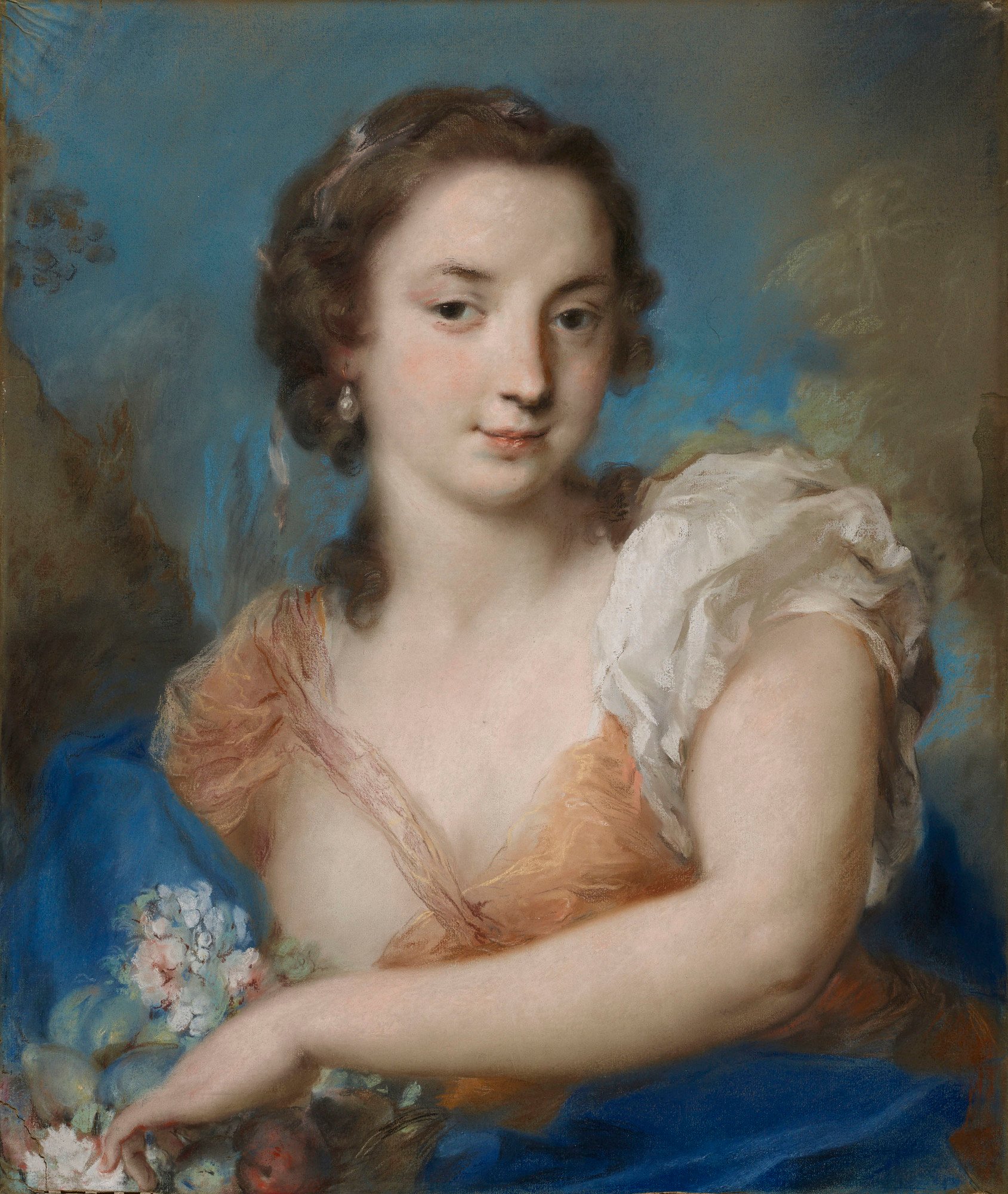
The Winter pastel by Rosalba Giovannia Carriera was acquired by George III, King of England. It entered the Royal Collection in 1762 as “a Beautiful Female covering herself with a Pelisse”. In traditional images Winter was typically shown as an old man, but Rosalba Carriera transformed the subject into a beautiful young woman. “Winter” was put on display in George III’s bedchamber at Buckingham Palace, alongside “Summer”.

Rosalba Carriera was born in Venice. She began her career as a painter of snuffboxes, but rose quickly to fame for her pastel portraits, which became highly desired across Europe. Carriera made several sets of allegories of the Four Seasons. The largest group of pastels by Carriera belonged to Frederick Augustus Elector of Saxony. Over 100 of her pastels were on display at his residence in Dresden in a ‘Rosalba Room’. The artist became blind in later life and died in 1757.

François Boucher (French, 1703–1770), The Four Seasons: Winter, 1755, 57x73cm, The Frick Collection, New York.

François Boucher painted this Winter from the series The Four Seasons in 1755 for Madame De Pompadour, King Louis XV’s long-term official mistress. Their original location is unknown, but their peculiar shape suggests that they were used as overdoors, no doubt in one of Pompadour’s many properties in France.

Instead of the hardship that traditionally illustrates the theme of winter, Boucher depicts a delightful encounter in joyous colours, a frosty background and a landscape buried under snow. A Tartar in pseudo-Russian dress pushes an elaborate sleigh with the heroine – most likely referring to Madame de Pompadour herself. Glancing out at us coyly, she sports a billowing fur-trimmed gown and a little fur necklace. Her hands may be warmed by a muff, but her upper body is completely exposed. This combination of luxury and seduction, treated in a fanciful and humorous manner, is typical of Boucher.

Étienne-Maurice Falconet (French, 1716 – 1791), Winter, c.1770, Marble, 135 cm, The Winter Palace, State Hermitage Museum, St Petersburg.

In April 1764, the 42-year-old Madame Marquise de Pompadour, the official chief mistress of King Louis XV of France unexpectedly died, and in the workshop of her beloved sculptor Etienne Maurice Falconet, the last of the statues she commissioned remained unfinished – the marble Winter, a young woman sitting on an ice cube and gracefully covering flowers with her robe.

A year later Falconet received an invitation from the Russian Empress Catherine the Great to work at her court. It was agreed that at the expense of the Russian treasury all unfinished work from the Falconet workshop would travel with him to Russia. And part of that deal was the unfinished “Winter” sculpture. Falconet completed “Winter” only 5 years after arriving in Russia. That’s how this statue, made by a French sculptor, ended up in the Winter Palace of the State Hermitage Museum in St Petersburg. Contemporaries of Falconet received the work as a masterpiece and the artist himself wrote: “This might be the very best work which I can do; I even dare to think that it is good.”

Jean Antoine Houdon (French, 1741 – 1828), Winter (La Frileuse), 1787, Bronze, 144x39x51cm, Metropolitan Museum of Art, New York.

L’Hiver or Winter is a bronze statue of a young woman cast by the neoclassical French sculptor Jean-Antoine Houdon. The statue personifies the winter season and is nicknamed La Frileuse, The Chilly Girl. This is reflected in both the medium (a cold, dark bronze) and the features of the sculpture, a young woman clad only in a shawl. Upon its completion and presentation at the 1787 Salon, the French yearly art fair, Winter shocked the French artistic establishment but delighted art lovers. The critics at the Salon indulged in some irony: “La Frileuse by Monsieur Houdon does not seem to achieve its effect. When someone is really cold, he tries to pull all his limbs close to him and covers his body more than his head. Nevertheless, it is pleasant to the eye and the proportions are correct” and “One must concur that winter would be a very desirable season if pretty shivering girls did not cover themselves in any other way.” Don’t think this critic will still have a job after saying this nowadays. In terms of her clothing, the Metropolitan Museum of Art describes it as “elegant but hardly adequate”. La Frileuse made me think of the song Let it Go from Frozen, “The Cold Never Bothered Me Anyway.”

The statue was bought by Louis Philippe Joseph, Duc d’Orléans, confiscated during the French Revolution and now in the Metropolitan Museum of Art, New York.

Paul Heermann (German, 1673 – 1732), Winter, c.1700, Marble, 65x64x34cm, Getty Center, Los Angeles. 

Shrouded in a heavy hooded cloak, this elderly man by Paul Heermann looks down with a deeply furrowed brow. As a personification of Winter, the bust gives visual expression to the chilling cold of that season. His old age refers to winter’s occurrence at the very end of the calendar year. This bust was probably part of a series of sculptures personifying the four seasons. At the Versailles Palace, it was fashion including statues of the seasons in the program for garden sculpture. The high level of finish and finely worked details of this bust, however, suggest that Winter was meant to be viewed up close, in an indoor palatial setting.

Jacob Matham (Dutch, 1571 – 1631) engraver, after Hendrik Goltzius (Dutch, 1558 – 1617) drawer, Winter, 1589, from the series The Seasons, engraving, diameter 26cm, National gallery of Art, Washington DC.

This Winter engraving has a very traditional iconography. The personification of Winter is an elderly man wearing a coat and warming his hands by holding a pot containing a fire; beyond is a wintery townscape with ice skaters and people collecting fire wood; the signs of the winter zodiac (Pisces, Aquarius and Capricorn) in the sky; and a cute little putto plays the cold Northern wind blowing into a cloud which results in rain and snow. And just so that we do not get it wrong, Hendrick Goltzius put the name “Hyems” just above the man, which is Latin for “Winter”.

Hendrick Goltzius designed four series with the seasons; Winter depicted here is from the set engraved by Jacob Matham.

The Four Evangelists

The Four Evangelists are the ones who wrote the four gospels in the New Testament, which is the second volume of the Bible. These gospels describe the life of Christ and are therefore in essence four times the same story but written by four different authors. The word “evangelist” comes from the Greek word εὐ-αγγέλιον (eu-angelion), which means “the good message”; εὔ = good, αγγέλιον = message. The word “angel” has the same origin and actually means “messenger”. The authors of these 4 gospel-books are the Saints Matthew, Mark, Luke and John.

Jacob Jordaens (1593 – 1678), “The Four Evangelists” (1625), 133x118cm, Oil on Canvas, Musée du Louvre, Paris.

The Four Evangelists are mostly depicted separately, but here is a 1625 painting by Jacob Jordaens in which they form a group. It’s clearly a group of four wise men, writing books. And therefore these can immediately be identified as the Four Evangelists. Identifying the individual evangelists is the next step. Each of them has his own symbol, and that’ the easy way to recognize them. That can be seen on the painting (c. 1614) by the Utrecht painter Abraham Bloemaert. Luke’s symbol is the ox, Mark has a lion, John his eagle, and for Matthew it’s an angel. It’s still the group of the Four Evangelists, together in one painting. But in most cases they are depicted in individual pictures, and as there are four of them, it’s excellent for series of four paintings, prints and even sculptures. Look for the ox, lion, eagle or angel and you know who is who.

Abraham Bloemaert (1566 – 1651), “The Four Evangelists” (c. 1614), 179x227cm, Oil on Canvas, Princeton University Art Museum.

Here are two Dutch Old Master prints from a series of the Four Evangelists. It’s Saint Matthew with the angel, and Saint John with the eagle. And both of them are receiving holy and spiritual inspiration for writing their gospel: the Gospel according to Matthew and the Gospel according to John. Prints from 1606 by Crispijn van de Passe after paintings by Gortzius Geldorp, 42x30cm, Engraving on Paper, Rijksmuseum, Amsterdam.