Recognizing saints in paintings is like solving a hidden picture puzzle, only the clues are palm branches, halos, arrows, a sword, a pilgrim staff, or even sometimes dogs! Once you know what to look for, every museum visit or church interior becomes a visual treasure hunt. This is about a visual language that painters used for centuries to tell stories and signal virtues. But it is not only about symbols. It is also about understanding the role these saints played in the lives of the people who venerated them. In the case of Sebastian and Roch, their images gave people hope and comfort during the darkest periods of the Black Death and recurring plague epidemics. These saints were more than just recognizable figures. They were spiritual companions in times of fear, loss and recovery.
In this crash course, we will meet two saints who are frequently and vividly depicted in western art: Roch and Sebastian. Once you know the tricks and symbols, you will start to see them everywhere and you will know exactly who they are. In short: Sebastian is the one pierced by arrows, Roch is the pilgrim lifting his tunic to reveal a swollen sore on his thigh, the visible sign of the plague disease.
The earliest written account of Sebastian’s life comes from a fifth-century text known as the Passio Sancti Sebastiani. According to this biography, Sebastian was a high-ranking Roman officer under Emperor Diocletian, around the year 300. Though he served at the heart of the Roman Empire, Sebastian was a committed Christian, using his position to support fellow believers and convert others. His defiance did not go unnoticed. When Sebastian continued to preach after being ordered to stop, Diocletian condemned him to death.
Sebastian was tied to a post and shot with arrows; so many that, according to the Passio, his body looked “like a hedgehog.” Remarkably, he survived. A Christian woman named Irene found him still alive, took him into her home, and nursed him back to health.
After being healed by Irene and rather than flee, Sebastian returned to confront the emperor and continue his mission. This time there would be no escape. He was beaten to death with clubs, and his body was thrown into a Roman sewer. Christians later recovered his remains and buried them in the catacombs along the Via Appia, a burial site that became an early pilgrimage destination.
Sebastian’s martyrdom was not just remembered, it grew! During outbreaks of plague in cities like Rome and Pavia, he became known as a powerful intercessor. People turned to him in desperation, hoping for protection or healing. Part of this devotion came from a visual connection: plague often brought painful skin lesions, which to the medieval eye resembled the wounds from arrows that pierced Sebastian’s body. Yet in his story, Sebastian miraculously survives these wounds. If he could heal, perhaps they could too. His body, punctured but intact, became a symbol of endurance and hope in the face of disease.
By the fifteenth century, as waves of plague, typhus, and dysentery overwhelmed European cities, his image spread rapidly in churches, chapels, and altarpieces. Sebastian was no longer just a martyr, but a solitary protector standing between humanity and divine interaction.
For Renaissance artists, Sebastian offered something else: the ideal male nude. His pierced yet miraculously preserved body gave painters a sacred excuse to explore human anatomy, grace, and even sensuality. Painters emphasized his physical beauty, strength, and sometimes his erotic vulnerability. Over time, Saint Sebastian became a complex figure: part Roman soldier, part Christian martyr, part symbol of erotic endurance.
The figure of Irene, who rescues and heals him, became popular in art during the Counter Reformation. She brought a renewed focus on compassion and quiet heroism, a contrast to the spectacle of violence. Her inclusion also emphasized that Sebastian’s story was not just about suffering, but about survival, healing, and of course about unshakable faith.
Saint Roch: the plague pilgrim and his faithful dog
According to tradition, Roch (or Rocco or Rochus) was born around 1348 in Montpellier, just as the Black Death was sweeping across Europe. Orphaned young, he gave away his inheritance, took up the pilgrim’s staff, and devoted himself to caring for plague victims as he traveled through France and Italy. Wherever he went, the sick recovered. His healing touch — and his refusal to abandon the afflicted — made him a figure of immense compassion and courage.
But his life of service eventually turned against him. In the city of Piacenza, Roch himself caught the plague. To avoid infecting others, he withdrew into the forest, prepared to die alone. There, a small miracle occurred: a dog appeared daily, bringing him bread and licking his wounds. Artists portrayed him as a weary pilgrim, often lifting his tunic to reveal a swollen sore on his thigh, the visible sign of plague. He is nearly always accompanied by his faithful dog, a symbol of loyalty, compassion, and daily grace.
Once healed, Roch returned to Montpellier. But his suffering was not over. Mistaken for a spy and unrecognized, he was thrown into prison, where he eventually died. Like Sebastian, Roch became one of the great plague saints of the Renaissance. He was the saint who had been there, not struck down in noble martyrdom, but sick, rejected, exiled, and healed. That made him deeply relatable. For many, he offered a vision of healing and survival through suffering.
His popularity surged during the Counter Reformation, especially in Catholic countries. He appeared in altarpieces, processions, and protective prints, sometimes shown receiving divine inspiration from an angel or being appointed by Christ himself as patron of the plague-stricken.
In Rubens’ dramatic vision, Roch is formally appointed by Christ himself as the patron of the plague victimes. In the upper part of the panel, we see an angel who holds a tablet with the inscription “Eris in peste patronus” which means “You will be the patron in times of plague.” In the lower part of the painting, figures suffering from the disease implore the saint’s protection.
Companions in crisis: Saint Sebastian and Saint Roch together
As plague returned again and again to Europe between the fourteenth and seventeenth centuries, artists and worshippers turned not to one protector, but to two. Saint Sebastian and Saint Roch began to appear side by side, in altarpieces, processions, chapels, and prints, forming a kind of alliance in the battle against disease.
The pairing made sense. Sebastian had endured violence and lived, if only briefly. Roch had fallen ill and survived. One was pierced, the other wounded. Both had skin lesions, which was so very recognisable for the ones suffering from the plague. Artists often placed them at either side of the Virgin and Child, turning them into protective witnesses for the sick and the fearful.
Once you know the clues, it’s easy to identify Sebastian and Roch. The first one with the arrows, tied up and pierced; Roch, the second one, the pilgrim with a swollen plague-sore on his thigh. Sebastian’s idealized, youthful body stands for sacrifice and beauty even in suffering. Roch’s older figure emphasizes humility and compassion. And both of them are on a path of recovery.
Together, they became companions in crisis. In times of fear, they offered a sense that the suffering had been seen, shared, somehow sanctified, and maybe even healed! A visual and spiritual double act, shaped by public need for hope and support in the dark days of the Black Death.
Bonus: Sebastian, Resurrection, and the path to Heaven.
As a bonus, let’s have a look at Sebastian on the Triptych of The Resurrection (c.1490) by Hans Memling from the Louvre, Paris. Three panels, and showing from left to right the path from suffering to heaven.
On the left panel, Sebastian is being pierced by arrows. That is the figure with whom the viewer suffering from the plague or disease might identify. Moving to the central panel, we see the resurrection of Christ from death. That must have given hope to beat the plague and rise and shine again. And to complete the path to healing and salvation, look at the panel on the right, with the ascension into heaven. You can just see Christ’s feet dangling in the top part of the panel, ascending into heavenly light.
So when you suffer from the plague, read this triptych from left to right. Hope to resurrect from the disease and heal. Or alternatively, ascend into heaven. Either way, a happy ending!
Meet Hercules! After writing about Perseus, I now turn to Hercules, another legendary son of Zeus, also born of a mortal mother. Like Perseus, Hercules belongs to the pantheon of Greek mythological heroes, but where Perseus is celebrated for his wit and cunning, Hercules is all about brute strength and unstoppable physical power. How can you recognise him in art? Look for bulging muscles, a hefty club, and the skin of the Nemean Lion; more on that last detail later.
Hercules is his Greek name; in Roman mythology, he’s known as Heracles. He’s most famous for the epic series of challenges known as the Twelve Labors, a set of nearly impossible tasks, each involving a monstrous creature or a supernatural trial. In this TAB: The Art Bard story, I’ll focus on three of his Labors: his battle with the Nemean Lion, his wrestling match with Antaeus, and his descent into the underworld to capture Cerberus, the terrifying three-headed hound of Hades.
But before we get to those heroic feats, let’s take a moment to look at Hercules’ extraordinary infancy, a childhood that already hinted at the hero he would become. It’s also the story behind nothing less than the creation of the Milky Way!
Consider this post both an introduction to Hercules and another crash course in Greek mythology. Let’s begin!
The Baby Who Bit a Goddess: Hercules and the Milky Way
According to Greek myth, Heracles was the illegitimate son of Zeus, king of the gods, and the mortal woman Alcmene. Zeus was married to Hera, queen of the gods, and his countless affairs with mortals enraged her. Heracles, born of one such affair, became a particular target of Hera’s wrath.
Yet Zeus had a bold plan to make his mortal son invincible: he secretly placed the baby at Hera’s breast while she slept, hoping the divine milk would grant him immortality.
But Hera awoke. The infant Heracles bit her nipple with such force that she screamed and pushed him away. As the baby tumbled back, her milk sprayed across the heavens, creating what we now see in the night sky as the Milky Way.
In Rubens’ painting, Zeus watches the scene unfold, his thunderbolts symbols resting at his feet.
The Baby Hercules vs. the Snakes
Another famous story tells of the night when two snakes slithered into Hercules’ cradle. They weren’t there by accident. They were sent by Hera, Zeus’s long-suffering wife, still furious about her husband’s affair with the mortal woman Alcmene, which had produced the illegitimate child Hercules.
Hera’s plan was simple: let the snakes do the dirty work and get rid of the child once and for all. But things didn’t go as she hoped. Hercules, still just a baby, grabbed the snakes with his bare hands and strangled them effortlessly, treating the deadly serpents like harmless toys.
According to Greek myth, Heracles was condemned to perform twelve nearly impossible tasks, known as the Twelve Labors, as a form of penance. Driven mad by Hera, he had killed his wife and children. Overcome with grief, he sought purification and consulted the Oracle of Delphi, who instructed him to serve King Eurystheus for twelve years. It was Eurystheus who assigned him the twelve labors, each one more dangerous and degrading than the last.
This punishment was part of Hera’s ongoing vendetta. Not only had she caused his madness, but the labors themselves were designed to humiliate and destroy him. Yet instead of breaking him, these trials became the very deeds that secured Hercules’ fame and turned him into a legend.
Hercules’ first task sent him to the hills of Nemea to slay a monstrous lion that had been terrorizing the region. But this was no ordinary beast. The Nemean Lion’s golden coat was invulnerable to weapons; neither sword nor arrow could pierce it. When Hercules discovered this, he did something only he could do. He trapped the lion inside its cave and wrestled it bare-handed. After a brutal struggle, he choked it to death with his immense strength. When the battle was over, he tried to skin the lion. But even in death, its pelt resisted every blade.
Unable to cut through the pelt with his knife, Hercules used the lion’s own claw to flay the beast. Razor sharp, the claw was said to pierce any soldier’s helm or shield. He then draped the invulnerable pelt over his shoulders, wearing the gaping lion’s head like a hood. From that moment on, the lion skin became part of his iconography and a lasting symbol of Hercules’ brute strength.
The Eleventh Labor: wrestling with Antaeus on the way to the Garden of the Hesperides
The wrestling match between Hercules and Antaeus became a legendary detour on his way to the Garden of the Hesperides, where he had to steal the golden apples.
Antaeus, a giant son of Gaia, the Earth goddess, had an unfortunate habit of challenging every traveler to a wrestling match. And winning! His secret was simple: as long as he remained in contact with the ground, and thus with Gaia his mother, the earth itself renewed his strength. Wrestling, after all, is about pinning your opponent down. But Hercules, no stranger to thinking as well as fighting, realized where Antaeus drew his power from. So he did the opposite. He lifted the giant high into the air, breaking his bond with the earth, and crushed him in a powerful embrace.
This scene became a favorite among artists in the Renaissance and Baroque periods. It gave them the perfect excuse to show off: two muscular bodies intertwined in violent motion. The struggle between Hercules and Antaeus offered not just a tale of brute strength, but also a clever mythological riddle and a glorious opportunity to turn male anatomy into art.
The Twelfth Labor was the most terrifying of all. Hercules had to descend into Hades, the Greek underworld, and bring back its guardian beast, the fearsome three-headed dog Cerberus.
Cerberus was the creature Hercules was sent to capture, not to kill, but simply to borrow and display. Like a mythical dog-walker, he descended into Hades, wrestled the beast into submission with his bare hands, and dragged it up into the land of the living. For a brief moment, Cerberus was paraded through the court of King Eurystheus as living proof of Hercules’ impossible strength, before being politely returned to his post in the land of the dead.
In the old Greek mythological days, one might have pictured Hercules standing at the brink of the underworld, just like the lone soul in the boat in Joachim Patinir’s haunting painting Charon Crossing the Styx (c. 1520, Prado, Madrid). Charon, the ferryman, guides his boat across the dark waters of the river Styx, the shadowy boundary between life and death. On one side of the river, a narrow, rocky side stream winds upward toward a glowing paradise, guarded by angels. On the other, a broad and inviting channel leads straight into what looks like a pleasant place but is, in fact, the gaping mouth of Hell, or Hades in the Greek tradition.
Charon, the grim ferryman of myth, rows his silent passenger toward a final judgment. But look closely at the right bank. Just before the gate of the underworld crouches a monstrous figure. This is Cerberus, part bulldog, part nightmare. The three-headed hound of Hades sits at the infernal threshold, ensuring that no soul may ever escape. In this Christianized vision of a Greek myth, Cerberus appears like a devil’s watch-dog, trapped in a kind of kennel at the entrance to eternal darkness.
The question of who pays the ferryman has echoed far beyond ancient myth. In Greek tradition, Charon demands a coin from each soul before granting passage across the river Styx. Without payment, there is no crossing, only a restless afterlife on the shadowy banks. The phrase found new life in the 1977 BBC series Who Pays the Ferryman?, set in Crete and centered on Alan Haldane, a British former soldier haunted by the moral debts of war and love. Just as Charon rows through the waters of Patinir’s painting, ferrying a soul toward judgment, the title reminds us that no crossing, whether into Hades or into memory, comes without its price.
Who Pays the Ferryman? BBC television series, 1977, theme composed by Yannis Markopoulos (Greek, 1939 – 2023).
The myth of Antaeus did not just inspire Renaissance painters and sculptors. It also found its way into the world of modern fragrance. In 1981, Chanel launched Antaeus, one of its first perfumes created specifically for men. In Chanel’s words: “Named after the mythological Greek giant who was invincible only as long as his feet remained on the ground, Antaeus is an intense yet subtle, smooth and rich fragrance that tells the story of a hero both virile and vulnerable.”
Antaeus, Pour Homme, Chanel, 1981.
A personal note. This was my very first perfume. I still remember the iconic 1980s advertisement: a sculpted male torso, arms raised in triumph, lifting the Antaeus bottle like a trophy or sacred object.
And it is only now, while writing this story about Hercules and Antaeus, that I realise the Chanel perfume was indeed named after the mythological giant, and that the visual imagery of the advertisement is a direct contemporary echo of the ancient tale. Learning by going.
After exploring prophets, sinners, and saints from the Biblical tradition, it’s time to turn back to the world of Greek mythology. Let’s start with two of its most iconic figures: Perseus and Medusa. Her story resonates today as a #MeToo narrative; his tale reads like the script of a modern superhero film. Greek myths may be older than the Bible, but the themes they carry, such as good versus evil, justice for the wronged, and the quest for hope, are timeless. So let’s dive in.
To give some context, I’ll introduce the two main characters, Perseus and Medusa, before following Perseus through his adventures, from his miraculous birth as the child of one of Zeus’ escapades to his dramatic wedding with Andromeda. The topics we’ll explore are:
The recurring theme: a busy life for our superhero and the eternal struggle between good and evil.
The Main Characters: Perseus and Medusa
Perseus is one of the prominent heroes in Greek mythology. Unlike some other Greek heroes, his strength did not rely solely on brute force but also on inner qualities like courage and determination. He was the son of Zeus, king of the gods, and Danaë, a mortal princess. Perseus is best remembered for slaying Medusa and for rescuing Andromeda from a sea monster.
Medusa, once a beautiful priestess in the temple of Athena, is one of the tragic figures in mythology. She was raped by Poseidon in Athena’s sacred temple. Because the act defiled a holy space, and possibly because Medusa had boasted of her beauty, Athena punished her by transforming her flowing hair into venomous snakes. And from that moment on, anyone who looked directly at Medusa would be turned to stone.
Poseidon, the rapist, went unpunished. It was the victim who bore the consequences. We do not know if Poseidon felt guilt or ever faced the weight of what he had done. What we do know is that Medusa became the embodiment of female suffering, even labeled a monster. Her transformation has come to symbolize the way women are punished or demonized. In today’s world, Medusa’s story is often reinterpreted through the lens of the #MeToo movement, challenging us to consider who the real monster truly was.
Perseus was born under remarkable and mysterious circumstances. His mother was Danaë, a mortal princess and daughter of Acrisius, the king of Argos. Acrisius, obsessed with control and fearful of fate, had received a chilling prophecy: one day, he would be killed by his own grandson. To stop this from happening, he locked Danaë in a bronze chamber, isolated high in a tower, where no man could reach her.
But the gods, as always in Greek myth, find a way. Zeus, king of the gods, saw Danaë and desired her. Taking the form of a shower of gold, he entered her prison and impregnated her. In time, Danaë gave birth to a son, whom she named Perseus.
When Acrisius discovered the child, he was furious and terrified. Yet he couldn’t bring himself to kill his own daughter and her infant directly. Instead, he sealed them in a wooden chest and cast them out to sea, leaving their survival to fate. But Zeus watched over them!
The sea carried Danaë and Perseus safely to the island of Seriphos, where a kind fisherman named Dictys took them in. Dictys raised Perseus as his own, and the boy grew into a brave and spirited young man.
(A note from the future: many years later, when Perseus had grown into a man, he took part in the Olympic Games. During a discus throw, his aim went astray and struck down a spectator. That man was none other than King Acrisius, his own grandfather. The prophecy Acrisius was so afraid of was fulfilled, by a tragic accident. But that lies far ahead in the story. For now, we return to the adventures of Perseus as a youth.)
As Perseus matured, he became fiercely protective of his mother. Her beauty had not faded, and it attracted the unwanted attention of many men, including the island’s ruler, King Polydectes. Polydectes was aggressive and arrogant, and he was determined to marry Danaë, whether she agreed or not. Perseus saw through him immediately and did everything he could to protect his mother.
Frustrated, Polydectes devised a plan to get Perseus out of the way. He announced he was marrying someone else and demanded that all his subjects bring him wedding gifts. Perseus, relieved that his mother wasn’t the bride, promised to give Polydectes whatever he wanted. The king seized the opportunity and asked for something outrageous: the head of Medusa, whose gaze could turn anyone to stone.
Perseus agreed, though he had no idea how he would complete such an impossible task.
Help from Athena and Hermes
To carry out the impossible task of killing Medusa, Perseus received crucial help from two gods: Athena, goddess of wisdom, and Hermes, the swift messenger of the gods.
Athena gave Perseus a highly polished bronze shield. It would allow him to see Medusa’s reflection without looking directly at her. A pretty vital move, since anyone who met her gaze would instantly turn to stone. Hermes provided him with winged sandals, enabling him to fly, and a sharp curved sword.
With Athena’s guidance and Hermes’s gifts, Perseus was ready to face the deadly Medusa. He flew to her, used the mirror-like shield to watch her movements, and without ever meeting her eyes, struck with precision. In one swift motion, he cut off her head, snakes and all.
As Perseus struck off Medusa’s head, something extraordinary happened. From the blood that poured from her neck, a winged horse sprang forth. This was Pegasus, who became Perseus’s loyal companion.
Perseus now carried two powerful tools. One was the head of Medusa, which still had the power to turn anyone who looked at it into stone. The other was Pegasus, the magical horse who could fly. With these, Perseus began his journey home. He planned to return to Seriphos, confront King Polydectes, and reunite with his mother Danaë.
But the way back would not be simple. Like many heroes, Perseus would face new challenges on the road. Each test would reveal more of his courage, his cleverness, and his sense of justice.
Atlas becomes a mountain
On his journey home, Perseus grew tired and stopped to rest in a distant land. This place was ruled by Atlas, a mighty giant who stood guard over a sacred garden. Perseus asked for shelter, explaining that he was the son of Zeus. But Atlas remembered a prophecy that warned him a son of Zeus would one day steal the golden apples from his garden. Fearing the prophecy, Atlas refused to let Perseus stay.
Perseus did not argue. Instead, he reached into his bag and pulled out the head of Medusa. When Atlas looked upon it, he was instantly turned to stone. His great body became part of the earth. His beard and hair turned into forests. His shoulders and arms became ridges and cliffs. His head rose into the sky as a high mountain. This, according to legend, is how the Atlas Mountains in Morocco originated and came to be named after the giant Atlas.
Perseus and Andromeda
As Perseus traveled home, riding the winged horse Pegasus, he flew over the coastline of ancient Ethiopia. There, he saw a young woman chained to the rocks at the edge of the sea. Her name was Andromeda. She had been left as a sacrifice to a sea monster, sent to punish the land for her mother’s pride. Her mother, Queen Cassiopeia, had once claimed that Andromeda was more beautiful than the sea spirits. This angered Poseidon, god of the sea. In revenge, he sent a terrifying monster to attack the coast. The only way to stop the destruction, the people believed, was to offer Andromeda to the creature.
Perseus was struck by Andromeda’s beauty, and he made a promise to save her. As the sea monster rose from the waves, Perseus flew into action. Riding Pegasus, he waited for the perfect moment. Then, at just the right time, he pulled Medusa’s head from his bag. The monster looked…, and instantly turned to stone.
Andromeda’s parents, the king and queen, were filled with gratitude. Perseus asked for Andromeda’s hand in marriage, and she agreed. Together, they would set off for his homeland. But their story was not over yet.
Wedding of Perseus and Andromeda, and Phineas as unwanted guest
After rescuing Andromeda, Perseus was welcomed as a hero. The wedding was quickly arranged, and the royal palace filled with celebration. But not everyone was pleased. At the height of the feast, an angry voice echoed through the hall. It was Phineus, Andromeda’s former fiancé. He stormed in with a group of armed men, furious that the bride had been given to another. He shouted that Andromeda had been promised to him, and that Perseus had stolen her. Tension rose. The joyful feast turned into chaos. Phineus and his followers attacked. Perseus tried to fight them off, but he was badly outnumbered.
Then, as a last resort, Perseus reached for the most fearsome weapon he had: the severed head of Medusa. Holding it aloft, he turned his gaze away. The attackers, caught mid-charge, had no time to look away. One by one, their bodies froze in place. Faces twisted in rage, weapons raised, they turned to cold, silent stone. The room fell quiet. Phineus was no more. The threat was over. The marriage of Perseus and Andromeda could finally begin in peace.
Saving his mother Danaë, and confronting Polydectes
After his adventures abroad, Perseus returned home to the island where he had grown up. But all was not well there. His mother, Danaë, was still being harassed by King Polydectes, who had never given up his attempts to force her into marriage. She had taken refuge in the temple of Athena, hiding from the king’s relentless advances.
Perseus went straight to the palace and confronted Polydectes. Without a word, Perseus pulled the head of Medusa from his bag. Polydectes and his supporters, unprepared and arrogant, looked straight at it and turned to stone. With justice served and his mother finally safe, Perseus restored peace to the island.
Medusa’s head on Athena’s shield
After the sea monster was killed, Andromeda and his mother Danaë saved, and justice delivered, Perseus fulfilled one last promise. He returned the head of Medusa to Athena, the goddess who had guided him on his quest.
Athena took the powerful object and placed it at the center of her shield. From then on, Medusa’s stony gaze would serve to protect. It would turn away evil, and remind all who saw it of the strength found in wisdom and courage.
So what do we make of Perseus? Like Daniel from the biblical tradition, he is not a hero of brute force but of cleverness, courage, and integrity. Both are young men who rise to great challenges with the help of higher powers, whether divine faith or Olympian favor. They confront arrogant rulers, monsters in both human and mythic form, and they stand up for those who cannot protect themselves.
The stories of Perseus are older than the Bible, mythological in form, but in essence they tell the same tale: that justice can prevail, and that even in dark times, there is hope for the oppressed. Daniel’s story, though biblical in origin, mirrors these ancient myths in spirit. Both narratives teach us that the powerful who act with pride and hubris will be humbled. Both reveal a world where integrity matters more than might. And both reassure us that in the end, with the help of God or the gods, peace can be restored.
Bonus: Versace!
Now from myth to Milan! The famous fashion house Versace uses the head of Medusa as its logo, a direct nod to Greek mythology. The choice wasn’t random. As children, the Versace siblings played among ancient ruins near Reggio Calabria in southern Italy. There, on an old mosaic floor, they encountered the image of Medusa.
Gianni Versace chose Medusa as the brand’s emblem. In myth, those who looked at her were turned to stone. In fashion, he hoped those who looked at his designs would be equally spellbound and captivated. Unlike Perseus, who avoided her gaze, we are drawn to it willingly, mesmerized. Carefully of course, because style and beauty can petrify!
Now that I’ve written about Jeremiah and Isaiah, it’s time to turn to Daniel and Ezekiel. These four are known as the Major Prophets, meaning they each have a full “major” book named after them in both the Hebrew and Christian Bibles. Ezekiel is a challenge, though. His visions are so abstract that they’re hard to picture, which makes him a tricky subject for visual storytelling.
Daniel, on the other hand, had plenty of adventures, and artists have loved depicting them in paintings and prints. Drama galore! He’s not always seen as a traditional “prophet” in the sense of an old wise man foretelling the future, but Daniel was definitely a visionary, and young and beautiful, and a smart cookie too! Here are some of the stories around Daniel, brought to life through art. Enjoy!
First some background on Daniel: He was part of the Jewish nobility in Jerusalem, but taken into exile when the Babylonians, under King Nebuchadnezzar, attacked and destroyed the city in 586 BC and looted its grand temple. Daniel and many others were deported to Babylon. Despite being a foreigner in exile, Daniel rose to a respected position at the royal Babylonian court, thanks to his intelligence and striking beauty.
A recurring theme in these stories is the downfall of rulers who abuse their power, and the triumph of justice. Daniel is on our side with his patience, wisdom and moral courage.
In Salomon Koninck’s Daniel before Nebuchadnezzar (c.1630), we see the young exile Daniel standing calmly before the powerful Babylonian king, counting to four on his fingers as he explains the king’s troubling dream that none of the royal wise men, seen on the left searching in books, could decipher. The king had dreamt of a giant statue made of four materials: a golden head, silver chest, bronze torso, and legs of iron mixed with clay. The statue was terrifying in appearance, until a mysterious stone struck it and shattered it to dust. Daniel reveals that the statue represents a succession of kingdoms, with Nebuchadnezzar’s own Babylonian empire as the golden head, and each one destined to fall.
The dream’s deeper meaning would unfold over generations. Babylon eventually fell to the Medes and Persians, just as Daniel had foretold. Koninck’s painting captures the quiet authority of Daniel among the king’s scribes, as the young visionary reveals that even the most powerful rulers are subject to the judgment of time and of something greater than themselves.
This story remains a warning to rulers of all eras not to overreach in their power, because pride and arrogance are always destined to fall, even for the mightiest people on earth.
The Writing on the Wall
Now to the next story, about King Belshazzar, a successor of Nebuchadnezzar. Belshazzar once held a lavish feast, using the sacred gold and silver vessels that had been looted from the temple in Jerusalem, Daniel’s homeland. At the height of the party, a mysterious hand appeared and began writing glowing words on the wall. No one could interpret them, so Daniel was summoned. He was the only one who understood the message: “mene, mene, tekel, upharsin”.
Daniel explained it as a divine judgment, and told King Belshazzar that this is what it means:
Mene means numbered, the days of your reign are numbered, and they are ended.
Tekel means weighed, you have been weighed and found wanting, you have failed the test.
Upharsin means divided, your kingdom will be divided and given to the Medes and Persians.
The message foretold the fall of Belshazzar and the end of the Babylonian kingdom. Daniel warned the king that by arrogantly flaunting the temple treasures and ruling with excess and pride, he had sealed his own fate. That very night, Belshazzar was killed, and the Persians took control of Babylon.
Rembrandt’s Belshazzar’s Feast captures this moment of divine intervention with dramatic intensity. The story remains a warning to rulers who govern with arrogance and disregard for justice. It also offers a quiet message of hope to the oppressed: power built on pride will not last, and justice will come in time.
The saying “the writing on the wall” comes directly from this dramatic moment in the Book of Daniel. In Dutch: een teken aan de wand.
The phrase “weighed and found wanting,” meaning “evaluated (weighed) and found to be lacking,” also comes from this same passage — the mysterious words Mene Mene Tekel Upharsin. In Dutch: gewogen en te licht bevonden.
Now to one of Daniel’s own dreams, in which he sees four strange beasts rising from a stormy sea. Disturbed by the vision, Daniel asks an angel to help him understand what it means. The angel explains that the four beasts represent four successive empires: the lion with eagle’s wings is often interpreted as Babylon, the bear as the Medo-Persian Empire, the leopard with four wings as Greece under Alexander the Great, and the final terrifying beast with iron teeth and ten horns as the Roman Empire.
Even the most fearsome of these, the monstrous last beast representing the Roman Empire, is destined to fall. Once again, the message is clear: no kingdom lasts forever.
This is a warning to rulers to govern with humility, not through violence or intimidation like the beasts of the vision, which rule with claws and teeth.
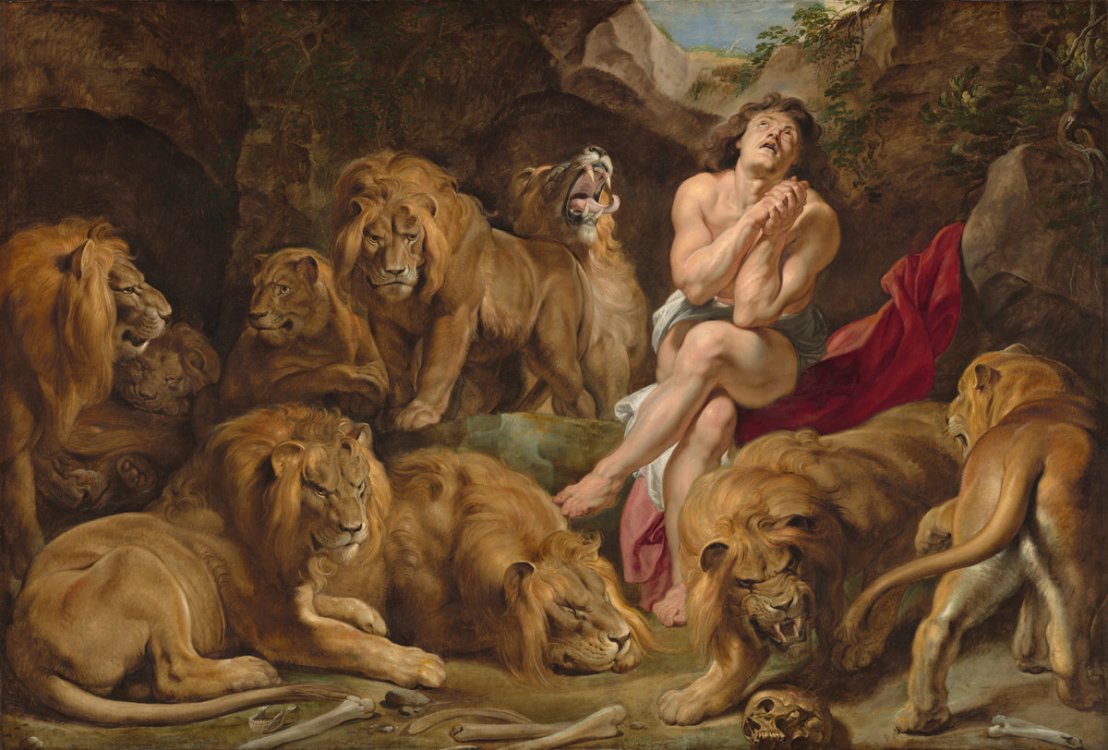
Daniel’s next adventure, and perhaps the most well-known, is his stay in the lions’ den. Rubens’s powerful painting in the National Gallery in Washington brings this dramatic moment to life with vivid realism.
So what happened? Daniel had become a favored advisor at the court of King Darius (or Cyrus, depending on the source), the Persian ruler who succeeded the Babylonians. But jealous rivals plotted against him. They tricked the king into issuing a decree that, for thirty days, no one could pray to any god or person except to King Darius himself. Anyone who disobeyed would be thrown to the lions. Devout as ever, Daniel continued to pray to his own God, the God of Israel. Though Darius admired Daniel and regretted the trap he had fallen into, he was bound by the law of the Medes and Persians, which could not be changed.
Daniel was thrown into the lions’ den. He kept praying, and help came in the form of the prophet Habakkuk, who was miraculously transported to Daniel with food – carried by an angel who lifted him by his hair (see the manuscript illustrations, and the engraving hereunder).
After a week, Darius had the den opened, and to everyone’s astonishment, Daniel was still alive and unharmed. The king rejoiced, and justice was swiftly served: Daniel’s accusers were thrown into the lions’ den in his place.
The moral? However hard the trial, and however hopeless the outcome may seem, faith and perseverance can lead to a just resolution. For Daniel, this meant both survival and vindication. The story remains a symbol of hope and courage. In modern terms: even when those in power make life miserable, keep your faith and hold your head high. A day of justice will come.
Now we turn to Susan and the Elders, which story remains startlingly relevant today. At its heart is a woman wrongly accused by two powerful men after she refuses their sexual advances. Her integrity is put on trial, her word weighed against that of respected elders. Yet she does not give in. Susanna chooses to speak, knowing the cost. It is a story of courage, the abuse of power, and ultimately, of justice, thanks to the young Daniel, who intervenes with clarity and moral insight. By cross-examining the two elders separately, Daniel uncovers their lies: each gives a contradictory account of the scene, revealing their falsehood and exposing their guilt. The story concludes with Susanna’s vindication and the elders’ downfall.
In the story, after Susanna refused their sexual advances, the elders sought revenge by claiming they had caught her committing adultery with a young man in her garden. According to the law at the time, adultery was punishable by death, and the testimony of two respected elders carried great weight. Their accusation was intended to destroy her reputation and life, but Daniel’s intervention ultimately revealed the truth and saved her.
Centuries later, this story continued to inspire artists, particularly in the Baroque period. Rembrandt’s Susanna and the Elders (1647), housed in the Gemäldegalerie in Berlin, captures a moment of vulnerability and fear. In contrast, Artemisia Gentileschi’s Susanna and the Elders (c.1610) is strikingly defiant. Painted when she was only seventeen, Artemisia – herself a survivor of sexual violence – transforms Susanna into a figure of resistance. Today, her version speaks with particular force, not only because of its raw visual intensity, but because the artist’s own trauma echoes through her entire oeuvre.
In the context of the MeToo movement, the story of Susanna feels painfully modern. A woman is cornered, threatened, and disbelieved by those in power. Yet she refuses to yield. With Daniel’s intervention, truth is reclaimed and the false accusers are unmasked. This ancient tale becomes, in today’s terms, a parable of resistance and the enduring hope for justice, even against overwhelming odds.
Yet we must also look critically at how this story has been visualized, especially in the Baroque era. For many male artists, including Rubens and Rembrandt, Susanna and the Elders became a pretext for painting the nude female body under the guise of a biblical subject. Susanna is often shown at her most vulnerable, surprised in the bath, exposed not only to the leering elders but also to us, the viewers. This dynamic implicates the audience, making us – consciously or not – silent participants. From a contemporary perspective, especially in light of #MeToo, we must ask: are we seeing Susanna through the eyes of Daniel, or through the eyes of the elders?
Daniel urges us to shift our perspective, from complicity to conscience. When we look at these artworks, we are invited not just to witness injustice, but to side with justice. Daniel’s judgment is not merely a narrative turning point, it is a call to the viewer: to recognize the abuse of power, to listen to the vulnerable, and to believe that justice, though often delayed, will prevail.
Daniel exposed the elders by separating them and asking each under which tree they had seen Susanna commit the alleged act. One claimed it was under a small mastic tree, the other said it was a big oak. Their conflicting answers revealed their lie, proving that their accusations were false and leading to Susanna’s vindication and the elders’ punishment, which was quite harsh in the days of Daniel, but also in the days when these engravings were made.
Daniel exposes the corruption of the priests of Bel
The next one is how Daniel exposes the corruption of the priests of Bel, one of the gods (or idols) in the land of king Darius (or Cyrus, depending on the source of the story). It’s a lesser-known but sharp story about uncovering corruption.
In this scene, King Cyrus of Persia, at the center, questions Daniel about his refusal to worship the god Bel, whose statue looms in shadow on the right, you can see the legs of the big statue. Cyrus insists Bel is a living deity, pointing to the daily offerings of food and wine that mysteriously vanish each night. Daniel calmly replies that bronze statues do not eat. The story takes a playful turn, this powerful king believes the idol consumes the offerings! But Daniel is about to expose the truth. What really happens to the food and wine? The answer reveals not just a trick, but a deeper tale of fraud, corruption, and the courage to speak truth to power. Daniel and Cyrus before the idol Bel (1633), Rembrandt van Rijn (1606 – 1669), Oil on panel, 24x30cm, Getty Center, Los Angeles.
In Babylon, there was a magnificent temple dedicated to the god Bel (or Baal), where the people believed the statue of the god consumed great daily offerings of food and wine. Every day the people offered the most tasteful dishes and the most wonderful wines. And next day the food and wine was always gone. King Cyrus was a devout believer and asked Daniel why he did not worship Bel like everyone else. Daniel replied that Bel was only a statue made by human hands and that it could not eat or drink. To prove otherwise, the king challenged Daniel: if the food was indeed not eaten by Bel, the priests would be executed. But if Bel had eaten it, Daniel would be punished.
That night, the king sealed the temple doors after the offerings were placed inside. But Daniel had secretly scattered ashes on the temple floor. Next morning, the food was gone, yet the floor revealed footprints leading to a hidden door under the altar tabel and a secret entrance in the corner of the temple. It turned out the priests and their families had been sneaking in at night to eat the offerings themselves. The king, shocked at the deception, had the false priests removed, and the temple of Bel was destroyed.
Hereunder four engravings that tell the story in a comic-book style.
The lesson, also for today in our own time and place! Even the most sacred institutions can be corrupted from within. Daniel’s calm wisdom once again uncovers the truth. Faith and trust, combined with reason, has the power to expose lies and uphold justice.
Closing remarks
A note on the Book of Daniel and the Bible in general. Many people do not realize that the Catholic and Protestant Bibles are not exactly the same. The stories of Daniel exposing the corruption of the priests of Bel, his intervention in the case of Susanna and the Elders, and Habbakuk delivering food when Daniel is in the lions’ den, are perfect examples of this difference. These stories are part of the so-called “Additions to Daniel,” which are included in the Catholic Bible but not in the Hebrew Bible and not in the Protestant Old Testament. In most Protestant traditions, they are considered apocryphal, meaning additional or non-canonical. So depending on which Bible you are reading, you might or might not find these stories at all.
A moral remark as final closing: What can we take from Daniel’s stories today? Perhaps this: all empires, whether Babylonian, Persian, Greek, Roman, or others from Daniel’s time to our own, no matter how powerful, eventually collapse under the weight of their own excess. Any leader who overreaches, who rules with arrogance or deception, is destined to share in that downfall. The stories in Daniel’s book reveal a pattern. When power is worshipped for its own sake, it corrupts systems, turning them into something beastly, inhumane, and blind to truth. Daniel also teaches patience. Injustice and oppression do not end quickly, but they do end. In time, those who do harm, whether by abusing power or silencing the innocent, will face their reckoning. And on a more personal level, Daniel shows us what it means to live with integrity in unfamiliar circumstances, to hold your head high and trust in justice, even when you are in exile or a stranger in a strange land.
Bonus
I can’t resist adding a little bonus here, partly because this scene is so full of drama, and partly because it features two remarkable statues by my favourite sculptor Bernini, in the Chigi Chapel in Rome.
One statue shows Daniel in the lions’ den, praying to God. A lion is at his feet, even licking one of them, emphasizing Daniel’s divine protection. Across from him, in a niche on the opposite side of the chapel, we see the prophet Habakkuk. He’s seated on a rock, his lunch basket beside him, pointing in the direction he wants to go. But the angel has other plans! Leaning out of the niche, the angel lifts Habakkuk by the hair and points decisively toward Daniel, guiding him to bring food to the imprisoned prophet. Bernini composed these two figures as part of a larger program within the Chigi Chapel, connecting them visually and theologically. It’s a sculptural narrative drawn from from the apocryphal additions to the Book of Daniel.
Here’s the full passage featuring Habakkuk and the miraculous food delivery. Read and enjoy!
Daniel 14:33-39

Now the prophet Habakkuk was in Judea; he had made a stew and had broken bread into a bowl, and was going into the field to take it to the reapers. But the angel of the Lord said to Habakkuk, “Take the food that you have to Babylon, to Daniel, in the lions’ den.” Habakkuk said, “Sir, I have never seen Babylon, and I know nothing about the den.” Then the angel of the Lord took him by the crown of his head and carried him by his hair; with the speed of the wind he set him down in Babylon, right over the den.

Then Habakkuk shouted, “Daniel, Daniel! Take the food that God has sent you.” Daniel said, “You have remembered me, O God, and have not forsaken those who love you.” So Daniel got up and ate. And the angel of God immediately returned Habakkuk to his own place.
Jacopo Del Duca aka Jacopo Siciliano (Italian, 1520 – 1604)
Le Gallerie degli Uffize, Florence
After a complex restoration which lasted over six months, the bronze sculpture and one of the leading lights of the Verone Corridor on the first floor of the Uffizi Gallery is glowing again: we are talking about the large statue of Silenus with Bacchus as a Child by the sixteenth-century artist Jacopo del Duca.
The restoration has been the first recovery intervention carried out on the statue in modern times. It had become necessary because of the excessive darkening of the bronze caused by many retouchings and corrections made on the surface of the Silenus over the centuries. Also, its base needed to be reinforced because of the presence of microcracks in several points.
Silenus with the Infant Bacchus, marble statue created in Rome around 1st century AD after a Greek bronze original by Lysippos from around 300 BC, discovered in Rome in the Gardens of Sallustius around 1566, height 198cm, Louvre, Paris.
The subject derives from a marble statue, now preserved in the Louvre, which is a Roman copy from the Imperial era after a bronze dating back to the late 4th century BC allegedly by the Greek sculptor Lysippos. The Louvre Silenus (the so-called Borghese Silenus) was found in the second half of the sixteenth century in a garden in Rome. The bronze copy of the Uffizi, was commissioned by Ferdinando I de’ Medici. In 1588, the Grand Duke placed the sculpture inside the gallery of Villa Medici in Rome and later moved in front of the villa’s portico. In 1787, Silenus with Bacchus as a Child was brought to Florence and displayed in the Uffizi Gallery, where it’s still found today.
In Greek mythology, Silenus was a companion and tutor to the wine god Bacchus (or in Greek Dionysus). A notorious consumer of wine, he was usually drunk and had to be supported by satyrs or carried by a donkey. But Silenus was also wise prophet and the bearer of terrible wisdom; he was described as the oldest, wisest and most drunken of the followers of Bacchus.
When Bacchus was born, Hermes – the messenger of the gods – took the infant and gave it to Silenus, then a minor forest god who loved getting drunk and making wine. Silenus took young Bacchus under his care and raised the child which grew to become one of the most important gods of Greek mythology. Eventually, Silenus, from a foster father became a follower of Bacchus and he became inextricably linked with the wine god.
The Ashmolean’s spring 2024 exhibition “Brueghel to Rubens, great Flemish drawings” will be devoted to some of the finest works of art produced by Flemish masters. Bruegel to Rubens will show 120 of the most outstanding drawings from the 16th and 17th centuries, with over 30 on display for the first time, including some which have only recently been discovered. Many of the drawings from Belgium are “Topstukken” – masterpieces designated by the Flemish Government for their exceptional quality and value.
The exhibition will show a remarkable range of artworks rarely seen in public because of their fragility and sensitivity to light. Among the works on show will be drawings by three of the most famous Flemish artists: Pieter Bruegel the Elder (c. 1525–69), Peter Paul Rubens (1577–1640) and Anthony Van Dyck (1599–1641). The exhibition will also present numerous drawings by other talented draughtsmen, such as Maerten de Vos, Hans Bol, and Jacques Jordaens.
These drawings were produced during a period of great change and prosperity in the region known as the Southern Netherlands. This area was a hub of artistic production driven by high demand from the established rural aristocracy, newly monied urban patricians, and many religious orders and professional guilds. All were eager to commission sacred and secular paintings, sculpture and decorative artworks which required preparation in drawing.
This exhibition will be a first for grouping South Netherlandish drawings according to their function in the artist’s studio and beyond, presented in three galleries: as sketches and copies; as preparations for other works; and as independent works of art in their own right. In doing so, the exhibition provides an insight into how these artists honed their drawing skills throughout their careers.
The 120 works on display range from quick scribbles to elaborate studies: from sensitive portraits to compositional studies for paintings; colourful designs for triumphal arches and monumental tapestries; and elaborate sheets made to celebrate friendships. These will be shown together with a selection of related works for which the drawings were designs; and with artworks which inspired them. Overarching themes running across the exhibition include the personal connections and networks forged between these artists, often resulting in collaborations. Many of them travelled extensively, settled abroad and became court artists across Europe, emphasising the broader international achievements of South Netherlandish artists.
To begin with, the show considers studies, made in the studio or out of doors (en plein air), and includes copies of other artworks, such as antique sculpture. A highlight is an album containing tiny drawings by Rubens from around 1590, including his earliest work produced when he was aged just 13: ‘The Abbot and Death’, inspired by a Hans Holbein woodcut. Rubens makes the scene his own, enlivening the action and rendering the skeleton figures more dynamic. There will also be a reconstruction of Rubens’s drawing desk, featuring Ancient Roman busts and coins from the Ashmolean’s collections, similar to those the artist is known to have collected and copied.
The exhibition then explores design-drawings created in preparation for works in other media, including paintings, prints, sculpture, architecture and decorative arts, such as metalwork, stained glass and tapestries.
One of the most striking examples is Bruegel’s ‘The Temptation of St Anthony’ (c. 1556), a hellish vision of demonic creatures across a bleak landscape which recalls the work of Hieronymus Bosch (c. 1450–1516). The drawing is meticulously rendered in pen and brown ink, intended to be made into an engraving by a professional printmaker. The Ashmolean has recently acquired an impression of the print, which will be on display for the first time in the exhibition.
Finally, the exhibition looks at drawings made as independent works of art, often for presentation or as gifts to patrons, friends and other artists. Among these are highly finished and painterly ‘cabinet miniatures,’ including a particularly fine example by Joris Hoefnagel – ‘An Arrangement of Flowers in a Vase with Insects’ (1594). This forms part of a display of sheets from ‘friendship albums’ with contributions from many South Netherlandish artists that would have circulated among friends and colleagues.
Rubens owed his worldwide fame partly to the prints he commissioned from his paintings. These prints are masterpieces in their own right, transforming colour and form into black and white. In 1900, the renowned Rubens expert Max Rooses donated a collection of engravings and woodcuts to the KMSKA. Today, the museum owns more than 700 Rubens prints from before and after Rubens’ death. With this exhibition “Black on White, Rubens Graphics from the KMSKA Collection” the general public can also enjoy these masterpieces, presented in the intimate atmosphere of the print room.
Rubens’ fame spread quickly and far beyond Europe. He owed this to his paintings, but certainly also to the many prints he commissioned of his works. With these prints, the master succeeded in making his work known to a larger public and spreading new trends among artists, even abroad. In doing so, Rubens always recognised the importance of protecting the quality of his works on paper. Thus, he was one of the first artists to be granted a copyright (temporarily) from 1620 to protect his prints from imitation and looting.
The master had a distinct vision, selecting work or coming up with his own compositions to be converted into prints. In doing so, he had a great preference for copper engraving and woodcut. These printing techniques require great virtuosity on the part of the maker to properly convert the colours, volumes and nuances of a painting into black-and-white and all gradations in between. Unlike, say, Albrecht Dürer, Rubens therefore left the cutting of his prints to others. Their craftsmanship combined with Rubens’ artistic guidance resulted in prints of particularly high quality.
He worked with Lucas Vorsterman I (1596-1674), who managed to achieve subtle transitions and a wide variety of tones with a range of shading and stippling. After a quarrel with Vorsterman, Rubens called on his pupil Paulus Pontius (1603-1658), who matched his master’s style but was more controlled. And although the woodcut technique was somewhat outdated in the 17th century, Rubens, inspired by his great example Titian, whose works had been reproduced in woodcuts, also teamed up with Christopher Jegher (1596-1652).
Rubens checked the proofs himself, correcting them with pen or retouching them with paint. The engraver or woodcutter then refined the copper plate or woodblock further and further based on these intermediate states. Ruben’s engravings and woodcuts thus became masterpieces in their own right. Long after his death, Rubens’ compositions were still published in print. And even without his direct interference, the quality of these prints rose to great heights.
Around 1626, Rubens recognised the talent of the Frisian brothers Boëtius and Schelte Adamszoon Bolswert. Schelte in particular produced many of the graphic works named after Rubens after his death. He excelled in landscape scenes, a genre Rubens focused on in his later life.
The story of Zeus and Callisto is part of Greek mythology and involves Zeus, the king of the gods, and Callisto, a beautiful nymph and one of the companions of the Artemis, goddess of the hunt and the equivalent of Diana in Roman mythology. Zeus is the same king of the gods as the Roman god Jupiter. The story of Zeus and Callisto serves as a tale about the capricious nature of the gods in Greek mythology. One of the most well-known versions can be found in Ovid’s “Metamorphoses”.
According to the myth, Callisto was a devoted follower of Artemis (Diana) and like the other companion nymphs in the group of Artemis, Callisto also swore to remain a virgin for her entire life. They are hunting together, bathing together and were a great subject for painters throughout the centuries to depict a group of female nudes. With the exception of Vermeer, who portrayed Artemis and her nymphs in a very discreet and decent manner.
Artemis (Diana) and her companion nymphs; Callisto was one of them. Diana can be recognised by the crescent moon worn as a tiara (c.1653). Johannes Vermeer (Dutch, 1632 – 1675), 98x105cm, Mauritshuis, The Hague.
However, Zeus, known for his numerous affairs and infidelities, set his eyes on Callisto and decided to seduce her. Disguising himself as Artemis, Zeus approached Callisto and took advantage of her, resulting in Callisto becoming pregnant.
Zeus (Jupiter), disguised as Artemis (Diana), even with the crescent mon on his/her head, seduces the nymph Callisto. The symbol of Zeus is the eagle and the arrows, which can be seen just behind Zeus, who now has the form and shape of Artemis (1727). Jacob de Wit (Dutch, 1695 – 1754), 240x205cm, Rijksmuseum, Amsterdam.
Zeus in the Guise of Artemis (Diana), and the Nymph Callisto; Zeus’ eagle can be seen just behind the pink cloth (1759). François Boucher (French, 1703 – 1770), 58x70cm), The Nelson-Atkins Museum of Art, Kansas City, MO.
When the truth came to light, Callisto faced the wrath of Artemis, who was furious at her for breaking her vow of chastity. The goddess could not bear to look at Callisto anymore, and she banished her from her company. Callisto was devastated and left to live a life of solitude.
Diana and Callisto; the pregnancy discovered. Diana on the left side, with the crescent moon on her head (c.1635). Most paintings have in their museum-titles “Diana” opposed to “Artemis”, but the two goddesses are the same; Artemis the Greek version and Diana the Roman one. Detail not to be missed on this Rubens painting is Diana’s enslaved servant. Peter Paul Rubens (Peter Paul Rubens (Flemish, 1577 – 1640), 203x326cm, Prado, Madrid.
As her pregnancy progressed, Callisto’s appearance began to change and she now has a baby belly. Hera, Zeus’s wife and the queen of the gods, noticed these changes and grew suspicious of her husband’s involvement. Feeling betrayed and enraged, Hera sought revenge on Callisto. After the nymph gave birth to a son named Arcas, Hera transformed Callisto into a bear.
Hera still wants to take revenge and changes Callisto into a Bear. On the left the peacock-carriage in which Hera descended from the sky. On the right the next moment from this episode, Callisto, now as a bear, walks away. (1590). Hendrick Goltzius (Dutch, 1558 – 1617), Engraving, 18×26cm, Rijksmuseum, Amsterdam.
Arcas, son of Zeus and Callisto
In the meantime Arcas, the child of Zeus and Callisto, grew up and became a skilled hunter. He lived in a beautiful land and was chosen to be the king of that peaceful and pastoral area, called “Arcadia”, named after Arcas. Throughout history the name “Arcadia” has continued to be a symbol of an unspoiled and idyllic natural world.
Many years later, when Callisto is wandering around as a bear, her son Arcas is hunting and encounters a bear; his mother, and Arcas doesn’t know that (c.1725). Sebastiano Ricci (Venetian, 1659 – 1734), 65x54cm, latest at Sotheby’s London 2019.
As a bear, Callisto was forced to roam the wilderness, unable to communicate or return to her human form. Years passed, and one day, Arcas, now a young hunter, came across his mother-bear in the forest. Unaware that the bear was his own mother, he prepared to shoot it with his arrow. However, Zeus, who had been watching the events unfold, intervened to prevent a tragic outcome. To protect Callisto and her son, Zeus turned Arcas into a bear as well and placed them both among the stars, forming the constellations Ursa Major (the Great Bear) and Ursa Minor (the Smaller Bear). In this way, they were immortalized in the night sky, and their bond was forever preserved.
Callisto (as a bear) is hunted by her son Arcas. On the top right side, Zeus (with the eagle) is inviting Callisto and Arcas into the sky, where they will be the Great Bear and the Smaller Bear, the Ursa Major and Ursa Minor star constellations. (1590). Hendrick Goltzius (Dutch, 1558 – 1617), Engraving, 18×26cm, Rijksmuseum, Amsterdam.
Hera did not like this at all; too much honour for Callisto and Arcas to be in the sky as stars. So, Hera descended from heaven and arrives with her carriage drawn by peacocks on sea-level, to complain to her friends the god Oceanus and his wife Tethis, a sea-goddess. Hera tells them that, in punishment for having such honorable place at the sky, they should never let the Callisto and Arcas, as Great and Smaller Bear, touch their waters and be able to wash themselves. Hera therefore instructs the gods of the sea that they shall not let either constellation sink below the horizon, and passing into the waters of the ocean. Indeed neither Ursa Major nor Ursa Minor ever set below the horizon, viewed from most regions in the Northern hemisphere.
Juno complaining to Oceanus and Thetis, ordering the sea gods to never let the Great Bear and Smaller Bear wash themselves in the ocean, to never have these star constellations sink into the sea (1590). Hendrick Goltzius (Dutch, 1558 – 1617), Engraving, 18×26cm, Los Angeles County Museum of Art, Los Angeles, CA.
Ursa Major (Great Bear) and Ursa Minor (Smaller Bear)
Map (c.1760) with the constellations of the Northern Hemisphere; Ursa Major, the Big Bear and on this map as La Grande Ourse on the left bottom and Ursa Minor, the Smaller Bear and on this map as La Petite Ourse, in the centre of the map (c.1760). Phillipe de la Hire (French, 1640 – 1718), hand colored engraving, 50x50cm, The Barry Lawrence Ruderman Map Collection, Stanford University, Stanford, CA.
The Big Bear constellation is also known as Ursa Major, which means “Great Bear” in Latin. The more popular term “Big Dipper” is actually a colloquial name for a prominent asterism within the Ursa Major constellation. The Big Dipper is a group of seven bright stars that form a distinctive shape resembling a ladle or a dipper. This shape is a well-known feature of the northern night sky. The Great Bear has served as a navigational tool for travellers to determine directions.
The seven bright stars from the constellation Ursa Major (“the Big Bear”) together forming the Big Dipper; four stars forming the bowl and three stars forming the handle.
The Starry Night “La Nuit Étoilée” by Vincent van Gogh. It’s the starry night above the river Rhone. With in the center of the sky a bright depiction of the Big Bear (1888). Vincent van Gogh (Dutch, 1853 – 1890), 73x92cm, Musée d’Orsay, Paris.
Polaris (North or Pole Star)
Ursa Major (Callisto, the Great Bear), Ursa Minor (Arcas, the Smaller Bear) and Polaris (North or Pole Star).
Polaris, commonly known as the North Star or Pole Star, is the brightest star in the constellation Ursa Minor (the Smaller Bear). It holds a special place in the night sky because it appears very close to the celestial north pole, the point in the sky around which all other stars appear to rotate as Earth spins on its axis. This makes Polaris a valuable navigational reference point, especially for travellers in the Northern Hemisphere. Polaris appears relatively stationary in the sky while other stars appear to move in circles around it as the night progresses. This unique characteristic made Polaris an important celestial marker for ancient sailors, explorers, and navigators who used it to determine their northward direction. Polaris can be found by extending the two outer stars of the Big Dipper’s bowl (from the constellation Ursa Major) in a straight line. This extension leads you to Polaris, making it a helpful guide for finding true north in the night sky.
Greek and Roman Gods
The three gods involved in the story of Zeus and Callisto are:
Zeus (Ζεύς) is the god of the sky and thunder, and king of the gods, married to Hera. His symbol is the eagle. The Roman equivalent is Jupiter, also knows as Jove. Read more about Zeus in The Twelve Olympians.
Hera (Ήρα) is the goddess of marriage, women and family and the queen of gods, wife of Zeus. Her symbol is the peacock. The Roman equivalent is Juno. See Hera in The Twelve Olympians.
Artemis (Ἄρτεμις) is the goddess of the hunt, and to be recognised by the moon crescent as tiara on her head. Her Roman equivalent is Diana. More about Artemis in The Twelve Olympians.
In religious contexts, the term “apostles” typically refers to the twelve individuals chosen by Jesus Christ to be his closest followers and to spread his teachings. They are also known as the Twelve Apostles or the Apostles of Jesus. The apostles played a significant role in the development and early spread of Christianity. They witnessed Jesus’ teachings, miracles, crucifixion, and resurrection. After Jesus’ ascension into heaven, the apostles became central figures in the formation of the early Christian community. They preached the gospel, performed miracles, and established churches in different regions. The word “apostle” comes from the Greek word “apostolos,” meaning “one who is sent out.” The twelve apostles are traditionally identified as:
Peter: fisherman, leader of the apostles and first pope according to Catholic tradition.
Andrew: brother of Peter, also a fisherman.
John: “The Beloved One”, known as the author of the Gospel of John.
James: the pilgrim, also referred to as James the Greater.
Matthew: former tax collector, maybe the author of the Gospel of Matthew.
Thomas: known for his initial doubt about Jesus’ resurrection.
Bartholomew: preaching as far as in India and Armenia, skinned alive.
Philip: baptised an Ethiopian courtier.
Simon: martyred by being sawn in half.
James: also known as James the Less.
Judas Thaddeus: not to be confused with Judas Iscariot.
Judas Iscariot: infamously known for betraying Jesus.
After Judas Iscariot’s betrayal and subsequent death, Matthias was chosen to replace him. The apostle Paul (originally known as Saul) is also considered an apostle, although he was not part of the original twelve. Paul played a significant role in spreading Christianity throughout the Mediterranean and authored several spiritual letters (epistles).
It’s worth noting that in some religious traditions, the term “apostle” may be used more broadly to refer to other individuals who were not part of the original twelve but were influential in the early Christian movement. For example, the apostle Paul is often considered an apostle due to his significant contributions to the spread of Christianity through his missionary journeys and his epistles included in the New Testament.
Peter
Peter Paul Rubens (Flemish, 1577 – 1640), The Apostle Peter with his attributes the keys, from the series The Twelve Apostles (c.1611), 107x82cm, Museo del Prado, Madrid.
Petrus (“Petrus”) was a fisherman named Simon. Jesus called him and his brother Andrew to be Jesus’ followers. He received the name “Cephas” from Jesus, which means “rock” in the local Aramaic language; hence “Peter” (Πέτρος, Petros), which means “rock” in Greek, the language of the first bible books. Peter is recognised as the leader of the 12 apostles and as the first Pope and Bishop of Rome. He was crucified in Rome under Emperor Nero around AD 65. Peter’s attributes are a set of keys, one gold and one silver, which are The Keys of Heaven. He is buried in the St Peter Basilica in Rome.
A story from the life of Peter is as follows. When Jesus was arrested, Peter had followed at a distance. On the painting hereunder we can see what happened next. A servant girl apparently recognised Peter and said to him, “You also were with the Nazarene, Jesus. “ Peter denied it. But then she said it to some bystanders. Again Peter denied it. Finally, the bystanders said it to him as well and, for the third time, he denied knowing Jesus. This time he swore, “I do not know this man of whom you speak”. Then the cock crowed for the second time and Peter remembered the words of Jesus, “Before the cock crows twice you will deny me three times.” Then Peter broke down and wept (New Testament, Mark 14:72).
Gerard Seghers (Flemish, 1591 – 1651), The Denial of St. Peter with Peter on the left side (c.1622), 173x227cm, North Carolina Museum of Art, Raleigh, NC.
Andrew
Peter Paul Rubens (Flemish, 1577 – 1640), The Apostle Andrew with the x-formed cross, from the series The Twelve Apostles (c.1611), 108x84cm, Museo del Prado, Madrid.
Andrew, in Latin “Andreas”, is the brother of Petrus. Both Andrew and Peter were fishermen by trade, hence the tradition that Jesus called them by saying that he will make them “fishers of men” These narratives record that Jesus was walking along the shore of the Sea of Galilee and initially used a boat, described as being Peter’s, as a platform for preaching to the multitudes on the shore and then as a means to achieving a huge trawl of fish on a night which had hitherto proved fruitless.
Andrew is said to have been martyred by crucifixion in the year 60, bound – not nailed – to a Latin cross of the kind on which Jesus is said to have been crucified. Yet a tradition developed that Andrew had been crucified on a cross of the form called crux decussata (X-shaped cross, or “saltire”), now commonly known as a “Saint Andrew’s Cross”, supposedly at his own request, as he deemed himself unworthy to be crucified on the same type of cross as Jesus had been. The “Saint Andrew’s Cross” is now also the national flag of Scotland. Several legends state that the relics of Andrew were brought by divine guidance from Constantinople to the place where the modern Scottish town of St Andrews stands today. Andrew preached along the Black Sea and the Dnieper River as far as Kiev, and from there he travelled to Novgorod. Hence, he became a patron saint of Ukraine, Romania, and Russia.
Andrew is traditionally portrayed with a long beard and a saltire cross. How to remember: the flag of Scotland and The Saint Andrews Golf Club, one of the oldest and most posh golf clubs worldwide
In the painting hereunder we find Jesus calling his first disciples. He approaches two fishermen at work on the Sea of Galilee: Simon, called Peter, and his brother Andrew. Their net is full when Jesus says to them: “Follow me, and I will make you fishers of men” (New Testament, Matthew 4:18).
Duccio di Buoninsegna (Italian, c.1250 – c.1319), The Calling of the Apostles Peter and Andrew (panel from the Maestá, Siena, c.1309), Tempera on Panel, 43×46cm, National Gallery of Art, Washington.
John
Peter Paul Rubens (Flemish, 1577 – 1640), The Apostle John with the chalice, from the series The Twelve Apostles (c.1611), 108x83cm, Museo del Prado, Madrid.
The Apostle John, also known as Saint John the Evangelist and not to be confused with John the Baptist, holds a significant place in Christian tradition and the New Testament of the Bible. John had a brother named James (often referred to as James the Greater). John, James and Peter, formed the inner circle of disciples closest to Jesus. They were present at all the important events in Jesus’ life and ministery. John is often referred to as “The Beloved One”, the disciple whom Jesus loved. He is portrayed as having a close and intimate relationship with Jesus. According to tradition, John is also credited as the author of the Gospel of John and the Book of Revelation. According to legend, John the Evangelist was given a cup of poisoned wine that he drank without harm. As emblems of the tale, John’s chalice symbolizes the Christian faith prevailing over death. In the painting above, Rubens depicted John with the chalice.
John (or Johannes) has an important presence at the crucifixion, as depicted in the painting hereunder. Immediately after Christ’s death, his followers lifted Jesus Christ down from the cross and lamented over his body. At the heart of the composition, the weeping Virgin kneels beside her dead son, supported by John. From the cross, Jesus had entrusted the care of his mother to his most beloved disciple. Joseph of Arimathea supports the dead body, Nicodemus holds up one end of the shroud. According to the Bible, these two men would anoint and bury the body. On the left, three women let their tears flow freely. One of them is Mary Magdalene (identified by her ointment jar), who dries her eyes with her cloak. On the right, by Christ’s feet, kneels a bishop, undoubtedly the man who commissioned the work. He is accompanied by Peter (with the keys of heaven) and Paul (with the sword used to behead him). The skull in the foreground is an allusion to Calvary, the site of the Crucifixion. The skull belongs to Adam, who was supposedly buried there. Van der Weyden rendered the bishop’s episcopal robes in breathtaking detail. The fact that the twelve apostles are depicted on the embroidered borders of the cope is significant. The bishop, after all, had followed in the footsteps of the apostles who spread the gospel after the Crucifixion. The presence of Peter and Paul behind the bishop can be explained in that light. As the first Bishop of Rome, Peter also had a special significance: he was the most eminent predecessor of the man who commissioned this painting.
Rogier van der Weyden (Flemish, c.1399 – 1464), The Lamentation of Christ with John in red robe supporting Mary in blue robe (c.1462), 81x130cm, Mauritshuis. The Hague.
James the Greater
Peter Paul Rubens (Flemish, 1577 – 1640), The Apostle James the Greater with pilgrim staff and hat, from the series The Twelve Apostles (c.1611), 108x83cm, Museo del Prado, Madrid.
James the Greater, in Latin “Jacobus Maior”, preached the message and teachings of Jesus in Spain and became the patron saint of Spain and, according to tradition, his remains are held in Santiago de Compostela. This name Santiago is the local evolution of his name “Sancti Iacobi”. The traditional pilgrimage to the grave of the saint, known as the “Way of St. James”, has been the most popular pilgrimage in Western Europe from the Early Middle Ages onwards. James is styled “the Greater” to distinguish him from the Apostle James “the Less”, with “greater” meaning older or taller, rather than more important. James the Greater was the brother of John. James, along with his brother John and Peter, formed an informal triumvirate among the Twelve Apostles. He is mostly depicted clothed as a pilgrim, with a scallop shell (Coquille St Jacques) on his shoulder, and his staff and pilgrim’s hat beside him. Pilgrims to his shrine often wore the scallop shell as symbol on their hats or clothes.
How to remember? Think: Coquille St Jacques and Pilgrimage to Santiago de Compostela.
Georges de la Tour (French, 1593 – 1652) , The Apostle James the Greater as pilgrim with the coquille St. Jacques (c.1620) from the Albi Apostles, 66x54cm, private collection, latest at Sotheby’s Masterpieces from the Fisch Davidson Collection, January 2023, New York, Lot 9.
Matthew
Anthony van Dyck (1599–1641), The Apostle Matthew (c.1619), 84x73cm, Rubenshuis (King Baudouin Foundation), Antwerp, Belgium.
Before becoming an apostle, Matthew (“Matheus” in Latin) worked as a tax collector in Capernaum. Tax collectors were often despised by their fellow Jews because they were seen as collaborators with the Roman authorities and were associated with greed and corruption. However, Jesus called Matthew to be one of his disciples, demonstrating his inclusive message of grace and forgiveness. As an apostle, Matthew witnessed Jesus’ teachings, miracles, and ministry firsthand. He was chosen by Jesus to be part of the inner circle of disciples and was present at significant events such as the Transfiguration and the Last Supper. After Jesus’ death and resurrection, Matthew, along with the other apostles, was entrusted with spreading the message of salvation and establishing the early Christian community.
Matthew is traditionally regarded as the author of the Gospel of Matthew, which is the first book of the New Testament. This gospel focuses on presenting Jesus as the Messiah, the fulfillment of Old Testament prophecies, and the teacher of the new law. According to tradition, after his time with Jesus, Matthew traveled and preached the Gospel, possibly in regions such as Ethiopia or Persia. However, the historical records regarding his later life and martyrdom are limited and not universally agreed upon.
The painting hereunder depicts the story from the Gospel of Matthew (New Testament, Matthew 9:9): “Jesus saw a man named Matthew at his seat in the tax collector’s office, and said to him, “Follow me”, and Matthew rose and followed Him.” Ter Brugghen depicts Matthew as the tax collector sitting at a table with few companions who seem to be more interested in the money and earthly tax collecting business. Jewish tax collectors in the time of Christ worked for the occupying Roman government, so they were especially hated in Israel. If that were not enough, tax collectors commonly took more than was required by the Romans in order to pay themselves. This meant tax collectors were frequently much wealthier than most Jewish citizens, who were just barely getting by day by day. The typical stereotype of a tax collector, in that time, was that of a greedy, sinful, traitorous sinner. On this painting Jesus Christ has entered the room, and is pointing at Matthew. Matthew is surprised and seems to say: “Who, me?”. This is a depiction of a moment of spiritual awakening and conversion, the moment when Matthew abandons everything and joins the circle and life of Jesus Christ.
Hendrick ter Brugghen (Netherlandish, 1588 – 1629), The Calling of Matthew when being a tax collector (1621), 102x137cm, Centraal Museum, Utrecht, The Netherlands.
Thomas
Peter Paul Rubens (Flemish, 1577 – 1640), The Apostle Thomas with the spear as his martyrdom attribute, from the series The Twelve Apostles (c.1611), 108x83cm, Museo del Prado, Madrid.
The Apostle Thomas, also known as “Doubting Thomas”, is particularly known for his initial skepticism regarding Jesus’ resurrection. After Jesus’ crucifixion, the other disciples told Thomas that they had seen the risen Jesus. However, Thomas expressed doubt and insisted that he needed to see and touch Jesus’ wounds to believe. Later, when Jesus appeared to the disciples, he specifically addressed Thomas and invited him to touch his wounds. Thomas, upon seeing and touching Jesus, declared, “My Lord and my God!” This incident reflects Thomas’ transformation from doubt to faith. Thomas’ subsequent activities and ministry are not extensively documented in the biblical texts. However, early Christian tradition suggests that he may have traveled and preached the Gospel in regions such as Parthia (part of modern-day Iran) and India and maybe even into China.
The subject of this painting herunder is taken from the Gospels (New Testament, John 20:24–28). The scene depicts the moment when Thomas, seeking proof of the Resurrection, places his fingers in the wound in Christ’s right side. Thomas not only rejected all the evidence of the Resurrection, but he also demands the most absolute, personal proof possible. He wants more than visual proof. He insists on disbelieving until he can physically touch the wounds in Jesus’ resurrected body. Which Christ allows him to do so. Here he gained his nickname: “Doubting Thomas.” This is the theme of human weakness in believing and the tendency to disbelieving.
Matthias Stom (Netherlandish, 1600 – 1650), The Incredulity of Thomas (c.1645), 125x99cm, Museo del Prado, Madrid.
Bartholomew
Peter Paul Rubens (Flemish, 1577 – 1640), The Apostle Bartholomew holding the knife as reference to his martyrdom being skinned alive, from the series The Twelve Apostles (c.1611), 107x83cm, Museo del Prado, Madrid. Bartholomew holds the knife in his hand, used for his martyr death.
The Apostle Bartholomew, in Latin “Bartholomaeus”, is listed among the apostles but is not as prominently featured as some of the others. He is mainly mentioned in the context of being one of the twelve and participating in the ministry of Jesus. According to early Christian traditions, Bartholomew is believed to have traveled extensively as a missionary, spreading the teachings of Jesus. Some traditions suggest that he traveled to India and Armenia, where he preached the Gospel and established Christian communities. The accounts of his martyrdom vary, but many sources indicate that he was martyred for his faith, with some accounts suggesting that he was flayed or crucified upside down.
One famous painting that features the apostle Bartholomew is “The Last Judgment” by Michelangelo. It is a monumental fresco located on the altar wall of the Sistine Chapel in Vatican City. In this painting, Bartholomew is depicted holding his own flayed skin, as he was said to have been martyred by being skinned alive. In Michelangelo’s depiction, Bartholomew holds his skin in one hand, while his other hand holds a knife, symbolizing the instrument of his martyrdom.
Bartholomew is the patron saint of tanners, tailors, leatherworkers, bookbinders, and butchers.
Michelangelo (Italian, 1475 – 1564) Saint Bartholemew holding his skin in one hand and his knife in the other, detail from The Last Judgement (1536 – 1541) Sistine Chapel, Vatican City.
Philip
Peter Paul Rubens (Flemish, 1577 – 1640), The Apostle Philip with the cross on which he was crucified, from the series The Twelve Apostles (c.1611), 107x83cm, Museo del Prado, Madrid. The attribute is the cross on which Philip was crucified. It’s a different form of cross compared to Saint Andrew’s cross.
According to the Bible, Philip was from the town of Bethsaida in Galilee, like Andrew and Peter. He is first mentioned in the Gospel of John, where he is called by Jesus to become his disciple. Philip played a role in several significant events in the New Testament. For example, he was present when Jesus fed the multitude of thousands with five loaves of bread and two fish. After Jesus’ crucifixion and resurrection, Philip continued to spread the teachings of Jesus and played a role in the early Christian community. Philip is particularly known for his encounter with an Ethiopian courtier or eunuch. He explained the Scriptures to the eunuch and baptized him, leading to the spread of Christianity in Ethiopia. A note: this could also have been Philip the Evangelist; it’s unclear if these two are one and the same Philip or both different ones. Philip the Apostle’s later life and his ultimate fate are not extensively recorded in the Bible. However, according to tradition, he continued to preach the gospel and performed miracles in various regions, including Syria and Greece. It is believed that Philip died as a martyr, having been crucified upside down. He is therefor often depicted with a cross.
Rembrandt painted the scene related to the baptism of an Ethiopian eunuch. In his painting, Rembrandt depicts the biblical episode found in the Book of Acts (New Testament, Acts 8:26-40), where the apostle Philip encounters an Ethiopian eunuch on the road to Gaza. The eunuch is reading a passage from the Book of Isaiah but does not fully understand its meaning. Philip explains the Scripture to him, and upon their arrival at a body of water, the eunuch requests to be baptized. Rembrandt captures this pivotal moment as Philip performs the baptism.
Rembrandt (Dutch, 1606 – 1669),The apostel Philip Baptising of the Eunuch, the courtier from Ethiopia (1626), 64x48cm, Museum Catharijneconvent, Utrecht, The Netherlands.
Simon
Anthony van Dyck (Flemish, 1599 – 1641), The Apostle Simon with his martyrdom attribute, the same on the right (c.1618), 64×48cm, Getty Center, Los Angeles.
The apostle Simon, also known as Simon the Zealot, was also one of the twelve apostles chosen by Jesus Christ. Not much is known about Simon’s background or his activities outside of being an apostle. The name “Simon the Zealot” suggests that he may have been a member of the Jewish political group called the Zealots, known for their fervent patriotism and opposition to Roman rule. As an apostle, Simon was entrusted with spreading the message of Jesus after his death and resurrection. Tradition holds that Simon continued to spread the Gospel after Jesus’ ascension, possibly traveling to Persia or further regions. Historical records regarding his later life and martyrdom are sparse and not widely agreed upon.
There are several paintings that depict the apostles, including Simon. However, there are no definitive or widely accepted artistic representations of Simon the Apostle, as there is no specific physical description of him in the biblical texts. In religious artwork, the apostles are often portrayed as a group or in scenes related to specific biblical events, such as the Last Supper or the Pentecost. In these depictions, Simon is typically included among the twelve apostles, but he may not always be individually highlighted or distinguishable. There is a vague story that Simon was martyred be being sawn in half and therefore in art, Simon sometimes has the identifying attribute of a saw.
Peter Paul Rubens (Flemish, 1577 – 1640), The Apostle Simon, with on the left side, under the book, the saw. the series The Twelve Apostles (c.1611), 108x83cm, Museo del Prado, Madrid.
James the Less
Pompeo Batoni (1708–1787), The Apostle James the Less with the club, symbol of his martyrdom (c.1741), 73x61cm, Basildon Park (National Trust), Berkshire, United Kingdom.
The apostle James the Less is called “Less” to indicate his relative obscurity or younger age compared to James the Great. Not much is known about James the Less beyond his designation as an apostle.
The martyr symbol traditionally associated with Saint James the Less is a fuller’s club, as he was said to have been martyred by being beaten to death with a club or a similar instrument. A fuller’s club was a tool used by fullers, the workers in the wool industry who beat or thump the cloth to clean, shrink and thicken it. James the Less is still the patron saint of the fullers and textile workers.
James the Less, from The Menologion of Basil II, (c.1000), an illuminated manuscript compiled for the Byzantine Emperor Basil II (reign 976 – 1025). It contains a synaxarion, a short collection of saints’ lives and around 430 miniature paintings by eight different artists, Vatican Library (Ms. Vat. gr. 1613), The Vatican.
Judas Thaddeus
Anthony van Dyck (Flemish, 1599 – 1641), The Apostle Judas Thaddeus (c.1620), 63×47cm, Louvre, Paris. The Louvre formerly identified this guy as Saint Joseph, the father of Jesus; understandable, as Joseph was a carpenter and here is someone pictured with a carpenter’s square. But this portrait fits very well in one of the two series of the apostles painted by Van Dyck, and therefore more likely this is an apostle.
Judas Thaddeus is one of the twelve original apostles, but information about him is limited. Although he certainly played an important role in spreading the teachings of Jesus Christ after his death and resurrection. Judas Thaddeus is believed to have traveled to various regions, including Syria, Mesopotamia, and Armenia, where he is highly venerated as one of the founding apostles of the Armenian Church. His attributes are ambiguous. It can be a club as symbol of his martyrdom, or a book as general “scripture” reference, or a flame around his head which represents his presence at Pentecost, when he received the Holy Spirit with the other apostles. I like the option of a carpenter’s square the most, as a metaphorical symbol of Judas Thaddeus being an architect of the church. Judas Thaddeus is the patron saint of desperate situations and lost causes; good to know!
A note: Judas Thaddeus is to be clearly distinguished from Judas Iscariot, the apostle who betrayed Jesus prior to his crucifixion.
Peter Paul Rubens (Flemish, 1577 – 1640), The Apostle Judas Thaddeus, from the series The Twelve Apostles (c.1611), 107x83cm, Museo del Prado, Madrid. The Prado identifies this one as James the Lees, and in older catalogues as Thomas. In my view it’s Thaddeus, because of the carpenter’s square. Although Thaddeus is not very often depicted in this way, certainly James the Less and Thomas are not depicted with this tool With the more obscure apostles it’s sometimes guessing who the painter meant to depict.
Judas Iscariot was chosen by Jesus Christ to be one of his apostles but is known primarily for his betrayal of Jesus. According to the Gospels, Judas agreed to betray Jesus to the religious authorities in exchange for thirty pieces of silver. He identified Jesus to the authorities by giving him a kiss, leading to Jesus’ arrest. This event ultimately led to Jesus’ crucifixion. The act of betrayal has been widely condemned, and Judas is often portrayed as a symbol of treachery and betrayal. Judas’ story concludes tragically. After the betrayal, he reportedly felt remorse for his actions and attempted to return the money. However, overcome by guilt, he ultimately hanged himself.
On the frescos by Giotto, both from the wonderful Scrovegni Chapel in Padua, we can see (above) Judas who just plotted his betrayal and received the bag with the thirty pieces of silver; firmly in grip of the devil! And (below) Judas identifies Jesus Christ with a kiss, an act of friendship he would turn into betrayal.
Peter Paul Rubens (Flemish, 1577 – 1640), The Apostle Matthias with the axe by which he was killed, from the series The Twelve Apostles (c.1611), 107x83cm, Museo del Prado, Madrid.
The Apostle Matthias was chosen to replace Judas Iscariot as one of the twelve apostles following Judas’ betrayal and subsequent death by suicide. After Jesus’ ascension, the remaining eleven apostles felt the need to replace Judas Iscariot in order to restore the number of apostles to twelve, a significant symbolic number. They believed it was essential to have twelve apostles to fulfill the mission and ministry that Jesus had entrusted to them. To select a new apostle, the remaining apostles prayed and sought guidance from God. They determined that the new apostle must be someone who had been with them from the beginning of Jesus’ ministry and had witnessed his resurrection. The apostles prayed, cast lots, and ultimately chose Matthias as the one to take Judas’ place. Matthias was then counted as one of the twelve, and he joined the other apostles in spreading the message of Jesus Christ. The biblical account does not provide extensive details about Matthias’ activities or specific teachings, and he is not mentioned again in the New Testament after his selection. In art, Matthias does not have a well-defined or universally recognized symbol. While he is often depicted as one of the twelve apostles, his individual attributes or symbols are not as established or consistent as those of some other apostles.
Anthony van Dyck (Flemish, 1599 – 1641), The Apostle Matthias with just a book as apostle-reference (c.1619), 65×48cm, Yale University Art Gallery, New Haven, CT.
Paul
Peter Paul Rubens (Flemish, 1577 – 1640), The Apostle Paul, from the series The Twelve Apostles (c.1611), 108x83cm, Museo del Prado, Madrid.
The Apostle Paul, originally known as Saul, is recognized as one of the most influential and prolific writers of the New Testament. Paul’s life and teachings played a crucial role in the spread of Christianity. Before his conversion to Christianity, Paul was a zealous persecutor of early Christians. However, his life took a dramatic turn when he encountered a vision of Jesus on the road to Damascus. This encounter led to his conversion and subsequent dedication to spreading the Gospel. Paul’s epistles, or letters, form a significant part of the New Testament. They provide theological insights, practical guidance for Christian living, and address various issues faced by the early Christian communities. Paul’s teachings contributed significantly to the development of Christian theology and helped shape the early Christian community. His writings continue to be studied and revered by Christians worldwide.
In addition to his theological and missionary contributions, Paul also endured hardships and persecution for the sake of the Gospel. He was imprisoned multiple times, faced opposition from both Jewish and Roman authorities, and eventually died as a martyr, traditionally believed to have been executed in Rome. Rubens includes Paul in his series of apostles, as many other artists also did. The depiction of Paul with a sword is primarily influenced by his writings and teachings. In his letters, Paul frequently uses metaphors related to warfare and battle to describe the Christian life and the spiritual struggle against evil. He speaks of the “sword of the Spirit” as a metaphor for the Word of God, emphasizing its power and authority.
And hereunder the Caravaggio painting with the moment of the apostle Paul’s conversion as described in the Acts of the Apostles in the Bible. Paul (then still known as Saul) is shown falling from his horse and extending his arms to the blinding divine light that emanates from heaven, in a gesture of astonishment and surrender.
Caravaggio (Italian, 1571 – 1610), Conversion of Paul on the Way to Damascus (1601), 230x175cm, Cerasi Chapel, Santa Maria del Popolo, Rome.
Peter and Paul
And to make the circle round, here is an El Greco painting that brings “Peter”, the first apostle, together with “Paul”, the last one. These two apostles are the most prominent figures in the early Christian community and have a common feast day. Peter, was chosen by Jesus as the leader of the apostles and is considered the first Pope. Paul, formerly a persecutor of Christians who underwent a profound conversion and became a significant evangelist and writer of several Epistles in the New Testament. The Feast of Saints Peter and Paul is observed on June 29 to commemorate the martyrdom of these apostles and to celebrate the role of these apostles in spreading the Gospel and establishing the early Christian Church. The feast is marked with special Masses and liturgical ceremonies, and it holds particular significance in Rome, where the Basilica of Saint Peter and the Basilica of Saint Paul Outside the Walls are dedicated to these saints.
El Greco (Greek, Spanish, 1541 – 1614), The Apostles Peter and Paul; Peter with the keys in his left hand, which is difficult to see, and Paul holding the sword (c.1595), 116x91cm (45.6 in), Museu Nacional d’Art de Catalunya, Barcelona, Spain.
Today August 15 is the official feast day of the “Assumption of Mary”. It’s a holiday in many, mostly Catholic, countries. But what is it about and how has it been depicted in art? This day is to celebrate that the Holy Virgin Mary, mother of Christ, is taken up into Heaven at the end of her earthly life. It’s not so much a historic event, but it’s deeply embedded in the Christian tradition, belief and faith. The historic element is that somewhere around the year 41, Mary passed away. From around the 3rd century the belief was added that the body of Mary was taken up into Heaven and in that sense she followed her son Jesus Christ, who was crucified and subsequently taken into Heaven about 10 years earlier. From the 5th century onwards, it was added that all the apostles were present at this very moment, which is depicted on the many paintings with Mary’s Assumption. They are the group of guys looking up in astonishment when Mary is taken into Heaven, up into the arms of God. On most paintings Mary goes up with the help of angels, like on the gigantic Titian altar piece, almost 7×4 meters, which is still on its original location in the Frari Church in Venice.
Annibale Carracci (1560 – 1609), “The Assumption of the Virgin Mary” (1587), 130x97cm, Oil on Canvas, Museo del Prado, Madrid.
There is still an endless dispute about the moment just before the heavenly Assumption of Mary. Did Mary only fell asleep, the so-called “Dormition”, and then went up? Or did she actually also really die? The official Catholic dogma around the subject is not clarifying this element. Pope Pius XII proclaimed in 1950 that Mary indeed “completed her earthly life” and that her body and soul went up into heavenly glory. The Pope used his Papal authority to declare this dogma and did so with “Papal Infallibility”. He made not clear if Mary just fell asleep and went up, or if she also really died before going up into Heaven. On the Titian painting, Mary goes up into Heaven and no indication of the moment just before the Assumption. On the Carracci painting from the Prado, Madrid, Mary is ascending from a tomb, which would indicate that Mary indeed died. On the Rubens altar piece, still in its original location in the Cathedral of Our Lady in Antwerp, the tomb is also present.
Peter Paul Rubens (1577 – 1640), “The Assumption of the Virgin Mary” (1626), 490x325cm, Oil on Panel, Cathedral of Our Lady, Antwerp.
I think the Assumption of Mary is a beautiful belief and it’s great to depict this story. Every viewer of a painting with the Assumption of Mary, the mother of Christ, has a mother him- or herself and many viewers are also “mother” themselves. And all those mothers will one day pass away. It must have given – and still gives – a lot of comfort to know or believe that Mary, as the mother of all mothers, was taken up into heaven after her death. It gives hope to everyone, and certainly to our mothers, that one day they will follow Mary up into Heaven. August 15 is a public holiday, but it’s above all the ultimate and sacred Mother’s Day.
Jan Lievens (1606 – 1674), “Samson and Delilah” (c. 1632), 131x111cm, Oil on Canvas, Rijksmuseum, Amsterdam.
On the 4th of June 1674, death of Jan Lievens, Dutch Golden Age painter and friend, colleague and rival of Rembrandt. Only a year younger than Rembrandt, they grew up together in Leiden and shared a studio in Amsterdam. Rembrandt became the well known favorite of all times, and Lievens always stayed in his shadow. But let’s look now at Jan Lievens’ “Samson and Delilah” painted around 1632. The story is from the Old Testament (Judges 16: 17-20) and goes as follows. The Israelite Samson is the strong invincible super-hero. Delilah is a treacherous smart woman, bribed by the Philistines, who seduces Samson into telling her the secret of his heroic strength. He tells her that he will lose his strength when his hair will be cut. When Samson falls asleep on her lap, she hands a pair of scissors to a frightened Philistine and in the next scene Samson’s powerful hairlocks will be gone. This is a scene of terror and suspense. On the painting it’s the moment when Samson still has all his strength, and the Philistine guy knows that and looks pretty anxious. But Delilah is determined and Samson’s hair (and strength!) will be gone in a second. This subject appeals to the viewer for a few reasons. It’s about a strong muscled guy, who now sleeps like a baby and will be powerless very soon. It’s also about women being smart and able to seduce men. And there is a moral: strong as you may be as a man, you are weak in the arms of a beautiful woman. And Lievens is depicting the moment when Samson still has all his power and strength. It can all still go wrong! There is suspense in this part of the story!
Here is also a painting that’s actually more a sketch. Over the centuries this small painting has been attributed on and off to Rembrandt or to Lievens. There are endless discussions between historians of art who the artists is behind this painting. Its for sure from the Rembrandt/Lievens studio, from around 1626, and it shows again the terrifying moment just before the cutting of Samson’s hair. Currently this painting is attributed to Rembrandt.
Attributed to Rembrandt (1606 – 1669), “Samson and Delilah” (c. 1626), 28x24cm, Oil on Panel, Rijksmuseum, Amsterdam.
In the days of Rembrandt and Lievens, artists were using prints as source of inspiration. It could very well be that the below print has been seen by Rembrandt and Lievens. It’s a print from 1611 by the Dutch artist Jacob Matham, after a painting by Rubens made in 1609. Most likely Lievens and Rembrandt have never seen the Rubens painting and only know the work through the Matham print. Rubens is depicting the moment of cutting the hair. But Rembrandt and Lievens choose the moment just before that, creating masterly that sense of terror and suspense. It can still go wrong! That’s like a Hitchcock thriller, but painted in the 17th century!
On the 30th of May, 1640, death of Peter Paul Rubens, the most important Baroque painter from the Flemish Netherlands. Rubens was not only a well-educated scholar and painter, but also businessman and diplomat. He made religious altarpieces, portraits of royalty, mythological paintings and hunting landscapes. All his paintings are impressive big pieces with lots of color and typical Baroque-emphasized movement and sensuality. He run a large studio in Antwerp which is now the Rubenshuis Museum.
Peter Paul Rubens (1577 – 1640), “The Descent from the Cross” (1613), 420x320cm, Oil on Panel, Cathedral of Our Lady, Antwerp, Belgium.
Here are two of his paintings. It’s “The Descent from the Cross” (1613), which is the 4×3 meters magnificent central panel of a triptych, which is still in its original place in the Cathedral of Our Lady in Antwerp, Belgium. The body of Christ is lowered from the cross, with very energetic support of Saint John (in the red mantle). Mary Magdalena is gracefully supporting Christ’ leg and Mary, a mother in despair, is stretching out her arms towards her son. Joseph of Arimathea and Nicodemus are placed on both sides of the scenel.
Also here is a 2×3 meters big painting of the legendary hero “Daniel in the Lions’ Den” (1614). Chief counselor to the Persian king, Daniel fell victim to his jealous co-officials. They plotted against him and threw him into a den of lions. But that plot truly failed! Daniel keeps on staring up and praying towards the light of heaven. And he stayed unharmed! Next day he was freed without a single scratch. A strong moral: look up when things get you down; keep your head up and think positive!
Peter Paul Rubens (1577 – 1640), “Daniel in the Lions’ Den” (1614), 224x351cm, Oil on Canvas, National Gallery of Art, Washington.