Tag: Hermitage

Perseus and Medusa

Perseus and Medusa

Super Hero and #MeToo

After exploring prophets, sinners, and saints from the Biblical tradition, it’s time to turn back to the world of Greek mythology. Let’s start with two of its most iconic figures: Perseus and Medusa. Her story resonates today as a #MeToo narrative; his tale reads like the script of a modern superhero film. Greek myths may be older than the Bible, but the themes they carry, such as good versus evil, justice for the wronged, and the quest for hope, are timeless. So let’s dive in.

To give some context, I’ll introduce the two main characters, Perseus and Medusa, before following Perseus through his adventures, from his miraculous birth as the child of one of Zeus’ escapades to his dramatic wedding with Andromeda. The topics we’ll explore are:

The recurring theme: a busy life for our superhero and the eternal struggle between good and evil.

The Main Characters: Perseus and Medusa

Perseus is one of the prominent heroes in Greek mythology. Unlike some other Greek heroes, his strength did not rely solely on brute force but also on inner qualities like courage and determination. He was the son of Zeus, king of the gods, and Danaë, a mortal princess. Perseus is best remembered for slaying Medusa and for rescuing Andromeda from a sea monster.

Medusa, once a beautiful priestess in the temple of Athena, is one of the tragic figures in mythology. She was raped by Poseidon in Athena’s sacred temple. Because the act defiled a holy space, and possibly because Medusa had boasted of her beauty, Athena punished her by transforming her flowing hair into venomous snakes. And from that moment on, anyone who looked directly at Medusa would be turned to stone.

Poseidon, the rapist, went unpunished. It was the victim who bore the consequences. We do not know if Poseidon felt guilt or ever faced the weight of what he had done. What we do know is that Medusa became the embodiment of female suffering, even labeled a monster. Her transformation has come to symbolize the way women are punished or demonized. In today’s world, Medusa’s story is often reinterpreted through the lens of the #MeToo movement, challenging us to consider who the real monster truly was.

Perseus, Roman copy after a Greek original of the 5th century BCE, Marble, height 29cm, Centrale Montemartini, Musei Capitolini, Rome. Medusa (c.1646), Gian Lorenzo Bernini (Italian, 1598 – 1680), Marble, height 68cm, Musei Capitolini, Rome.

Danaë, Perseus’ mother; Zeus, his father

Perseus was born under remarkable and mysterious circumstances. His mother was Danaë, a mortal princess and daughter of Acrisius, the king of Argos. Acrisius, obsessed with control and fearful of fate, had received a chilling prophecy: one day, he would be killed by his own grandson. To stop this from happening, he locked Danaë in a bronze chamber, isolated high in a tower, where no man could reach her.

But the gods, as always in Greek myth, find a way. Zeus, king of the gods, saw Danaë and desired her. Taking the form of a shower of gold, he entered her prison and impregnated her. In time, Danaë gave birth to a son, whom she named Perseus.

When Acrisius discovered the child, he was furious and terrified. Yet he couldn’t bring himself to kill his own daughter and her infant directly. Instead, he sealed them in a wooden chest and cast them out to sea, leaving their survival to fate. But Zeus watched over them!

The sea carried Danaë and Perseus safely to the island of Seriphos, where a kind fisherman named Dictys took them in. Dictys raised Perseus as his own, and the boy grew into a brave and spirited young man.

(A note from the future: many years later, when Perseus had grown into a man, he took part in the Olympic Games. During a discus throw, his aim went astray and struck down a spectator. That man was none other than King Acrisius, his own grandfather. The prophecy Acrisius was so afraid of was fulfilled, by a tragic accident. But that lies far ahead in the story. For now, we return to the adventures of Perseus as a youth.)

As Perseus matured, he became fiercely protective of his mother. Her beauty had not faded, and it attracted the unwanted attention of many men, including the island’s ruler, King Polydectes. Polydectes was aggressive and arrogant, and he was determined to marry Danaë, whether she agreed or not. Perseus saw through him immediately and did everything he could to protect his mother.

Danaë locked in the tower, Perseus with his mother Danaë drifting away, the fisherman Dictys who found Perseus and his mother, and King Polydectes who will soon start harassing Danë.
Illustration (c.1470) from Raoul Lefèvre (French, 15th Century) “Recoeil des Histoires de Troyes”, 9x12cm, Koninklijke Bibliotheek KB 78 D 48, National Library of the Netherlands, The Hague. For the full page of the manuscript, with text and illustration, click here.

An impossible task: killing Medusa

Frustrated, Polydectes devised a plan to get Perseus out of the way. He announced he was marrying someone else and demanded that all his subjects bring him wedding gifts. Perseus, relieved that his mother wasn’t the bride, promised to give Polydectes whatever he wanted. The king seized the opportunity and asked for something outrageous: the head of Medusa, whose gaze could turn anyone to stone.

Perseus agreed, though he had no idea how he would complete such an impossible task.

Help from Athena and Hermes

To carry out the impossible task of killing Medusa, Perseus received crucial help from two gods: Athena, goddess of wisdom, and Hermes, the swift messenger of the gods.

Athena gave Perseus a highly polished bronze shield. It would allow him to see Medusa’s reflection without looking directly at her. A pretty vital move, since anyone who met her gaze would instantly turn to stone. Hermes provided him with winged sandals, enabling him to fly, and a sharp curved sword.

With Athena’s guidance and Hermes’s gifts, Perseus was ready to face the deadly Medusa. He flew to her, used the mirror-like shield to watch her movements, and without ever meeting her eyes, struck with precision. In one swift motion, he cut off her head, snakes and all.

Death of Medusa and the birth of Pegasus

As Perseus struck off Medusa’s head, something extraordinary happened. From the blood that poured from her neck, a winged horse sprang forth. This was Pegasus, who became Perseus’s loyal companion.

Perseus now carried two powerful tools. One was the head of Medusa, which still had the power to turn anyone who looked at it into stone. The other was Pegasus, the magical horse who could fly. With these, Perseus began his journey home. He planned to return to Seriphos, confront King Polydectes, and reunite with his mother Danaë.

But the way back would not be simple. Like many heroes, Perseus would face new challenges on the road. Each test would reveal more of his courage, his cleverness, and his sense of justice.

Atlas becomes a mountain

On his journey home, Perseus grew tired and stopped to rest in a distant land. This place was ruled by Atlas, a mighty giant who stood guard over a sacred garden. Perseus asked for shelter, explaining that he was the son of Zeus. But Atlas remembered a prophecy that warned him a son of Zeus would one day steal the golden apples from his garden. Fearing the prophecy, Atlas refused to let Perseus stay.

Perseus did not argue. Instead, he reached into his bag and pulled out the head of Medusa. When Atlas looked upon it, he was instantly turned to stone. His great body became part of the earth. His beard and hair turned into forests. His shoulders and arms became ridges and cliffs. His head rose into the sky as a high mountain. This, according to legend, is how the Atlas Mountains in Morocco originated and came to be named after the giant Atlas.

Perseus and Andromeda

As Perseus traveled home, riding the winged horse Pegasus, he flew over the coastline of ancient Ethiopia. There, he saw a young woman chained to the rocks at the edge of the sea. Her name was Andromeda. She had been left as a sacrifice to a sea monster, sent to punish the land for her mother’s pride. Her mother, Queen Cassiopeia, had once claimed that Andromeda was more beautiful than the sea spirits. This angered Poseidon, god of the sea. In revenge, he sent a terrifying monster to attack the coast. The only way to stop the destruction, the people believed, was to offer Andromeda to the creature.

Perseus was struck by Andromeda’s beauty, and he made a promise to save her. As the sea monster rose from the waves, Perseus flew into action. Riding Pegasus, he waited for the perfect moment. Then, at just the right time, he pulled Medusa’s head from his bag. The monster looked…, and instantly turned to stone.

Andromeda’s parents, the king and queen, were filled with gratitude. Perseus asked for Andromeda’s hand in marriage, and she agreed. Together, they would set off for his homeland. But their story was not over yet.

Wedding of Perseus and Andromeda, and Phineas as unwanted guest

After rescuing Andromeda, Perseus was welcomed as a hero. The wedding was quickly arranged, and the royal palace filled with celebration. But not everyone was pleased. At the height of the feast, an angry voice echoed through the hall. It was Phineus, Andromeda’s former fiancé. He stormed in with a group of armed men, furious that the bride had been given to another. He shouted that Andromeda had been promised to him, and that Perseus had stolen her. Tension rose. The joyful feast turned into chaos. Phineus and his followers attacked. Perseus tried to fight them off, but he was badly outnumbered.

Then, as a last resort, Perseus reached for the most fearsome weapon he had: the severed head of Medusa. Holding it aloft, he turned his gaze away. The attackers, caught mid-charge, had no time to look away. One by one, their bodies froze in place. Faces twisted in rage, weapons raised, they turned to cold, silent stone. The room fell quiet. Phineus was no more. The threat was over. The marriage of Perseus and Andromeda could finally begin in peace.

Saving his mother Danaë, and confronting Polydectes

After his adventures abroad, Perseus returned home to the island where he had grown up. But all was not well there. His mother, Danaë, was still being harassed by King Polydectes, who had never given up his attempts to force her into marriage. She had taken refuge in the temple of Athena, hiding from the king’s relentless advances.

Perseus went straight to the palace and confronted Polydectes. Without a word, Perseus pulled the head of Medusa from his bag. Polydectes and his supporters, unprepared and arrogant, looked straight at it and turned to stone. With justice served and his mother finally safe, Perseus restored peace to the island.

Medusa’s head on Athena’s shield

After the sea monster was killed, Andromeda and his mother Danaë saved, and justice delivered, Perseus fulfilled one last promise. He returned the head of Medusa to Athena, the goddess who had guided him on his quest.

Athena took the powerful object and placed it at the center of her shield. From then on, Medusa’s stony gaze would serve to protect. It would turn away evil, and remind all who saw it of the strength found in wisdom and courage.

Closing Notes

So what do we make of Perseus? Like Daniel from the biblical tradition, he is not a hero of brute force but of cleverness, courage, and integrity. Both are young men who rise to great challenges with the help of higher powers, whether divine faith or Olympian favor. They confront arrogant rulers, monsters in both human and mythic form, and they stand up for those who cannot protect themselves.

The stories of Perseus are older than the Bible, mythological in form, but in essence they tell the same tale: that justice can prevail, and that even in dark times, there is hope for the oppressed. Daniel’s story, though biblical in origin, mirrors these ancient myths in spirit. Both narratives teach us that the powerful who act with pride and hubris will be humbled. Both reveal a world where integrity matters more than might. And both reassure us that in the end, with the help of God or the gods, peace can be restored.

Bonus: Versace!

Now from myth to Milan! The famous fashion house Versace uses the head of Medusa as its logo, a direct nod to Greek mythology. The choice wasn’t random. As children, the Versace siblings played among ancient ruins near Reggio Calabria in southern Italy. There, on an old mosaic floor, they encountered the image of Medusa.

Gianni Versace chose Medusa as the brand’s emblem. In myth, those who looked at her were turned to stone. In fashion, he hoped those who looked at his designs would be equally spellbound and captivated. Unlike Perseus, who avoided her gaze, we are drawn to it willingly, mesmerized. Carefully of course, because style and beauty can petrify!

Winter in art

Winter in art

“Baby, it’s cold outside…”

Now that we are in the middle of the winter, I’ve started thinking about how this “winter” concept has been represented in art. It’s the harshest season of the year, certainly when there was no electricity or gas, but some touching images have been produced over the centuries.

It was not just landscape painters who gave us winter scenes with frozen rivers and skaters. Painters also personified winter as an old man with a fur coat and warming his hands at a brazier. And from the the 18th century, artists depicted winter as a young woman, adding a sensual and warm touch to the cold.

I choose some ten works of art, all depicting winter as a “personification”; as a human figure depicted with symbolic attributes, representing the abstract idea of “winter”. Starting with the French Impressionist Berthe Morisot, as I like her paintings so much. And then going back in time to the 17th century Flemish painter David Teniers, to Madame de Pompadour – lover of King Louis XV of France, to the bedroom of King George III of England, to La Frileuse, the chilly girl, by the French sculptor Houdon. It’s an eclectic batch of art, but all lovely. They give inspiration and warmth in this cold season. Like Vivaldi’s Winter from The Four Seasons.

Along with its Summer pendant, Winter depicts a fashionable Parisian woman who personifies a season. Berthe Morisot debuted the paintings together at the Paris Impressionist exhibition in 1880. Morisot’s images of the Parisienne, a popular figure type representing an elegant, upper-class Parisian woman, were considered utterly contemporary. A critic said about Morisot’s Winter: “with its figure, so courageously modern, of the Parisian woman braving the cold in her furs.”

Berthe Morisot (Édouard Manet’s model and sister-in-law) was one of the most respected members of the Impressionist movement. At the beginning of the 20th century, her aura began to dim and her painting, labelled “feminine”, was relegated to second rank. Only recently, thanks also to the grand 2019 Morisot exhibition in the Musée d’Orsay, Berthe Morisot was incontestably regarded again as a great artist.

Abraham Bloemaert (Dutch, 1566 – 1651), Allégorie de l’hiver (et de l’amour) or Winter (and love), c.1627, 70x58cm, Musée du Louvre, Paris.

This old man by the Dutch Golden Age painter Abraham Bloemaert is representing Winter. Wearing a fur hat and very carefully warming himself at a small stove full of red-hot coals or charcoal. His nose and cheeks reflect the heat of the coal. It’s not only a representation of winter, but also hinting to love and passion. Love – and it’s pleasure – happens to be gallant to the ones who court the fire of love with caution.

David Teniers the Younger (Flemish, 1610 – 1690), Winter, from the series The Four Seasons, c.1644, Oil on Copper, 22x16cm, National Gallery, London.

David Teniers the Younger brings the cycle of the seasons to an end with an old man representing Winter. Wrapped in velvet and fur, he hunches over to warm his hands at a brazier, a small stove that’s heated with charcoal. His face is wrinkled, his beard long and frosted with white. In the background a small, monochrome skating scene. It’s a personification of winter and Teniers chose a character of an appropriate age and dressed him accordingly. Winter as the last season of life.

The tiny picture is on a copper base, which allowed the paint to flow more freely than it would on canvas. Teniers could show minute detail: the facial characteristics and expressions, Winter’s splendid hat and the objects on his table. Allegorical paintings of the seasons were popular at the time, and Teniers painted several versions of the subject. David Teniers was cashing in on the popularity of the series and turning them out quickly to fulfil demand.

Caesar Boëtius van Everdingen (Dutch, 1616 – 1678), A Young Woman Warming her Hands over a Brazier: Winter, c.1646, 97x81cm, Rijksmuseum, Amsterdam.

This young woman by Caesar Boëtius van Everdingen warms her hands above a dish of glowing coals, holding her hands under a piece of cloth. She personifies Winter. This season was usually represented as an old man: old because the year is coming to an end, like towards the end of life. Van Everdingen’s choice of a young, richly attired woman is rather unusual. Cesar Boëtius van Everdingen was a Dutch Golden Age painter, from Alkmaar.

Giovanni Battista Pittoni the younger (Italian, 1687 – 1767), Allegory of Winter and Summer, c.1730, 125x112cm, Bristol City Museum & Art Gallery, Bristol, United Kingdom.

For this allegory of Winter and Summer, the painter Giovanni Battista Pittoni turned to traditional iconographic examples. Summer is personified as a young woman, and Winter as an old man warming his hands over a brazier. Summer gestures to a small angel-like figure in the top right corner (difficult to see on the picture). That’s the Spirit of Dawn whose urn of water provides the dew droplets of summer and frost in the winter.

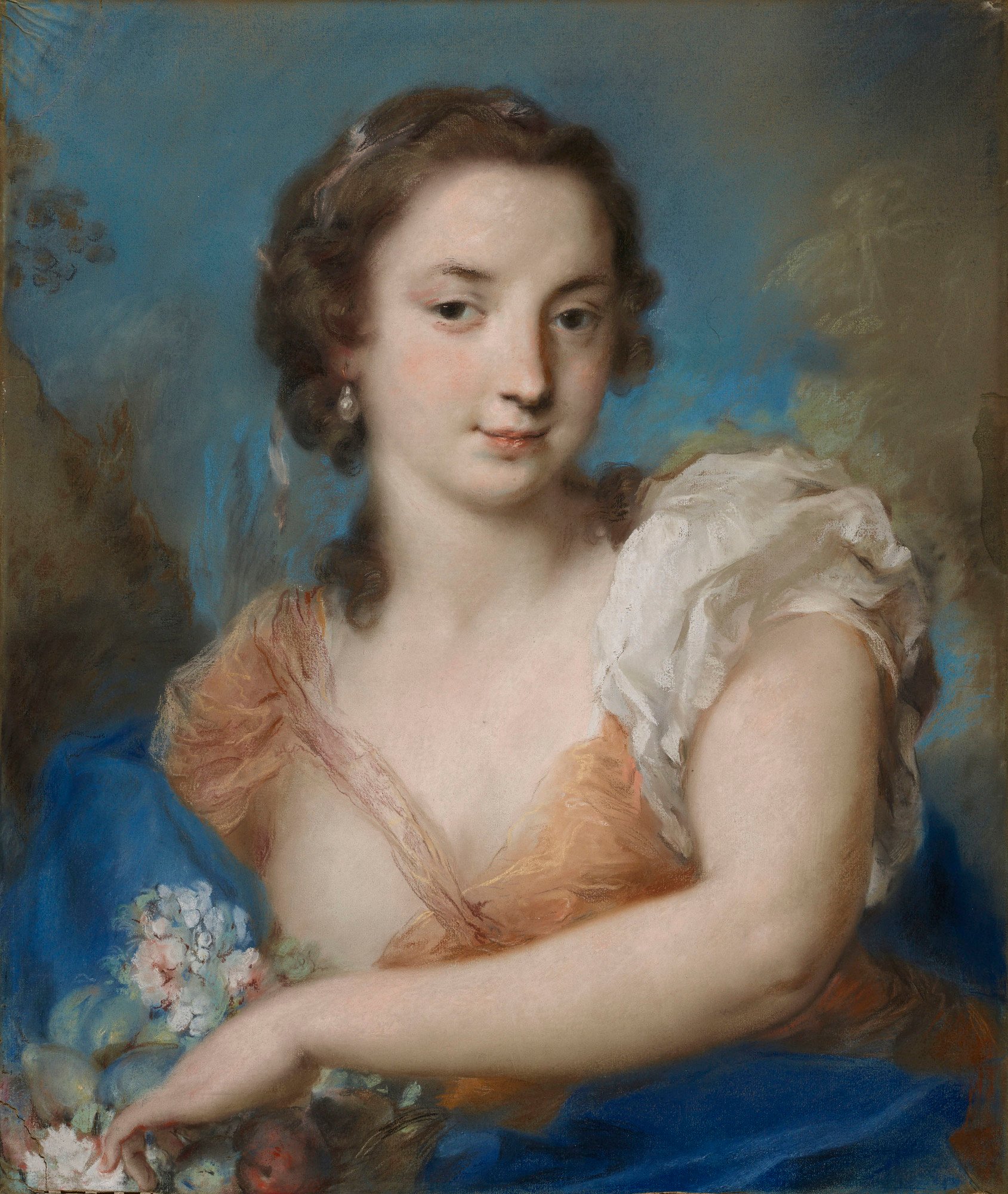
The Winter pastel by Rosalba Giovannia Carriera was acquired by George III, King of England. It entered the Royal Collection in 1762 as “a Beautiful Female covering herself with a Pelisse”. In traditional images Winter was typically shown as an old man, but Rosalba Carriera transformed the subject into a beautiful young woman. “Winter” was put on display in George III’s bedchamber at Buckingham Palace, alongside “Summer”.

Rosalba Carriera was born in Venice. She began her career as a painter of snuffboxes, but rose quickly to fame for her pastel portraits, which became highly desired across Europe. Carriera made several sets of allegories of the Four Seasons. The largest group of pastels by Carriera belonged to Frederick Augustus Elector of Saxony. Over 100 of her pastels were on display at his residence in Dresden in a ‘Rosalba Room’. The artist became blind in later life and died in 1757.

François Boucher (French, 1703–1770), The Four Seasons: Winter, 1755, 57x73cm, The Frick Collection, New York.

François Boucher painted this Winter from the series The Four Seasons in 1755 for Madame De Pompadour, King Louis XV’s long-term official mistress. Their original location is unknown, but their peculiar shape suggests that they were used as overdoors, no doubt in one of Pompadour’s many properties in France.

Instead of the hardship that traditionally illustrates the theme of winter, Boucher depicts a delightful encounter in joyous colours, a frosty background and a landscape buried under snow. A Tartar in pseudo-Russian dress pushes an elaborate sleigh with the heroine – most likely referring to Madame de Pompadour herself. Glancing out at us coyly, she sports a billowing fur-trimmed gown and a little fur necklace. Her hands may be warmed by a muff, but her upper body is completely exposed. This combination of luxury and seduction, treated in a fanciful and humorous manner, is typical of Boucher.

Étienne-Maurice Falconet (French, 1716 – 1791), Winter, c.1770, Marble, 135 cm, The Winter Palace, State Hermitage Museum, St Petersburg.

In April 1764, the 42-year-old Madame Marquise de Pompadour, the official chief mistress of King Louis XV of France unexpectedly died, and in the workshop of her beloved sculptor Etienne Maurice Falconet, the last of the statues she commissioned remained unfinished – the marble Winter, a young woman sitting on an ice cube and gracefully covering flowers with her robe.

A year later Falconet received an invitation from the Russian Empress Catherine the Great to work at her court. It was agreed that at the expense of the Russian treasury all unfinished work from the Falconet workshop would travel with him to Russia. And part of that deal was the unfinished “Winter” sculpture. Falconet completed “Winter” only 5 years after arriving in Russia. That’s how this statue, made by a French sculptor, ended up in the Winter Palace of the State Hermitage Museum in St Petersburg. Contemporaries of Falconet received the work as a masterpiece and the artist himself wrote: “This might be the very best work which I can do; I even dare to think that it is good.”

Jean Antoine Houdon (French, 1741 – 1828), Winter (La Frileuse), 1787, Bronze, 144x39x51cm, Metropolitan Museum of Art, New York.

L’Hiver or Winter is a bronze statue of a young woman cast by the neoclassical French sculptor Jean-Antoine Houdon. The statue personifies the winter season and is nicknamed La Frileuse, The Chilly Girl. This is reflected in both the medium (a cold, dark bronze) and the features of the sculpture, a young woman clad only in a shawl. Upon its completion and presentation at the 1787 Salon, the French yearly art fair, Winter shocked the French artistic establishment but delighted art lovers. The critics at the Salon indulged in some irony: “La Frileuse by Monsieur Houdon does not seem to achieve its effect. When someone is really cold, he tries to pull all his limbs close to him and covers his body more than his head. Nevertheless, it is pleasant to the eye and the proportions are correct” and “One must concur that winter would be a very desirable season if pretty shivering girls did not cover themselves in any other way.” Don’t think this critic will still have a job after saying this nowadays. In terms of her clothing, the Metropolitan Museum of Art describes it as “elegant but hardly adequate”. La Frileuse made me think of the song Let it Go from Frozen, “The Cold Never Bothered Me Anyway.”

The statue was bought by Louis Philippe Joseph, Duc d’Orléans, confiscated during the French Revolution and now in the Metropolitan Museum of Art, New York.

Paul Heermann (German, 1673 – 1732), Winter, c.1700, Marble, 65x64x34cm, Getty Center, Los Angeles. 

Shrouded in a heavy hooded cloak, this elderly man by Paul Heermann looks down with a deeply furrowed brow. As a personification of Winter, the bust gives visual expression to the chilling cold of that season. His old age refers to winter’s occurrence at the very end of the calendar year. This bust was probably part of a series of sculptures personifying the four seasons. At the Versailles Palace, it was fashion including statues of the seasons in the program for garden sculpture. The high level of finish and finely worked details of this bust, however, suggest that Winter was meant to be viewed up close, in an indoor palatial setting.

Jacob Matham (Dutch, 1571 – 1631) engraver, after Hendrik Goltzius (Dutch, 1558 – 1617) drawer, Winter, 1589, from the series The Seasons, engraving, diameter 26cm, National gallery of Art, Washington DC.

This Winter engraving has a very traditional iconography. The personification of Winter is an elderly man wearing a coat and warming his hands by holding a pot containing a fire; beyond is a wintery townscape with ice skaters and people collecting fire wood; the signs of the winter zodiac (Pisces, Aquarius and Capricorn) in the sky; and a cute little putto plays the cold Northern wind blowing into a cloud which results in rain and snow. And just so that we do not get it wrong, Hendrick Goltzius put the name “Hyems” just above the man, which is Latin for “Winter”.

Hendrick Goltzius designed four series with the seasons; Winter depicted here is from the set engraved by Jacob Matham.

The Olympian Gods

The Olympian Gods

This is a 101 crash course in Greek and Roman gods. In ancient Greek mythology, twelve Olympian gods and goddesses ruled over the affairs of mankind from their palace on Mount Olympus. Besides this canon of major deities, many other gods, half-gods, human offspring and heroes visited the Olympus, and these twelve Olympians descended frequently to earth to have their wars, love affairs, parties and weddings, with other gods and humans. With 2,917 meters, Mount Olympus is the highest mountain in Greece, about 80 km southwest from Thessaloniki.

Cornelis van Poeleburgh (1594 – 1667), “Feast of the Gods” (1623), 32x84cm, Wadsworth Atheneum Museum of Art, Hartford, Connecticut.

Roman mythology draws directly on Greek mythology and the Romans identified their own gods with those of the ancient Greeks. Greek and Roman mythologies are therefore often classified together as Classical mythology. The interpretations of Greek myths by the Romans often had a greater influence on narrative and pictorial representations of “classical mythology” and therefore the twelve Olympians are often known under their Roman or Latin names.

There is a certain hierarchy, with Zeus being the King of the Gods and Hera their Queen. Almost all of these twelve have family relationships, Zeus often is the father although his kids have different mothers. The Olympian Gods and Goddesses have their own field of reign, covering all aspects of antique mankind. They can be recognised by their posture and physics, and by their attributes. Hereunder the Twelve Olympians, also with their Roman names and of course with their attributes. After some practising it becomes an easy and fun task to recognise them. Here is the 101 crash course!

Zeus (Jupiter)

King of the Gods and ruler of Mount Olympus, god of the sky, lightning, thunder, law, order and justice. The Roman equivalent is Jupiter. He is associated with a bundle of thunderbolts and the eagle. Zeus is married to Hera.

Heinrich Friedrich Füger (1751 – 1818), “Jupiter” (c.1800), 103x79cm, Hungarian National Gallery, Budapest.

Zeus (Greek Ζεύς, Roman Jupiter) is the senior god, ruling over the other deities who are living on their divine Mount Olympus. He held dominion over the earth and sky and was the ultimate arbitrator of law and justice. He controls the weather, specifically with thunder and lightning. He married Hera, but he had a wandering eye and a penchant for flings with any and all women and occasionally a man or boy. His romantic interests gave birth to numerous other gods, demi-gods, and mortal heroes on the earth. Many of the myths about Zeus concern his seemingly endless adulterous rapes of mortals and demi-gods. His wife Hera doesn’t like this at all of course. Zeus’ amorous adventures and Hera’s counterattacks and revenge provide an endless source of fun and many of these stories are inspiration for generations of artists. On the painting Zeus (Jupiter) enthroned, with the eagle at his feet and in his hand a bundle of thunderbolts.

Hera (Juno)

Queen of the Gods, Goddess of marriage and family. The Roman equivalent is Juno. Her attribute is the peacock. Hera is the wife of Zeus.

Hendrick Goltzius (1558 – 1617), “Juno” (c.1595), 13x11cm, Drawing on Paper, Rijksmuseum, Amsterdam.

Hera (Greek Ἥρᾱ, Latin Juno) rules as the queen of the gods. As the goddess of marriage and fidelity, she was one of the only Olympians to remain steadfastly faithful to her spouse, Zeus. Though faithful, she was also vengeful, and tormented many of Zeus’s extramarital partners. This has been depicted multiple times throughout history of art and is an endless source of stories and inspiration for painters. Acting as a matronly Queen of the deities of Olympus, she is normally associated with women, marriage and childbirth. Hera’s most usual attribute is her favourite bird, the peacock, as can be seen in-extremis on Glotzius’ drawing from the Rijksmuseum.

Poseidon (Neptune)

The God of the Sea. The Roman equivalent is Neptune. He can be recognised by his trident, horses and dolphins. Poseidon (God of the Sea) is a brother of Zeus (God of the Sky) and Demeter (God of the Land).

John Singleton Copley (1738 – 1815), “Neptune” (c.1754), 70x113cm, The Metropolitan Museum of Art, New York.

When Zeus became king, he divided the universe amongst himself and his two brothers of which Poseidon (Greek Ποσειδῶν, Latin Neptune) received dominion over the seas and waters of the world, its storm and earthquakes. He was the protector of seamen and the god of horses. Poseidon lived with his wife in a magnificent palace under the sea, though he was a frequent visitor on Mount Olympus. On the painting, as usual, Neptune is depicted as an old man with long flowing white hair and beard, riding over the waves of the sea in a coach made of a shell and drawn by his horses. His head crowned as king of the seas, trident in one hand and a big pearl in his other hand.

Demeter (Ceres)

Goddess of the Harvest and Agriculture. The Roman equivalent is Ceres. Her attributes are wheat and the cornucopia, which is the horn of plenty. Demeter is the sister of Zeus and Poseidon.

Antoine Watteau (1684 – 1721), “Ceres” (c.1717), 142x116cm, National Gallery of Art, Washington.

Known as the “good goddess” to the people of the earth, Demeter (Greek Δημήτηρ, Latin Ceres) is the goddess of the harvest, who oversaw farming, agriculture, and the fertility of the earth. Not surprisingly, as she controlled the production of food, she was very highly worshipped in the ancient world. On the paining by Watteau she represents summer. Ceres wields a sickle and sits on clouds among sheaves of wheat. The figures surrounding Ceres — the crayfish, the lion, and the nude blond woman — represent the zodiacal symbols of summer (Cancer, Leo, and Virgo). The name of Ceres comes back in the word “cereal”.

Athena (Minerva)

Goddess of War and Wisdom. The Roman equivalent is Minerva. Her symbols are the owl and the body armour including a helmet. Athena is born out of Zeus’ head.

Rembrandt van Rijn (1606 – 1669), “Minerva” (1635), 138x117cm, The Leiden Collection, New York.

Athena (Greek Ἀθηνᾶ, Latin Minerva), was the daughter of Zeus, born out of his head and already at birth dressed in full armour. Athena’s strength rivaled that of any of the other gods. She refused to take any lovers, remaining determinedly a virgin. She took her place on Mount Olympus as the goddess of justice, strategic warfare, wisdom, rational thought, and arts and crafts. In the Rembrandt painting, Minerva can be seen in her study, looking up from her large folio. Her regal appearance is enhanced by the laurel wreath crowning her head. In the background are more books and parts of her body armour, a golden helmet, a spear and a large shield.

Artemis (Diana)

Goddess of the Moon and the Hunt. The Roman equivalent is Diana. Symbols are the moon, bow and arrow. She is a daughter of Zeus and Apollo is her twin brother.

Pietro Antonio Rotari (1707 – 1762), “Diana” (c.1740), 109x77cm, Private Collection, latest at Sotheby’s.

Artemis (Greek Ἄρτεμις, Latin Diana)  and her twin brother Apollo were children of Zeus. The twins became important Olympians, though they were as different as night and day. Artemis was quiet, dark and solemn, the goddess of the moon, forests, archery, and the hunt. Like Athena, Artemis had no desire to marry. She was the patron goddess of feminine fertility, chastity, and childbirth, and was also heavily associated with wild animals. On the painting she is easily recognised by the crescent moon worn as a tiara, the bow and arrow on her back and a hunting dog at her feet.

Apollo

God of the Sun, Light and Music. His attributes are the lyre, sun and laurel wreath. Apollo is a son of Zeus and Artemis is his twin sister.

Rosalba Carriera (1675 – 1757), “Apollo” (c.1743), 67x52cm, Pastel on Paper, The State Hermitage Museum, St Petersburg.

Artemis’s twin brother Apollo (Greek Ἀπόλλων and the same name in Latin) was the god of the sun, light, music, prophecy, medicine, and knowledge, and thus the exact opposite of Demeter. Zeus may have been the senior of the deities, but among the most important and popular with the Greeks and Romans, and later with artists, is Apollo. He is a beardless young man, and the epitome of male beauty. His most common attribute is the lyre, his constant companion for both music and poetry. Apollo was considered the most handsome of the gods. He was cheerful and bright, enjoyed singing, dancing, and drinking, and was immensely popular among both gods and mortals. He also took after his father in the chasing of mortal women and from time to time a boy. On the painting Apollo is depicted as a male beauty, with his lyre and a laurel wreath on his head.

Ares (Mars)

God of Violent War. The Roman equivalent is Mars. Spear, shield and armour are his symbols. Zeus is Ares’ father.

Hendrick ter Brugghen (1588 – 1629), “Mars” (1629), 107x93cm, Centraal Museum, Utrecht.

The attributes of Ares (Greek Ἄρης, Latin Mars) are any part of arms and armour of a warrior, like a helmet and shield. Where Athena oversaw strategy, tactics, and defensive warfare, Ares revealed in the violence and bloodshed that war produced. Often depicted asleep, as on our painting here, which makes him more sympathetic. The God of War asleep becomes the Good of Peace. His name is still used in “martial arts”.

Hephaestus (Vulcan)

God of Fire and Blacksmith of the Gods. The Roman equivalent is Vulcan. To be recognised by fire and the hammer. He married Aphrodite.

Pompeo Girolamo Batoni (1708 – 1787), “Vulcan” (c.1750), 98x76cm, Pinacoteca Civica, Como.

Hephaestus (Greek Ἥφαιστος, Latin Vulcan) learned the blacksmith’s trade, built himself a workshop, and became the god of fire and metallurgy. His forges produce the fire of volcanoes. Hephaestus was horribly ugly – at least by the standards of gods and goddesses – but he managed to marry the beautiful Aphrodite, goddess of love. His attributes derive from his role, and include the hammer and anvil as used in the working of metals. These tools can be seen on this painting, with fire in the background. The word “volcano” refers to the Roman name of Hephaestus, Vulcan.

Aphrodite (Venus)

Goddess of Love, Beaty and Sexuality. The Roman equivalent is Venus. She can be recognised a dove and beauty aspects like jeweller and flowers. Aphrodite married Hephaestos.

François Boucher (1703 – 1770), “Venus” (1751), 108x85cm, The Metropolitan Museum of Art, New York.

Aphrodite (Greek Ἀφροδίτη, Latin Venus) as the most beautiful woman, was married to the most ugly of the gods, Hephaestus. She enjoyed a number of flings with mortal humans, including an affair with the beautiful young guy Adonis. Aphrodite (mostly as Venus) has proved hugely popular in Western art, all too often as an excuse for painting a classical female nude and in the case of her affair with Adonis, also with a beautiful man. This tradition of depicting Aphrodite largely or completely unclothed dates from classical times, already on some of the wall paintings found in the ruins of Pompeii. The Boucher painting, formally called “The Toilette of Venus” was executed for the bathroom of Madame de Pompadour, the powerful mistress of Louis XV. Boucher devised a summary of the key features: Venus as female beauty, and an unfurling of luxurious furniture, fabric, flowers, and pearls. The name of the goddess still lives on in the words “aphrodisiac” and “venereal”.

Hermes (Mercury)

God of travel, commerce and communication, Messenger of the Gods. The Roman equivalent is Mercury. Attributes are winged sandals, hat with wings, and the caduceus, a rod with two entwined serpents. His father is Zeus.

Peter Paul Rubens (workshop), “Mercury” (c.1637), 180x69cm, Museo del Prado, Madrid.

Hermes (Greek Ἑρμῆς, Latin Mercury) is the god who spends as much time among mortals as he does on Olympus: he’s the divine messenger and emissary. Attributes associated with that role include winged sandals, a distinctive staff with a pair of serpents around it, known as a caduceus, and a hat or helmet which bears wings too. The pair of entwined serpents along the caduceus indicates his swiftness as a messenger. This is where the word “mercurial” comes from. There’s also a touch of mischief about Hermes, which has resulted in him being referred to as the divine trickster. He’s thus seen as the protector of all messengers, travellers, thieves, merchants and orators. On the Prado painting we can see the wings around his feet and on his head, and the two snakes around the rod; and of course the male beauty of Hermes himself.

Dionysus (Bacchus)

God of Wine. The Roman equivalent is Bacchus. As God of Wine he can of course be recognised by the grapevine and a cup. Dionysus is the youngest son of Zeus.

Michelangelo Merisi, known as Caravaggio (1571 – 1610), “Bacchus” (c.1598), 95x85cm, Le Gallerie degli Uffizi, Florence.

As the god of grape harvest, wine and its making and consumption, Dionysus (Greek Διόνυσος, Latin Bacchus) was an easy favourite among Olympians and mortals alike. Dionysus was the only Olympian to be born of a mortal mother, and perhaps that was part of the reason why he spent so much time among mortal men, traveling widely and gifting them with wine. Like on the Caravaggio painting here, he is almost always associated with wine and drunkenness. His most distinctive attributes are grapes, wine leaves and of course a glass of wine. His name lives on in the word “bacchanal”.