Tag: Frans Hals

Frans Hals

Frans Hals

Rijksmuseum, Amsterdam

16 February – 9 June 2024

The Rijksmuseum presents “Frans Hals, an exhibition of some 50 of the Dutch master’s greatest paintings, many on loan from top international collections.

Frans Hals (Antwerp c.1583 – Haarlem 1666) is regarded as one of the most innovative artists of the 17th century, for his brisk, impressionistic painting style. With unparalleled boldness and talent, he captured the vitality of his subjects – from stately regents to cheerful musicians and children – and made them live and breathe on the canvas. 

The Laughing Cavalier (1624), Frans Hals (Dutch, c.1583 – 1666), 83x67cm, Wallace Collection, London.

Frans Hals set himself the goal as a painter of capturing his subjects as the living, breathing, spirited people they were, in the most convincing manner possible. He achieved this by deliberately and courageously developing a unique style that was utterly original in Dutch 17th-century painting. Hals chose to use rapid brushwork to achieve an unprecedented sense of dynamism in his portraits. He is one of very few artists in the history of Western art to have successfully painted people smiling and laughing – most painters shied away from this challenge simply because it is so difficult. The subjects of Hals’s paintings come even more to life in this Rijksmuseum exhibition through explorations of their individual identities and social worlds. Malle Babbe, for example, must have been a familiar figure on the streets of Haarlem, and Pekelharing was probably an actor touring with a British theatre company.

Frans Hals’s original style and technique earned him a reputation in his own time as a virtuoso, a status equalled only by the likes of Rembrandt in the Netherlands and Velázquez in Spain. He was an in-demand portraitist among the wealthy citizenry of Haarlem and other cities in the region. Over the course of the 18th century, however, Hals’s work gradually fell into obscurity. It wasn’t until the 19th century that French art critic and journalist Théophile Thoré-Bürger (1807–1869) rediscovered his work, as well as that of Vermeer. Until the 1960s, Frans Hals was regarded as one of the ‘big three’ of 17th-century Dutch painting, alongside Rembrandt and Vermeer. Later, however, interest in the artist waned significantly – reason enough for the Rijksmuseum, The National Gallery, London, and Gemäldegalerie, Berlin, to place him on the highest possible pedestal and to show how truly boundary-breaking he was as an artist.

The Lute Player (c.1623), Frans Hals (Dutch, 1582 – 1666), with frame 108x100cm , Musée du Louvre, Paris.

The artist’s expressive, gestural brushwork has always been seen as the most distinctive quality of his art, and he can justifiably be described as the forerunner of Impressionism. Hals’s virtuosic style influenced fellow artists Gustave Courbet, Édouard Manet, James McNeil Whistler, Claude Monet, Max Liebermann, Vincent van Gogh, John Singer Sargent and others. Almost all of them visited Haarlem to admire his portraits of individuals and civil militia groups.

Frans Hals is organised by the Rijksmuseum in partnership with the National Gallery, London, and Gemäldegalerie, Staatliche Museen zu Berlin.

Frans Hals (1582 – 1666), a family (portrait) reunited!

This is the story of a rich merchant family from 17th Century Haarlem in The Netherlands. Or it’s actually the story of a portrait of that family. Gijsbrecht and Maria van Campen celebrated in 1624 their 20th wedding anniversary, by ordering a family portrait from the famous Dutch painter Frans Hals. They wanted to be portrayed in grand style, together with their 13 children. And that became a big painting of nearly 4 meters long. Almost too big to fit in any house. Oh, small detail indeed, after the painting was finished, child nr 14 was born. It’s a daughter, and she conveniently got photoshopped into the painting in the bottom left corner. Not by Frans Hals but by Salomon de Bray (1597 – 1664), another famous painter from Haarlem.

Proposed reconstruction of the original Van Campen Family portrait (1624) as painted by Frans Hals (1582 – 1666).

Frans Hals was a popular portrait painter, who lived and worked in Haarlem. He depicted his clients in an informal realistic and relaxed way, but certainly grand and with elegance. Exactly how a liberal “new-rich” successful merchant wants to be depicted. It should be old-style “royal”, but in an informal modern way. Think how the European royal families of these days like to be photographed: royal and grand, but informal at the same time!

Frans Hals (1582 – 1666), “Van Campen Family Portrait in a Landscape” (1624), 151x164cm, Oil on Canvas, Toledo Museum of Art, Toledo, Ohio.
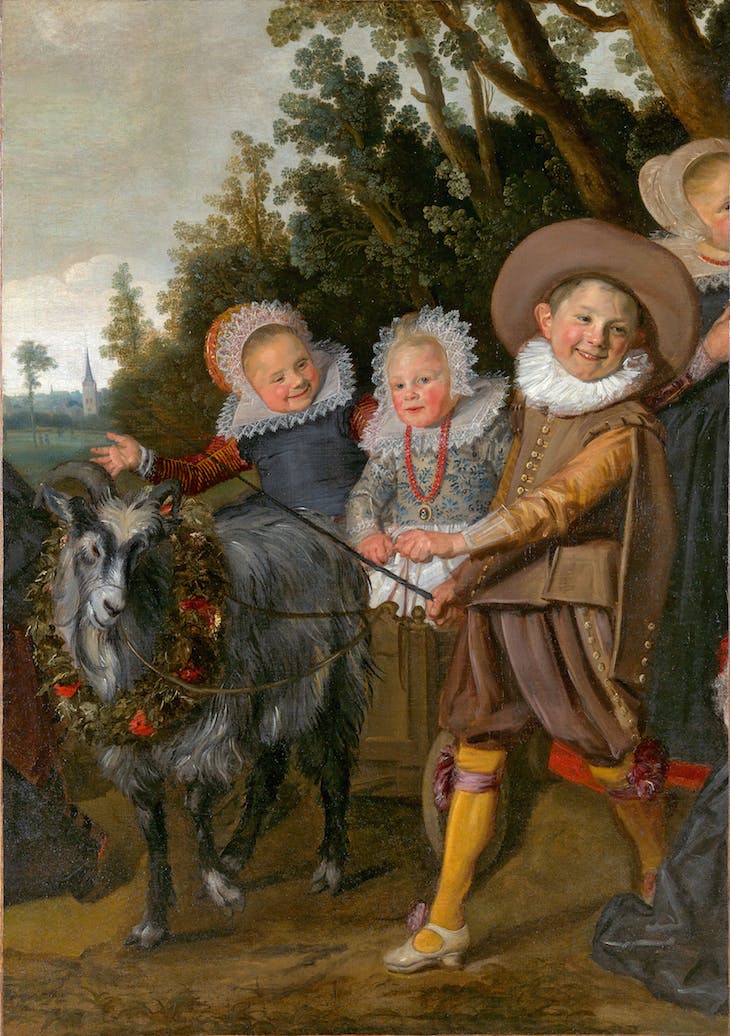
Frans Hals (1582 – 1666), “Children of the Van Campen Family with a Goat Cart” (1624), 151x108cm, Oil on Canvas, Royal Museums of Fine Arts of Belgium, Brussels.

The picture with the parents and their 14 children as shown here above is a reconstruction. Of the original painting, three pieces still exist: “Van Campen Family in a Landscape” in the Toledo Museum of Art, “Children of the Van Campen Family with a Goat Cart” in the Royal Museums of Fine Arts of Belgium and “Head of a Young Boy” in a private collection. For the first time in two hundred years, the three surviving pieces of this monumental family portrait are on view side by side at an exhibition in the Fondation Custodia in Paris (until August 25, 2019.

Frans Hals (1582 – 1666), “Head of a Young Boy” detail from “Van Campen Family Portrait in a Landscape” (1624), Private Collection.

The descendants of the Van Campens decided to cut their family portrait into pieces and sell it as separate “Frans Hals” paintings. The original painting was rather big and difficult to fit in any decent house and almost unsellable in its original format. And by cutting in into pieces, one actually creates even more paintings by the famous Frans Hals! Now, after a few hundreds of years, those three individual paintings have been puzzled together to reunite the parents and children Van Campen in one family portrait. In modern times, you sometimes edit someone out of a picture. But here we are happy to put a family with 14 children together again. The original piece with the portrayal of the two children in the bottom right corner is still missing. If you happen to know the whereabouts of these two kids, please do contact me or the Royal Museums of Fine Arts in Brussels.

Reconstruction of “Van Campen Family Portrait in a Landscape” (1624) by Frans Hals. The child at the bottom left was added by Salomon de Bray. The part in grey is still missing.