Andrea Mantegna’s Lamentation of Christ, housed in the Pinacoteca di Brera in Milan, is a portrayal of the aftermath of Christ’s crucifixion. Painted around 1483, it depicts the lifeless body of Jesus being mourned by the Virgin Mary, Mary Magdalene, and Saint John the Evangelist. The most striking aspect of the painting is Mantegna’s use of foreshortening to create a sense of depth and realism.
The painting was found in Mantegna’s studio at the time of his death, sold by his son Ludovico to Cardinal Sigismondo Gonzaga and inventoried among the property of the lords of Mantua in 1627.
The iconography of the work, probably intended for the artist’s private devotion, refers to the compositional scheme of the Lamentation over the Dead Christ, in which mourners are gathered around the body prepared for burial, laid out on the stone of unction and already anointed with perfumes. The composition produces a great emotional impact, accentuated by the extreme foreshortening: Christ’s body is very close to the viewpoint of the observer who, looking at it, is drawn into the center of the drama; every detail is enhanced, the rigor mortis of the body and the wounds of the crucifixion. It is an absolute peak in Mantegna’s production, a work whose expressive force and masterly handling of the illusion of perspective have made it one of the best-known symbols of the Italian Renaissance.
The Khan Academy has a beautiful video with explanation about Mantegna’s Lamentation of Christ. worth viewing before visiting.
The Pinacoteca di Brera is in the heart of Milan. For details about visiting, click here.
The Storm on the Sea of Galilee or the “Calming of the Storm” is a story recounting a moment when Jesus and his disciples were on a boat crossing the Sea of Galilee, and a sudden and severe storm arose. As the disciples panicked and feared for their lives, Jesus, who was asleep in the boat, was awakened when they screamed, “Save us! We’re going to drown!” He replied, “You of little faith, why are you so afraid?” Then he got up and said to the winds and the waves, “Peace! Be still!” and it was completely calm; the wind ceased, and there was a dead calm sea. The disciples were filled with great awe and said to one another, “Who then is this, that even the wind and the sea obey him?”
The Sea of Galilee was known for its sudden and fierce storms. The locals were people of the land who were generally uncomfortable at sea, especially since they believed the sea to be full of frightening creatures. Storms on lakes can arise and intensify quickly, but they also tend to calm down rapidly. By asking the question “Why are you so afraid?”, Jesus was asking his disciples to explore in their own minds the cause and origin of fear, so they would realize that all fear has its roots in assumptions and is counterproductive in finding solutions. This “miracle of calming the sea and the wind” is a message that it’s better to keep faith and find courage to bring a difficult (and maybe hopeless) task to a good end than to fear and give up. The “Calming of the Storm miracle” is to be interpreted symbolically as the ability to bring peace and order to the turbulent aspects of life. Don’t panic, keep faith!
The story is recounted in the New Testament and is mentioned in three of the four Gospels, Matthew (8:23-27), Mark (4:35-41), and Luke (8:22-25).
Rembrandt depicts the panic-stricken disciples struggle against a sudden storm, and their fight to regain control of their fishing boat, ripping the sail and drawing the craft perilously close to the rocks in the left foreground. One of the disciples succumbs to the sea’s violence by vomiting over the side. Amidst this chaos, only Jesus, at the right, remains calm, like the eye of the storm. Awakened by the disciples’ desperate pleas for help, he rebukes them: “Why are you fearful, oh you of little faith?” and then rises to calm the fury of wind and waves. The Storm on the Sea of Galilee (1633), Rembrandt van Rijn (Netherlandish, 1606 – 1669), 160x128cm, Isabella Stewart Gardner Museum, Boston MA, stolen in 1990. Here is more info about the theft of this Rembrandt (and another Rembrandt and a Vermeer!), plus the contact details for any info on the current whereabouts.
The Storm on the Sea of Galilee (c.1595), Engraved by Aegidius Sadeler II (Flemish, 1570 – 1629), 21×25cm, Rijksmuseum, Amsterdam.
Backhuysen was one of the leading painters of seascapes in the late 17th century. He often put to sea when a storm threatened in order to observe the changing weather conditions. The Storm on the Sea of Galilee (1695), Ludolf Backhuysen (Netherlandish, 1630 – 1708), 58x72cm, Indianapolis Museum of Art, Indianapolis IN.
Brueghel depicts the boat, lashed by the waves with Jesus asleep inside, at the precise moment when one of the disciples decides to wake him before they are all shipwrecked. Also in the vessel are eleven of the disciples who make every effort not to be sunk, rowing and attempting to manage the sails. The Storm on the Sea of Galilee (1596), Jan Brueghel the Elder (Flemish, 1568 – 1625), Oil on Copper, 27x35cm, Museo Nacional Thyssen-Bornemisza, Madrid.
On this print we see two professional boatsmen trying to get control over the sails, while the disciples are pretty useless. The waves have the form of a sea monster. The Storm on the Sea of Galilee (c.1582), print 2:12 from the series The Miracles of Christ, Engraved by Harmen Jansz Muller (Netherlandish, c.1539 – 1617), 21×26cm, Rijksmuseum, Amsterdam.
In this 11th century manuscript illustration, we see two scenes in one: on the left Jesus sleeping and on the right when he is calming the storm. The Storm on the Sea of Galilee (c.1000), Illustration from the Gospels of Otto III, created in Reichenau Abbey, manuscript size 34x24cm, München, Bayerische Staatsbibliothek (Clm 4453), München, Germany.
Delacroix depicts Jesus sleeping peacefully while his panicked disciples weather a violent storm. Delacroix painted at least six variations on this biblical theme, but this version is considered his first oil sketch for the series. The Storm on the Sea of Galilee (1853), Eugène Delacroix (French, 1798 – 1863), 46×55cm, Nelson Atkins Museum of Art, Kansas City MO.
The Storm on the Sea of Galilee (c.1010), from the Hitda Codex nr 1640 fol. 117r, Universitäts- und Landesbibliothek, Darmstadt, Germany. The Hitda Codex is a Christian Gospel book with twenty-two full-page miniatures with an emphasis on Jesus’ miracles, produced around 1000-1020. The miniatures include a dedication image depicting the patron, Abbess Hitda of the convent in Meschede, North Rhine-Westphalia, Germany.
The Storm on the Sea of Galilee (c.1608), Engraved by Cornelis Galle the Elder (Flemish, 1576 – 1650) after design by Maerten de Vos (Flemish, 1532 – 1603), 18x22cm, Rijksmuseum, Amsterdam.
Jesus Calms the Storm, from Matthew (8:23-27)

23 Then he got into the boat and his disciples followed him. 24 Suddenly a furious storm came up on the lake, so that the waves swept over the boat. But Jesus was sleeping. 25 The disciples went and woke him, saying, “Lord, save us! We’re going to drown!”

26 He replied, “You of little faith, why are you so afraid?” Then he got up and rebuked the winds and the waves, and it was completely calm.

27 The men were amazed and asked, “What kind of man is this? Even the winds and the waves obey him!”
Jesus Calms the Storm, from Mark (4:35-41)

35 That day when evening came, he said to his disciples, “Let us go over to the other side.” 36 Leaving the crowd behind, they took him along, just as he was, in the boat. There were also other boats with him. 37 A furious squall came up, and the waves broke over the boat, so that it was nearly swamped. 38 Jesus was in the stern, sleeping on a cushion. The disciples woke him and said to him, “Teacher, don’t you care if we drown?”

39 He got up, rebuked the wind and said to the waves, “Quiet! Be still!” Then the wind died down and it was completely calm.

40 He said to his disciples, “Why are you so afraid? Do you still have no faith?”

41 They were terrified and asked each other, “Who is this? Even the wind and the waves obey him!”
Jesus Calms the Storm, from Luke (8:22-25)

22 One day Jesus said to his disciples, “Let us go over to the other side of the lake.” So they got into a boat and set out. 23 As they sailed, he fell asleep. A squall came down on the lake, so that the boat was being swamped, and they were in great danger.

24 The disciples went and woke him, saying, “Master, Master, we’re going to drown!” He got up and rebuked the wind and the raging waters; the storm subsided, and all was calm.

25 “Where is your faith?” he asked his disciples. In fear and amazement they asked one another, “Who is this? He commands even the winds and the water, and they obey him.”
Today March 19th is the day dedicated to Saint Joseph. Who is he? Joseph is one of the three members of the Holy Family, together with the Virgin Mary and her child Jesus.He is a carpenter from Nazareth and a widower, who married the Virgin Marry at that time already pregnant with Jesus. The virgin birth of Jesus is the Christian doctrine that Jesus was conceived and born by his mother Mary through the power of the Holy Spirit and without sexual intercourse. Joseph is therefore Jesus’s foster-father. In most paintings with the Holy Family, Joseph has a minor role and just in the background. Only from the 15th century artists gave more attention to Joseph and made him visible as head of the Holy Family. When the bible speaks about Jesus’s brothers and sisters, those are children of Joseph from a previous marriage.Saint Joseph is the patron saint of family life, fathers, unborn children and carpenters and in Western Christianity his celebration day is March 19th. And in Italy, this special day of Saint Joseph (San Giuseppe in Italian) is also Father’s Day. Joseph might be a lesser celebrity in the biblical world, but as “father” he is a figure that means so much in everyone’s life. Even when he is a foster-father.
Robert Campin (1378 – 1444), “Saint Joseph” (right-hand panel of the “Annunciation Triptych – Merode Altarpiece”) (c. 1430), 65x27cm, Oil on Panel, The Metropolitan Museum of Art, New York.
This is the right-hand panel of a triptych. The old man Joseph, who is engaged to the Virgin Mary, works in his carpenter shop. The mousetraps he made, on the bench and in the shopwindow opening onto the street, are symbols of the crucifixion of Jesus which will only happen 33 years later. Jesus on the cross is considered the devil’s mousetrap.
Robert Campin (1378 – 1444), “Annunciation Triptych – Merode Altarpiece” (c. 1430), 65x118cm, Oil on Panel, The Metropolitan Museum of Art, New York.
Looking at the triptych as a whole, the middle panel shows the moment when the Virgen Mary gets the message from the angel Gabriel that she will be pregnant with Jesus. It’s even the moment of the divine impregnation itself. On the right panel Joseph in his workshop, busy making the mousetraps and no idea what is happening to Mary at this very moment. On the left the donors of this triptych.
French 15th century, “The Expectant Madonna with Saint Joseph” (c.1435), 71x35cm, Tempura on Panel, National Gallery of Art (Samuel H. Kress Collection), Washington DC.
When Joseph was engaged to Mary he found out she became pregnant, and certainly not by him! Joseph was very much doubting if he should indeed marry her. As he considered splitting up, an angel of the Lord appeared to him in a dream. “Joseph” the angel said, “do not be afraid to take Mary as your wife. For the child within her was conceived by the Holy Spirit.” As is written in the bible, see Matthew 1: 18-20. On the picture above you can see Mary, pregnant with Jesus, and Joseph as an old man doubting about what happened. This is not a very common image to see in paintings and it’s obviously a mysterious element in the whole story and even a bit embarrassing for Joseph. The message from the angel to Joseph is then solving this element to everyone’s satisfaction, including Joseph’s. From the 15th century the Holy Family (Maria, Jesus and Joseph) as a subject became way more popular and that helped to raise Joseph in public esteem. Joseph is from then on represented more sympathetically and more prominently.
George de la Tour (1593 – 1652), “Saint Joseph the Carpenter” (1642), 137x102cm, Oil on Canvas, Louvre, Paris.
This painting by George de la Tour (1642, from the Louvre) cannot be missed in any story about Joseph. As patron saint of carpenters, Joseph is working on a beam, helped by his foster son Jesus. The arrangement of pieces of wood on the floor evokes a cross and prefigures the crucifixion of Jesus. The young Jesus with the candlelight shining on his face makes already a reference to becoming the “Light of the World”. George de la Tour shows that even Jesus lived a simple and innocent earthly life, but he included divinity’s presence by way of the light of the candle.
Bartolomé Esteban Murillo (1617 – 1682), “The Holy Family” (1650), 144x188cm, Oil on Canvas, Museo del Prado, Madrid.
Here we see the Holy family with a playing Jesus and two caring parents in a domestic scene. It shows home life but also work, symbolized by Saint Joseph’s carpenter tools on the right. The almost leading role of Joseph, the foster father, corresponds to the increased worship of Joseph as a father figure within the Holy Family. Over the centuries the image of Joseph developed from a grumpy old man to a caring – and younger – father.
Sir John Everett Millais (1829 – 1896), “Christ in the House of His Parents – The Carpenter’s Shop” (1850), 86x140cm, Oil on Canvas, Tate Gallery, London.
This is a painting from the Pre-Raphaelite painter Millais, showing a scene from the boyhood of Jesus and placed in Joseph’s carpenter workshop. It’s full of symbolic messages. Jesus, as a boy, has wounded himself at a nail and is being comforted by his parents Mary and Joseph. Blood is dripping from his hand on his foot. Both spots of blood are foreshadowing the crucifixion. On the right we see the young Saint John the Baptist with a bowl of water, as reference to the baptizing of Jesus Christ. At the back on the wall is a carpenter’s triangle, referring to the Holy Trinity of God, the Holy Spirit, and Jesus son of God. And the dove, symbolizing the Holy Spirit, is sitting on the ladder.
The pre-Raphaelites wanted to strip-away all traditions of painting since Raphael. Millais removed all beauty and placed the scene in an ordinary carpenter workshop, with common people as the Holy Family. The picture prompted many negative reviews. The Times described it as ‘revolting’ and objected to the way in which the artist had dared to depict the Holy Family as ordinary, lowly people in a humble carpenter’s shop. Charles Dickens was one of the most vehement critics, describing the young Christ as ‘a hideous, wry-necked, blubbering, red-headed boy, in a bed gown’. The painting can be seen in the Tate Gallery, London, where it’s now considered one of their masterpieces.
Bartolomé Esteban Murillo (1617 – 1682), “The Heavenly and Earthly Trinities – The Pedroso Murillo” (c. 1680), 293x207cm, Oil on Canvas, National Gallery, London.
This painting illustrates the belief that Jesus was both human and divine, by placing him in the middle of the two “Trinities”. The vertical line is the Holy Trinity, with God the Father, the Holy Ghost (the dove), and Jesus as the Son of God. Jesus looks up towards heaven, but affectionately holds hands with his human parents, Mary and Joseph. The three together, as the horizontal line, make up the Earthly Trinity. Mary’s loving gaze and gracefully upturned palm are directed towards her young son. Joseph looks out of the picture towards us, inviting us to adore Jesus. Murillo transforms a complex theological principle into a very human and accessible image. With Jospeh as the connecting figure between us humans and the divine world of God.
Willem Claesz. Heda (1594 – 1680), “Still Life with a Roemer and Watch” (1629), 46x69cm, Oil on Panel, Mauritshuis, The Hague.
Let’s have Sunday brunch 17th Century style! And that’s best done with Willem Claesz. Heda, Dutch Golden Age painter from Haarlem, The Netherlands. He specialized in the genre of “banketjes” and “ontbijtjes” (banquets and breakfasts), and most of them in a monochrome manner. Not much known about his life, not even an exact date of birth or death. But his legacy can be seen in the important museums all over the world. Let’s have a closer look at the one from the National Gallery of Art in Washington. And let’s find the hidden message in what seemingly is just a banquet still life painting.
Willem Claesz. Heda (1594 – 1680), “Banquet Piece with Mince Pie” (1635), 107x111cm, Oil on Canvas, National Gallery of Art, Washington.
This is the aftermath of a feast meal; a table filled with exotic food, luxurious tableware and precious glasses. The lemon and olives have been imported from the Mediterranean. The salt – expensive in those days – can been seen on a silver salt cellar. The mince pie, filled with meat and fruits and spices, is a dish for special occasions and on this painting has clearly been eaten already. A glass broke, the goblet fell over and the candle went out. But the message is shown exactly in the middle and in the front; it even sticks out of the painting right into our face. And that’s the piece of bread. The roll has not been touched. Bread in the Eucharistic meaning represents the body of Christ. Heda tells us that we should not overlook the Christian faith while being seduced by the pleasures and richness of food and earthly goods.
Willem Claesz. Heda (1594 – 1680), “Still Life with a Ham, Bread and Precious Vessels” (1654), 105x147cm, Oil on Canvas, Museum of Fine Arts, Budapest.
And here is another still life breakfast painting by Heda. It’s from the Museum of Fine Arts in Budapest. On the table a ham, lemon, oysters, the salt on the silver salt cellar, precious vessels, Venetian glass and even a “nautilus cup”, made of the nautilus shell imported from the Far East. This painting shows the wealth of a rich merchant from the Dutch Golden Age. But also here, on the left side of the table, is that very modest, untouched, lonely piece of bread. All the richness on one side of the table and on the other side, at that pure white clean tablecloth, the power of the Christian faith, symbolized by a simple bread roll. I guess the owners of these paintings, those rich merchants in the 17th Century, liked to show off their wealth and their taste for international and exotic treasures, but they also wanted to show how modest and down-to-earth they were. It’s true Calvinist behavior; almost as an excuse for wealth and success.
On the 30th of May, 1640, death of Peter Paul Rubens, the most important Baroque painter from the Flemish Netherlands. Rubens was not only a well-educated scholar and painter, but also businessman and diplomat. He made religious altarpieces, portraits of royalty, mythological paintings and hunting landscapes. All his paintings are impressive big pieces with lots of color and typical Baroque-emphasized movement and sensuality. He run a large studio in Antwerp which is now the Rubenshuis Museum.
Peter Paul Rubens (1577 – 1640), “The Descent from the Cross” (1613), 420x320cm, Oil on Panel, Cathedral of Our Lady, Antwerp, Belgium.
Here are two of his paintings. It’s “The Descent from the Cross” (1613), which is the 4×3 meters magnificent central panel of a triptych, which is still in its original place in the Cathedral of Our Lady in Antwerp, Belgium. The body of Christ is lowered from the cross, with very energetic support of Saint John (in the red mantle). Mary Magdalena is gracefully supporting Christ’ leg and Mary, a mother in despair, is stretching out her arms towards her son. Joseph of Arimathea and Nicodemus are placed on both sides of the scenel.
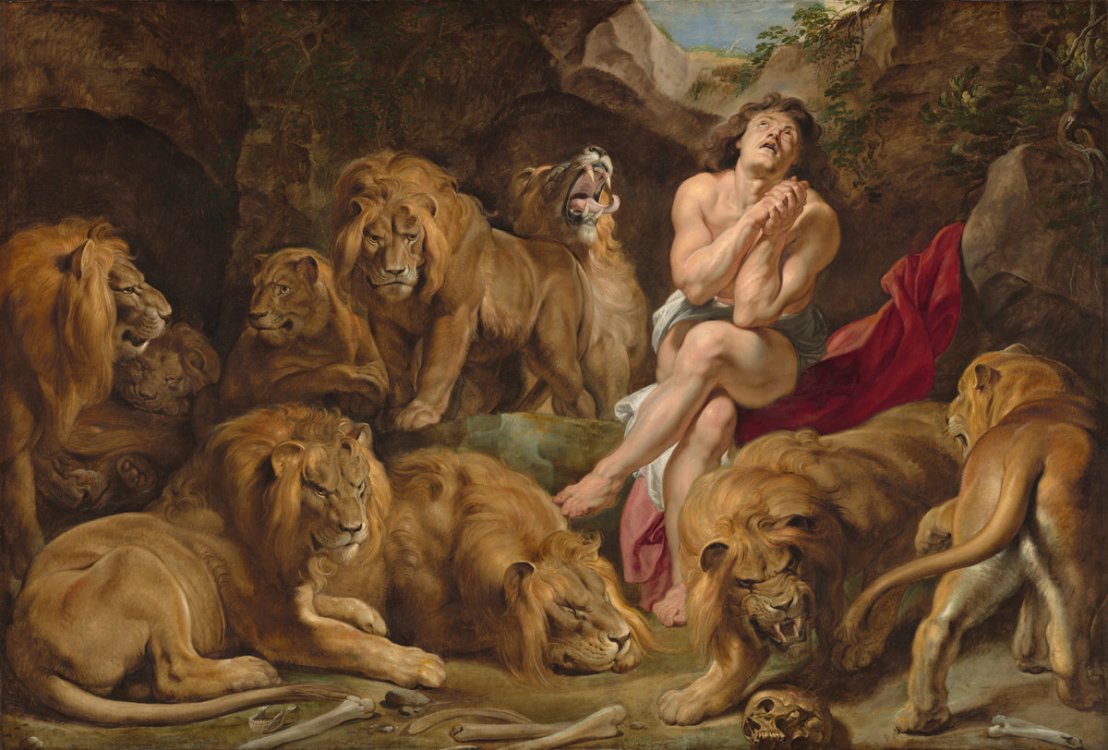
Also here is a 2×3 meters big painting of the legendary hero “Daniel in the Lions’ Den” (1614). Chief counselor to the Persian king, Daniel fell victim to his jealous co-officials. They plotted against him and threw him into a den of lions. But that plot truly failed! Daniel keeps on staring up and praying towards the light of heaven. And he stayed unharmed! Next day he was freed without a single scratch. A strong moral: look up when things get you down; keep your head up and think positive!
Peter Paul Rubens (1577 – 1640), “Daniel in the Lions’ Den” (1614), 224x351cm, Oil on Canvas, National Gallery of Art, Washington.