Month: March 2021

Saint Joseph

Saint Joseph

“Carpenter from Nazareth”

Today March 19th is the day dedicated to Saint Joseph. Who is he? Joseph is one of the three members of the Holy Family, together with the Virgin Mary and her child Jesus. He is a carpenter from Nazareth and a widower, who married the Virgin Marry at that time already pregnant with Jesus. The virgin birth of Jesus is the Christian doctrine that Jesus was conceived and born by his mother Mary through the power of the Holy Spirit and without sexual intercourse. Joseph is therefore Jesus’s foster-father. In most paintings with the Holy Family, Joseph has a minor role and just in the background. Only from the 15th century artists gave more attention to Joseph and made him visible as head of the Holy Family. When the bible speaks about Jesus’s brothers and sisters, those are children of Joseph from a previous marriage. Saint Joseph is the patron saint of family life, fathers, unborn children and carpenters and in Western Christianity his celebration day is March 19th. And in Italy, this special day of Saint Joseph (San Giuseppe in Italian) is also Father’s Day. Joseph might be a lesser celebrity in the biblical world, but as “father” he is a figure that means so much in everyone’s life. Even when he is a foster-father.

Robert Campin (1378 – 1444), “Saint Joseph” (right-hand panel of the “Annunciation Triptych – Merode Altarpiece”) (c. 1430), 65x27cm, Oil on Panel, The Metropolitan Museum of Art, New York.

This is the right-hand panel of a triptych. The old man Joseph, who is engaged to the Virgin Mary, works in his carpenter shop. The mousetraps he made, on the bench and in the shopwindow opening onto the street, are symbols of the crucifixion of Jesus which will only happen 33 years later. Jesus on the cross is considered the devil’s mousetrap.

Robert Campin (1378 – 1444), “Annunciation Triptych – Merode Altarpiece” (c. 1430), 65x118cm, Oil on Panel, The Metropolitan Museum of Art, New York.

Looking at the triptych as a whole, the middle panel shows the moment when the Virgen Mary gets the message from the angel Gabriel that she will be pregnant with Jesus. It’s even the moment of the divine impregnation itself. On the right panel Joseph in his workshop, busy making the mousetraps and no idea what is happening to Mary at this very moment. On the left the donors of this triptych.

French 15th century, “The Expectant Madonna with Saint Joseph” (c.1435), 71x35cm, Tempura on Panel, National Gallery of Art (Samuel H. Kress Collection), Washington DC.

When Joseph was engaged to Mary he found out she became pregnant, and certainly not by him! Joseph was very much doubting if he should indeed marry her. As he considered splitting up, an angel of the Lord appeared to him in a dream. “Joseph” the angel said, “do not be afraid to take Mary as your wife. For the child within her was conceived by the Holy Spirit.” As is written in the bible, see Matthew 1: 18-20. On the picture above you can see Mary, pregnant with Jesus, and Joseph as an old man doubting about what happened. This is not a very common image to see in paintings and it’s obviously a mysterious element in the whole story and even a bit embarrassing for Joseph. The message from the angel to Joseph is then solving this element to everyone’s satisfaction, including Joseph’s. From the 15th century the Holy Family (Maria, Jesus and Joseph) as a subject became way more popular and that helped to raise Joseph in public esteem. Joseph is from then on represented more sympathetically and more prominently.

George de la Tour (1593 – 1652), “Saint Joseph the Carpenter” (1642), 137x102cm, Oil on Canvas, Louvre, Paris.

This painting by George de la Tour (1642, from the Louvre) cannot be missed in any story about Joseph. As patron saint of carpenters, Joseph is working on a beam, helped by his foster son Jesus. The arrangement of pieces of wood on the floor evokes a cross and prefigures the crucifixion of Jesus. The young Jesus with the candlelight shining on his face makes already a reference to becoming the “Light of the World”. George de la Tour shows that even Jesus lived a simple and innocent earthly life, but he included divinity’s presence by way of the light of the candle.

Bartolomé Esteban Murillo (1617 – 1682), “The Holy Family” (1650), 144x188cm, Oil on Canvas, Museo del Prado, Madrid.

Here we see the Holy family with a playing Jesus and two caring parents in a domestic scene. It shows home life but also work, symbolized by Saint Joseph’s carpenter tools on the right. The almost leading role of Joseph, the foster father, corresponds to the increased worship of Joseph as a father figure within the Holy Family. Over the centuries the image of Joseph developed from a grumpy old man to a caring – and younger – father.

Sir John Everett Millais (1829 – 1896), “Christ in the House of His Parents – The Carpenter’s Shop” (1850), 86x140cm, Oil on Canvas, Tate Gallery, London.

This is a painting from the Pre-Raphaelite painter Millais, showing a scene from the boyhood of Jesus and placed in Joseph’s carpenter workshop. It’s full of symbolic messages. Jesus, as a boy, has wounded himself at a nail and is being comforted by his parents Mary and Joseph. Blood is dripping from his hand on his foot. Both spots of blood are foreshadowing the crucifixion. On the right we see the young Saint John the Baptist with a bowl of water, as reference to the baptizing of Jesus Christ. At the back on the wall is a carpenter’s triangle, referring to the Holy Trinity of God, the Holy Spirit, and Jesus son of God. And the dove, symbolizing the Holy Spirit, is sitting on the ladder.

The pre-Raphaelites wanted to strip-away all traditions of painting since Raphael. Millais removed all beauty and placed the scene in an ordinary carpenter workshop, with common people as the Holy Family. The picture prompted many negative reviews. The Times described it as ‘revolting’ and objected to the way in which the artist had dared to depict the Holy Family as ordinary, lowly people in a humble carpenter’s shop. Charles Dickens was one of the most vehement critics, describing the young Christ as ‘a hideous, wry-necked, blubbering, red-headed boy, in a bed gown’. The painting can be seen in the Tate Gallery, London, where it’s now considered one of their masterpieces.

Bartolomé Esteban Murillo (1617 – 1682), “The Heavenly and Earthly Trinities – The Pedroso Murillo” (c. 1680), 293x207cm, Oil on Canvas, National Gallery, London.

This painting illustrates the belief that Jesus was both human and divine, by placing him in the middle of the two “Trinities”. The vertical line is the Holy Trinity, with God the Father, the Holy Ghost (the dove), and Jesus as the Son of God. Jesus looks up towards heaven, but affectionately holds hands with his human parents, Mary and Joseph. The three together, as the horizontal line, make up the Earthly Trinity. Mary’s loving gaze and gracefully upturned palm are directed towards her young son. Joseph looks out of the picture towards us, inviting us to adore Jesus. Murillo transforms a complex theological principle into a very human and accessible image. With Jospeh as the connecting figure between us humans and the divine world of God.

March and the god Mars

March and the god Mars

March is the month named after Mars, in Roman mythology the God of War. He is also an agricultural guardian. The month March, opening the year of farming, is considered the start of the year for the Roman calendar, which had only ten months. With March being the first, September is number seven, October number eight and November and December nineth and tenth. But who is Mars? Although being the god of war, he is also a god of peace (when sleeping!), an epitome of male beauty, and the secret beau of Venus, Goddess of Love. Let’s look at a few paintings with Mars and also some together with Venus. The last painting is revealing the real scandal!

Hendrick ter Brugghen (1588 – 1629), “Mars Asleep” (1629), 107x93cm and 152x140cm with frame, Oil on Panel, Centraal Museum, Utrecht.

This is not a common soldier. This is Mars, God of War, in a 17th Century human form. The harness on the painting is a very rich and precious piece of work made in Italy. It was owned by Hendrick ter Brugghen and kept in his studio. Exactly the same harness and helmet ended up on other paintings by Ter Brugghen and by his colleagues from Utrecht. Around 1648, the end of the Eighty Years’ War and a final end to Spain’s rule over the Netherlands, the painting was placed in its current frame. The weapons and tools of war on the frame are chained together and cannot be used any longer. Mars fell asleep; he now represents peace. In the true Dutch tradition when Mars, God of War, falls asleep, Mercury, God of Trade, will get active again. A political painting in its time.

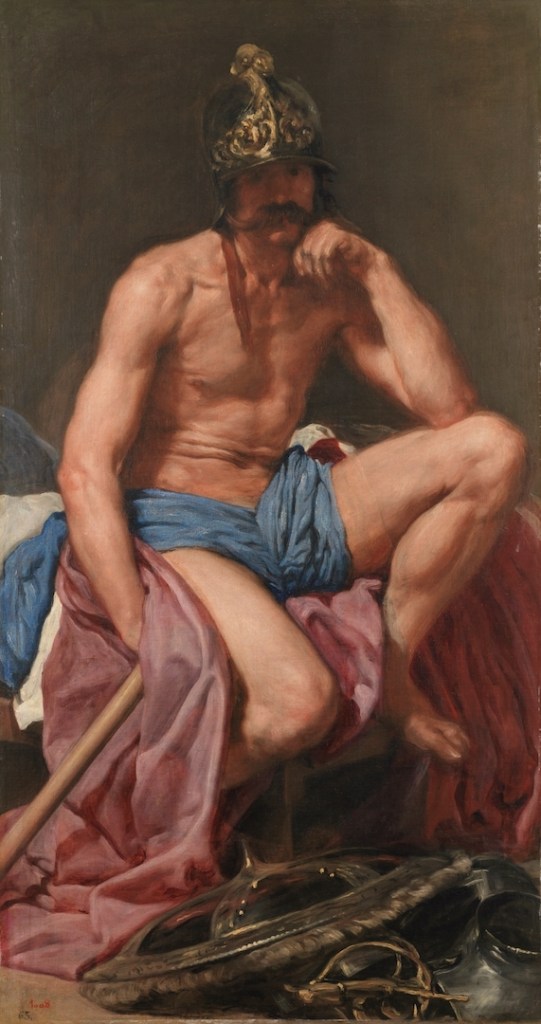
Diego Rodríguez de Silva y Velázquez (1599 – 1660), “Mars” (1638), 179x95cm, Oil on Canvas, Museo del Prado, Madrid.

Here is Velázquez majestic painting of Mars. Mars is lazily seating on a soft, unmade bed. The bedclothes belong to a luxurious bed much more suited to amorous struggle than to battles and war. Mars is only wearing his helmet; his shield and armour lie at the ground. This picture is a defeat of arms by love which conquers all. The painting was made for the Spanish royal hunting pavilion on the outskirts of Madrid, in a century when Spain was in continuous wars. An amorous Mars seems certainly more sympathetic than a war-god in full armour.

Sandro Botticelli (1445 – 1510), “Venus and Mars” (1485), 69x173cm, Oil and Tempera on Panel, National Gallery, London.

This Italian Renaissance painting by Botticelli shows Venus, the Roman goddess of love, and Mars, god of war, surrounded by playful and naughty satyrs. Venus watches Mars asleep – and snoring – and she contemplates her victory: love has conquered war. Although it’s unfaithful love, as Venus was in fact married to Vulcan, god of fire and an unattractive blacksmith. The little satyr guys are playing with Mars’s armour: one put the too big helmet on his head and another crawled inside his breastplate. Even one blows a conch shell in his ear to wake Mars, but of course unsuccessfully. The couple have been making love, and Mars obeyed to the male habit of falling asleep after sex. Most likely the painting was commissioned to celebrate the marriage of a wealthy Florentine couple, and was meant to decorate the bedroom with that witty representation of sensual pleasure. There is another thought about Mars’s state of undress. It was thought that looking at an image of a beautiful man would help to conceive a boy – the most desirable heir in those days.

Louis Jean François Lagrenée (1725 – 1805), “Mars and Venus, Allegory of Peace” (1770), 65x54cm, Oil on Canvas, Getty Museum, Los Angeles.

The French rococo painter Louis Jean François Lagrenée shows us Mars, throwing back the curtains to reveal a sleeping Venus. Mars is captivated by her beauty; his shield and sword lie on the ground. A pair of white doves are building a nest in Mars’s helmet. A 18th Century example of “make love not war”. Mars gives peace a chance.

Joachim Wtewael (1566 – 1638), “Mars and Venus Surprised by Vulcan” (1601), 21x16cm, Oil on Copper on Panel, Mauritshuis, The Hague.

This painting depicts the adultery of Venus and Mars. Venus’ husband Vulcan – god of fire and standing with his back to us on the left – has caught the couple in the act. When Vulcan heard that Venus and Mars had an affair, he – as a skilled blacksmith – made an invisible bronze net to catch them in their love bed. The metal net was so delicate that the two beautiful gods did not know that they had been captured until it was too late. Vulcan invited all the gods from Mount Olympus to come and laugh at the trapped lovers. A detail: Mercury, god of trade, is getting jealous and said he is willing to replace Mars. He can be seen above the bed and Cupido is already sending an arrow in Mercury’s direction. The still-life in the foreground is Mars’s armour, Vulcan’s hammer and Venus her red slippers, an old-fashioned symbol of adultery.

Because of the erotic subject matter, the painting’s early owners will have concealed the painting behind a curtain. For a longtime this painting was kept in depot by The Mauritshuis “to protect an immature public against itself”. Only from 1987 this small painting is shown to the public in its full splendor; painted on copper, which is excellent for expressing fine details. It’s an erotic picture, very attractive for the viewers. But it’s certainly also a showcase for the skills of the Joachim Wtewael. And above all an embarrassment for Venus and Mars!