Tag: baroque

San Carlo alle Quattro Fontane (1646), Borromini, Rome.

San Carlo alle Quattro Fontane (1646), Borromini, Rome.

Francesco Borromini (Italian, 1599 – 1667)

Rome

San Carlo alle Quattro Fontane, also called San Carlino, is an iconic masterpiece of Baroque architecture. The church was designed by the architect Francesco Borromini, and it was his first commission. The church is built for the Spanish Trinitarians, an order dedicated to the freeing of Christian slaves.

San Carlo alle Quattro Fontane (1646), Francesco Borromini (Italian, 1599 – 1667), Rome.

In the 1630s, the monks of the Trinitarian Order were searching for an architect to build a church connecting their monastery. Francesco Borromini offered to complete the commission free of charge in order to start his career as a solo architect. The rise of baroque architecture prompted Borromini to bring his sculpture background to life by creating unexpected combinations of curves and rectangular forms in his work. Many baroque architects during the seventeenth century focused their design basis to fall in line with proportions of the human body. Borromini was non-classical in the sense that he based his designs on geometric figures. In San Carlino it all culminates in the dome with its geometrical patters.

San Carlo alle Quattro Fontane (1646), view into the dome, Francesco Borromini (Italian, 1599 – 1667), Rome.

Francesco Borromini (1599–1667) came from a lower-class background but quickly built a name for himself by taking on small commissions for churches around Europe. Borromini became known as a father of baroque architecture after completing his first solo project, the San Carlo alle Quattro Fontane. Borromini first found his interest in architecture through his travels to Milan, in which his father sent him to observe stonecutting. His interest lead to years of architectural and sculptural training which caused a growing debt to his father. Borromini fled to Rome to avoid his debt and found himself becoming an architectural star pupil under renowned Italian architect Carlo Maderno. Together, Maderno and Borromini worked side by side on numerous architectural giants, St. Peter’s Basilica, Palazzo Barberini, Sant’Andrea della Valle, until Maderno died and Borromini found himself working as a solo baroque architect.

San Carlo alle Quattro Fontane (1646), Floorplan, Francesco Borromini (Italian, 1599 – 1667), Rome.

Being inside this small church San Carlino and looking up towards the dome is a grand exprerience and makes one realise that Borromini is a top genius of architecture. This church, small as it is, is a masterpiece of the baroque era. For Saint Peter’s church one needs to queue for hours, San Carlino has no queues at all!

The Khan Academy has a great and very instructive video about San Carlino and the Trinitarians, who commissioned the church.

Peter Paul Rubens (1577 – 1640)

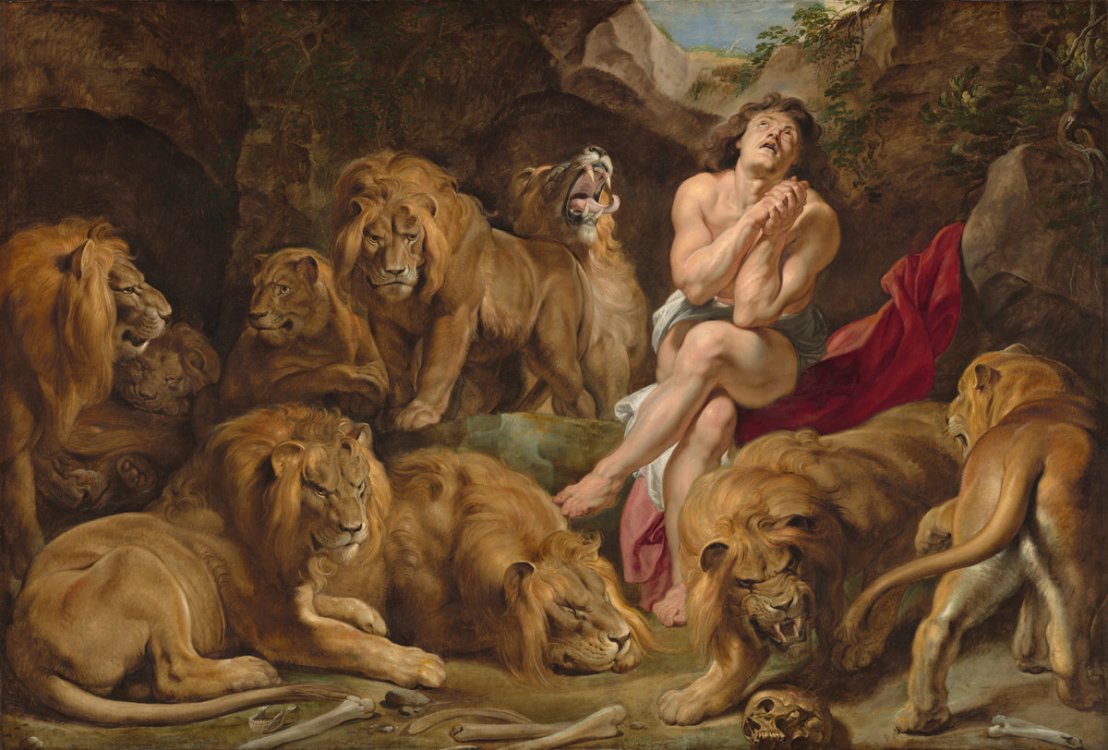
On the 30th of May, 1640, death of Peter Paul Rubens, the most important Baroque painter from the Flemish Netherlands. Rubens was not only a well-educated scholar and painter, but also businessman and diplomat. He made religious altarpieces, portraits of royalty, mythological paintings and hunting landscapes. All his paintings are impressive big pieces with lots of color and typical Baroque-emphasized movement and sensuality. He run a large studio in Antwerp which is now the Rubenshuis Museum.

Peter Paul Rubens (1577 – 1640), “The Descent from the Cross” (1613), 420x320cm, Oil on Panel, Cathedral of Our Lady, Antwerp, Belgium.

Here are two of his paintings. It’s “The Descent from the Cross” (1613), which is the 4×3 meters magnificent central panel of a triptych, which is still in its original place in the Cathedral of Our Lady in Antwerp, Belgium. The body of Christ is lowered from the cross, with very energetic support of Saint John (in the red mantle). Mary Magdalena is gracefully supporting Christ’ leg and Mary, a mother in despair, is stretching out her arms towards her son. Joseph of Arimathea and Nicodemus are placed on both sides of the scenel.

Also here is a 2×3 meters big painting of the legendary hero “Daniel in the Lions’ Den” (1614). Chief counselor to the Persian king, Daniel fell victim to his jealous co-officials. They plotted against him and threw him into a den of lions. But that plot truly failed! Daniel keeps on staring up and praying towards the light of heaven. And he stayed unharmed! Next day he was freed without a single scratch. A strong moral: look up when things get you down; keep your head up and think positive!

Peter Paul Rubens (1577 – 1640), “Daniel in the Lions’ Den” (1614), 224x351cm, Oil on Canvas, National Gallery of Art, Washington.

Jacob Jordaens (1593 – 1678)

1021px-Jacob_Jordaens_-_Susanna_and_the_Elders_-_Google_Art_Project
Jacob Jordaens (1593 – 1678), “Susanna and the Elders” (1653), Oil on Canvas, 203x154cm, National Gallery of Denmark, Copenhagen.

On the 19th of May, 1593, birth of Jacob Jordaens, one of the top Flemish Baroque painters. Here is his “Susanna and the Elders“. The painting learns us that the concept of female beauty is changing over time. The story in a nutshell: as Susanna bathes in her garden, two lustful elders observe her and threaten to claim that she was meeting a young man unless she agrees to come with them. Susanna refuses to be blackmailed and at the end virtue triumphs. Look at the dog! It’s the symbol of fidelity and he is already barking at the elders.